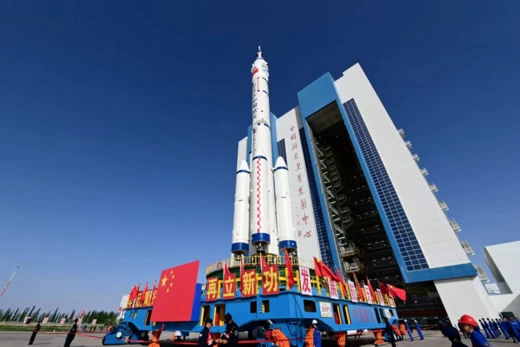
Shenzhou 6
China's second crewed spaceflight, with two astronauts.

Shenzhou 6 marked China's second crewed space mission. It lifted off on October 12, 2005, atop a Long March 2F rocket from the Jiuquan Satellite Launch Center. The spacecraft carried astronauts Fei Junlong and Nie Haisheng into low Earth orbit for a five-day stay. The launch occurred just three days shy of the second anniversary of Shenzhou 5, China's first human spaceflight.
For the first time, the crew could remove their spacesuits, conduct scientific experiments, and move into the orbital module, which gave them access to toilet facilities. The exact nature of their work was kept secret, though some speculated it involved military reconnaissance—a notion considered unlikely, as similar U.S. and Soviet experiments had shown humans in space are not well suited for such tasks. The mission landed in the Siziwang Banner of Inner Mongolia on October 16, 2005, the same site used for previous crewed Shenzhou flights (though earlier uncrewed flights, like Shenzhou 1, touched down in the Gobi Desert).
Both crew members were on their first spaceflight. They were introduced to the Chinese public and international media at a press conference approximately 2-3 hours before launch. Nie Haisheng celebrated his 41st birthday while in orbit. According to Huang Chunping, chief designer of the Long March 2F rocket, the flight crew was chosen from three candidate pairs. Six pairs had trained for the mission; about a month before launch, the selection process narrowed from six to three pairs, then to prime and backup. The *Ta Kung Pao* newspaper reported that Zhai Zhigang and Nie Haisheng had been the leading pair, having been among the final three for Shenzhou 5.
The crew arrived at the spacecraft about two hours and 45 minutes before launch, with the hatch closing 30 minutes later. At 01:00:05.583 UTC on October 12, Shenzhou 6 lifted off. The launch proceeded normally: the escape rocket separated 120 seconds after launch when the rocket was traveling 1,300 m/s; 16 seconds later, the four boosters detached at an altitude of 52 km; the payload fairing and first stage separated 200 seconds after launch. The second stage burned for another 383 seconds, and the spacecraft separated from the rocket 200 km above the Yellow Sea. Using its own propulsion, it entered an orbit of 211 km by 345 km, inclined at 42.4 degrees, about 21 minutes after launch.
Quick Facts
- Mission Type
- Crewed test flight
- Operator
- China Manned Space Agency
- Orbits Completed
- 76
- Spacecraft Type
- Shenzhou
- Manufacturer
- China Aerospace Science and Technology Corporation
- Crew Size
- 2
- Crew Members
- Fei Junlong / Nie Haisheng
- Launch Rocket
- Long March 2F (Y6)
- Launch Site
- Jiuquan, LA-4/SLS-1
- Launch Contractor
- China Academy of Launch Vehicle Technology
- Landing Site
- Honggor Sum, Siziwang Banner, Inner Mongolia (42 · 21 · 58 · N · 111 · 25 · 52 · E · region:CN_type:landmark)
Facts from the source article.
Lore & Background
The crew were able to change out of their spacesuits, conduct scientific experiments, and enter the orbital module for the first time, giving them access to toilet facilities. The exact activities of the crew were kept secret but were thought by some to include military reconnaissance, however this is likely untrue given that similar experiments in the US and USSR determined that humans in space are not suited for military reconnaissance. It landed in the Siziwang Banner of Inner Mongolia on October 16, 2005, the same site as previous crewed Shenzhou flights (though earlier uncrewed flights, like Shenzhou 1, touched down in the Gobi Desert). This is the first spaceflight for both crew members. The crew was introduced to the Chinese public and international media at a press conference approximately 2-3 hours before the launch.
Reader's Guide
Shenzhou 6 marked China's second human spaceflight and its first multi-day mission, demonstrating the ability to sustain a crew in orbit for an extended period. The crew's entry into the orbital module for the first time allowed access to living quarters and toilet facilities, a significant step beyond the single-module Shenzhou 5 flight. The mission also involved orbit-changing maneuvers and scientific experiments, though many details were kept secret. The successful launch, orbit, and landing—at the same site as previous Shenzhou flights—confirmed the reliability of the Shenzhou spacecraft and Long March 2F rocket. The mission's crew, both first-time spacefliers, were introduced to the public only hours before launch, and the selection process involved multiple pairs of astronauts. Shenzhou 6 helped China gain experience in longer-duration spaceflight, paving the way for future missions.
Did You Know?
- Nie Haisheng celebrated his 41st birthday in space.
- The launch time was changed from October 13 to October 12, possibly to avoid cold weather.
- The capsule landed approximately 1 km from its planned target.
Origins & the Russian Heritage
China's path to crewed spaceflight began earlier than many realize. The Shuguang program, initiated in 1967 and projected for a 1973 launch, was ultimately cancelled in 1972 and the broader program shelved in 1980 due to funding constraints. The effort was revived in 1992 under Project 921, and in 1995 China struck a technology-transfer agreement with Russia covering life support, docking systems, and spacesuits derived from the Soyuz program. This partnership shaped the Phase One spacecraft's architecture, which mirrors Soyuz's three-module layout while being roughly ten percent larger and heavier. The general designer for Shenzhou 1 through 5 was Qi Faren, but from Shenzhou 6 onward, leadership of the overall design passed to Zhang Bainan, marking a generational handoff at the program's helm.
Three-Module Architecture & Engineering Choices
Shenzhou's structure divides into three distinct sections: a forward orbital module, a central reentry module, and an aft service module. This tripartite arrangement follows a core engineering principle—minimizing the mass that must survive atmospheric reentry. Only the reentry module, which houses the crew's seats, needs heat shielding, freeing the other two modules from that weight penalty and allowing more interior volume. The orbital module accommodates experiments, crew-serviced equipment, and habitation space, while the service module carries life support and propulsion hardware. Two pairs of solar panels, one set on each of the outer modules, span over forty square metres and deliver more than 1.5 kilowatts of average power, exceeding Soyuz's 1.0 kW. The reentry module's shape balances crew living space against the need for aerodynamic control during descent.
From Maiden Flight to the Crewed Era
The Shenzhou program's first uncrewed test lifted off on 19 November 1999, after which the designation Shenzhou was formally adopted—a name chosen by then-president Jiang Zemin. Three further uncrewed flights followed before the landmark crewed mission, Shenzhou 5, launched on 15 October 2003. Since then the spacecraft has become the backbone of China's human spaceflight operations, accumulating seventeen crewed flights by the time of Shenzhou 23. All missions have launched from the Jiuquan Satellite Launch Center in Gansu aboard Long March 2F rockets and touched down near Dorbod Banner in Inner Mongolia. During uncrewed test flights, the orbital modules were left functioning in orbit for days after the reentry capsule returned; notably, Shenzhou 5's orbital module continued operating for six months post-launch.
Docking, Station Support & the Road Ahead
Beginning with Shenzhou 8, the spacecraft adopted the Chinese Docking Mechanism, derived from the joint Soviet-American Androgynous Peripheral Attach System, enabling it to berth with China's space infrastructure. Two Shenzhou vehicles are typically docked to the Tiangong modular station, working alongside Tianzhou cargo spacecraft to sustain operations. Earlier, Shenzhou missions had already docked with the Tiangong-1 and Tiangong-2 experimental stations. A distinctive capability sets Shenzhou apart from Soyuz: because the sole hatch connecting the orbital and reentry modules is part of the reentry section, the orbital module can be left in orbit after separation for later redocking or even as an additional station module. Looking ahead, the current Shenzhou design is slated for replacement by the next-generation Mengzhou, which will feature a two-module configuration.
Frequently Asked Questions
Who flew on Shenzhou 6?
The mission carried a two-person crew: Fei Junlong and Nie Haisheng.
When and where did Shenzhou 6 launch?
It lifted off on October 12, 2005, from the Jiuquan Satellite Launch Center aboard a Long March 2F rocket.
How long did the Shenzhou 6 crew stay in orbit?
The duo spent five days in low Earth orbit before re-entering the atmosphere and returning to Earth.
What made Shenzhou 6 a step beyond Shenzhou 5?
For the first time in a Chinese crewed flight, the astronauts could shed their heavier suits, run scientific experiments, and relocate to the orbital module where a toilet was available.
Where did Shenzhou 6 land?
The capsule touched down in the Siziwang Banner region of Inner Mongolia.
More in Crewed Shenzhou missions 1-19
Spotted an error? Know more?
Reader corrections go straight into our review queue. Suggest an edit · How this site is sourced