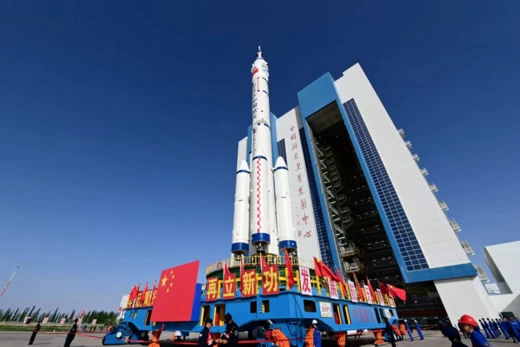
Shenzhou 16
First application-phase mission to Tiangong space station.

Shenzhou 16, the sixteenth mission in China's Shenzhou program, lifted off on May 30, 2023, heading for the Tiangong space station. This marked the eleventh crewed Chinese spaceflight and the first mission of Tiangong's "application phase" after the station was fully assembled. On board were three crew members, including Gui Haichao, a professor and researcher from Beihang University who became the first civilian scientist ever to fly on a Shenzhou spacecraft.
Quick Facts
- Mission Type
- Tiangong space station crew transport
- Operator
- China Manned Space Agency
- Spacecraft Type
- Shenzhou
- Manufacturer
- China Aerospace Science and Technology Corporation
- Crew Size
- 3
- Crew Members
- Jing Haipeng / Zhu Yangzhu / Gui Haichao
- Crew Evas
- 1
- Crew Eva Duration
- 7 hours, 55 minutes
- Launch Date
- 30 May 2023, 01:31:13 UTC (09:31:13 CST)
- Launch Rocket
- Long March 2F/G (Y16)
- Launch Site
- Jiuquan, LA-4/SLS-1
- Launch Contractor
- China Academy of Launch Vehicle Technology
Facts from the source article.
Lore & Background
Shenzhou 16 was the fifth crewed spaceflight to the Tiangong space station, with a mission duration of approximately five months. The spacecraft completed construction and testing in December 2022 and was maintained in a state of near-readiness prior to launch as a potential lifeboat for the Shenzhou 15 crew. The flight launched from Jiuquan Satellite Launch Center on 30 May 2023 at 9:31 AM China Standard Time, following the launch of the Tianzhou 6 cargo spacecraft and near the end of the Shenzhou 15 mission. Just under 7 hours after launch, the spacecraft docked with the Tianhe core module's nadir docking port. Upon entering the station, the crew were greeted by and performed a handover ceremony with the crew of Shenzhou 15, with whom they shared a four-day mission overlap prior to the previous crew's departure on June 3.
Reader's Guide
Shenzhou 16 marked a significant transition for the Tiangong space station, being the first mission of its 'application phase' after assembly was complete. The mission set records and milestones: Commander Jing Haipeng made his fourth trip to space, a new record for a Chinese taikonaut; payload specialist Gui Haichao became the first Chinese civilian in space; and Zhu Yangzhu became the first Chinese flight engineer to perform a spacewalk. The spacewalk on 20 July 2023 lasted 7 hours and 55 minutes, beating the previous EVA duration record of 7 hours and 6 minutes on Shenzhou 15. The mission's return on 30 October 2023 featured an apparent hole in the descent parachute and the capsule tumbling on impact, but the crew was unharmed. Shenzhou 16 demonstrated the continued expansion of China's human spaceflight capabilities, including the inclusion of civilian scientists and the execution of complex station maintenance tasks.
Did You Know?
- Shenzhou 16 was the first flight of the 'application phase' of Tiangong after station assembly was completed.
- Gui Haichao, a professor at Beihang University, became the first Chinese civilian in space.
- The spacewalk on 20 July 2023 lasted 7 hours and 55 minutes, a new EVA duration record for Chinese spaceflight.
From Ambition to Partnership: The Road to Shenzhou
China's ambition to send humans into orbit stretches back to 1967, when the Shuguang spacecraft was conceived with a projected 1973 debut. Despite successfully placing an uncrewed satellite in space in 1970, the Shuguang project was shelved in 1972 and formally wound down by 1980, as funding simply could not sustain the effort. Two decades of dormancy followed until Project 921 reignited the program in 1992. The resulting Phase One spacecraft deliberately mirrored the general architecture of Russia's Soyuz, with its three separable modules. A pivotal 1995 agreement with Moscow brought in critical Soyuz subsystems—life support, docking hardware, and spacesuit technology—which were then integrated into the Chinese design. Qi Faren served as general designer through the Shenzhou 5 era, after which Zhang Bainan assumed overall design responsibility. The outcome was a vehicle that honored its Soviet predecessor's proven layout while growing roughly ten percent larger and incorporating modernized systems throughout.
Engineering the Three-Module Architecture
The Shenzhou's physical layout rests on a single guiding principle: return as little mass to Earth as possible. The forward orbital module carries experimental payloads, crew-serviced equipment, and in-orbit living space. The central reentry module—shaped as a compromise between maximizing interior volume and providing aerodynamic control during descent—houses the crew's seats and is the only section that survives atmospheric passage. The aft service module holds life-support systems, propulsion, and power generation. Because the orbital and service modules never reenter, they require no heat shielding, freeing up structural mass for additional volume. This design also enables a capability Soyuz lacks: the orbital module can be left functioning in orbit for later redocking, as demonstrated when Shenzhou 5's orbital section continued operating for six months after its crew returned. Two pairs of solar arrays spanning over forty square meters deliver more than 1.5 kilowatts of average power, exceeding Soyuz's one-kilowatt output, while four propulsion engines and space for an inflatable landing raft further distinguish the Chinese craft from its Russian counterpart.
A Quarter-Century of Flights: Operational Record
Since its maiden uncrewed launch on 19 November 1999, the Shenzhou family has completed twenty-three missions, seventeen of them crewed, with the first human flight—Shenzhou 5—lifting off on 15 October 2003. Every mission to date has ridden a Long March 2F rocket from the Jiuquan Satellite Launch Center in Gansu province, with landings near Dorbod Banner in Inner Mongolia. For added safety during the most vulnerable phase of flight, each vehicle is enclosed in a protective fairing and equipped with a launch escape system. The docking hardware, in use since Shenzhou 8, descends from the joint Soviet-American Androgynous Peripheral Attach System. In its current operational role, two Shenzhou spacecraft are typically berthed alongside China's Tiangong modular space station, supplemented by Tianzhou cargo vehicles; earlier missions serviced the Tiangong-1 and Tiangong-2 prototypes. The program has already outlived its initial design window, and a next-generation two-module vehicle called Mengzhou is in development to eventually take over the crewed-transport role.
A Name Rooted in Myth: The Etymology of Shenzhou
The designation 神舟 (Shénzhōu) is far more than a technical label; it is a deliberate act of cultural storytelling. Literally, the characters translate to 'the Divine vessel on the Heavenly River,' where Heavenly River (天河) is the Classical Chinese term for the Milky Way. But the name also operates as a pun and neologism: it sounds identical to 神州 (Shénzhōu), an ancient poetic epithet for China itself, meaning 'the Divine realm.' By choosing this word, the program wove together three threads of Chinese intellectual heritage—mythological cosmology, classical astronomy, and the poetic naming tradition for the nation—into a single two-character title. The name was selected by then-president Jiang Zemin following the successful first uncrewed flight in 1999, after which the earlier working designation Project 921 was formally retired. In this way, the spacecraft's identity was anchored not in a serial number or a generic acronym, but in a linguistic echo that connects the vehicle to the very sky it was built to cross.
Frequently Asked Questions
Who flew on Shenzhou 16?
Jing Haipeng commanded the three-person crew, which also included payload specialist Gui Haichao, a researcher from Beihang University. The team spent roughly five months aboard the Tiangong space station.
What made Shenzhou 16 a historic first?
It was the first crewed flight to Tiangong after the station was fully assembled, opening what China calls the application phase of station operations. It also carried the first civilian scientist ever to ride a Shenzhou spacecraft.
When did Shenzhou 16 launch and land?
The spacecraft lifted off on 30 May 2023 and the crew returned to Earth on 30 October 2023. That gave the team about five months of continuous time in orbit.
Who was Gui Haichao and why did his flight matter?
Gui Haichao is a professor and researcher at Beihang University who flew as a payload specialist on this mission. He became the first non-military, non-professional-astronaut civilian to travel on a Shenzhou spacecraft.
What does the 'application phase' of Tiangong mean?
Once construction was complete, China shifted focus from building the station to using it as a long-term research platform. Shenzhou 16 was the inaugural crewed mission under that new era, prioritizing science experiments and station utilization over assembly work.
More in Crewed Shenzhou missions 1-19
Spotted an error? Know more?
Reader corrections go straight into our review queue. Suggest an edit · How this site is sourced