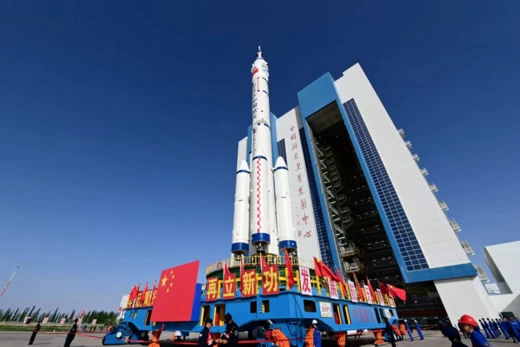
Shenzhou 7
First Chinese spacewalk mission, launched 2008.

Shenzhou 7 was the third human spaceflight mission of the Chinese space program, launched on 25 September 2008. It marked the first Chinese extra-vehicular activity (EVA), carried out by crew members Zhai Zhigang and Liu Boming, and initiated the 'second step' of the China Manned Space Program.
Quick Facts
- Mission Type
- Crewed test flight
- Operator
- China Manned Space Agency
- Spacecraft Type
- Shenzhou
- Manufacturer
- China Aerospace Science and Technology Corporation
- Crew Size
- 3
- Crew Members
- Zhai Zhigang / Liu Boming / Jing Haipeng
- Crew Evas
- 1
- Crew Eva Duration
- 22 minutes
- Launch Date
- 25 September 2008, 13:10:04 UTC
- Launch Rocket
- Long March 2F
- Launch Site
- Jiuquan, LA-4/SLS-1
- Launch Contractor
- China Academy of Launch Vehicle Technology
Facts from the source article.
Lore & Background
During the mission, a miniaturized satellite was released, which tested mini-satellite technology and observed the spacecraft. A solid lubricant exposure experiment was also conducted, with equipment retrieved during the spacewalk. The mission used China's first data relay satellite, Tianlian I, launched in April 2008, to improve communication coverage. The spacecraft landed safely in Siziwang Banner, Inner Mongolia, on 28 September 2008.
Reader's Guide
Shenzhou 7 holds significance as the mission that achieved China's first spacewalk, a milestone that placed China among the elite group of nations capable of extra-vehicular activity. It demonstrated advancements in spacesuit technology, orbital module modifications, and the use of a data relay satellite to enhance communication. The mission also tested miniaturized satellite deployment and solid lubricant experiments for future space facilities. Its success was recognized with the 2009 Space Achievement Award from the Space Foundation and drew congratulations from foreign leaders. The mission's management team saw key personnel changes, reflecting the evolving structure of China's space program.
Did You Know?
- The Shenzhou 7 EVA made China the third country to conduct an extra-vehicular activity, after the Soviet Union (later Russia) and the United States.
- A fire alarm was reported at the beginning of the EVA but was confirmed to be a false alarm.
- A miniaturized satellite about 40 cm long and weighing 40 kg was released during the mission and operated for about 30 days.
From Shuguang to Project 921
China's ambitions to send humans into orbit date back further than most observers realize. In 1967, the nation initiated the Shuguang program, a crewed spacecraft design projected to reach the sky by 1973. Despite successfully placing an uncrewed satellite into orbit in 1970, the Shuguang effort was shelved in 1972, and the broader program was formally abandoned by 1980, primarily because the country simply could not afford it. Decades of groundwork, however, did not go entirely to waste. When Beijing relaunched its human spaceflight initiative in 1992 under the designation Project 921, engineers drew on those earlier studies. A pivotal turning point came in 1995, when China signed a technology-transfer agreement with Russia, gaining access to Soyuz-derived systems for life support, docking, and spacesuits. The resulting Phase One spacecraft adopted the familiar three-module Soyuz layout, which was then modernized with the newly acquired Russian engineering. Qi Faren served as general designer through Shenzhou 5, after which Zhang Bainan took the helm.
Three-Module Architecture
The Shenzhou spacecraft is organized around a deliberate engineering principle: keep as little mass as possible in the portion that must survive the fiery descent through the atmosphere. The vehicle is split into three distinct sections. At the front sits the orbital module, a cylindrical compartment housing experimental equipment, crew-operated payloads, and additional living space. From Shenzhou 8 onward, this module also carries the docking mechanism, derived from the joint Soviet-American Androgynous Peripheral Attach System. In the middle is the reentry module, the sole section that touches down on Earth, shaped as a compromise between crew comfort and aerodynamic control. Aft of that lies the service module, which carries life-support systems, four propulsion engines, and one pair of the spacecraft's solar arrays. Together the two pairs of panels span more than forty square metres, generating over 1.5 kilowatts—well above Soyuz's 1.0 kilowatt. Because the orbital and service modules are jettisoned before reentry, they need no heat shielding, freeing up volume and reducing the mass that must be protected. A further distinction from Soyuz is that Shenzhou can leave its orbital module in orbit for later redocking, a capability the Russian vehicle lacks.
Operational History & Station Role
Since its maiden uncrewed launch on 19 November 1999, the Shenzhou family has accumulated twenty-three flights, seventeen of them crewed, beginning with the historic Shenzhou 5 mission on 15 October 2003. Every single launch has ridden a Long March 2F rocket off the pad at Jiuquan Satellite Launch Center in Gansu Province, with landings near Dorbod Banner in Inner Mongolia. In its early years the spacecraft served as a standalone orbital platform; the Shenzhou 5 orbital module, for instance, kept operating in space for six months after its crew had already returned home. As China's space infrastructure matured, Shenzhou missions shifted to docking with the Tiangong-1 and Tiangong-2 target stations. In the current era, two Shenzhou vehicles are typically berthed simultaneously with the larger Tiangong modular space station, while the Tianzhou cargo spacecraft handles resupply. The spacecraft is single-use by design, encased in a fairing and fitted with a launch-escape system during ascent for crew safety. Looking ahead, Shenzhou is slated to be succeeded by the next-generation Mengzhou, which will adopt a simpler two-module configuration.
Etymology & Cultural Naming
The name Shenzhou is as much a piece of cultural storytelling as it is a technical designation. In Classical Chinese, the phrase Tiānhé refers to the Milky Way, the great river of stars arching across the night sky. The full literal rendering of the spacecraft's name is therefore 'the Divine vessel upon the Heavenly River'—a craft sailing the celestial waters. But the name also works as a deliberate pun. Shénzhōu, with a different character for 'divine,' is a poetic and ancient epithet for China itself, evoking the idea of a sacred realm. Because both phrases share the identical pronunciation, the spacecraft's name simultaneously invokes the cosmos and the nation, binding the two together in a single syllable. The name was selected by then-president Jiang Zemin after the first uncrewed flight in 1999, when Project 921 was formally renamed. The choice reflects a broader tradition in Chinese naming that draws on classical poetry, astronomy, and theology, lending the vehicle a mythic resonance that purely alphanumeric designations rarely achieve.
Frequently Asked Questions
Who flew on Shenzhou 7?
The three-person crew was Zhai Zhigang, Liu Boming, and Jing Haipeng. Zhai and Liu were the two astronauts who actually stepped outside the spacecraft for the spacewalk.
What is Shenzhou 7 best known for?
It delivered China's first-ever crewed extra-vehicular activity, with two astronauts working in the vacuum outside the orbital module. That spacewalk was the entire reason the mission existed.
When did Shenzhou 7 launch and land?
The spacecraft lifted off on 25 September 2008 and returned to Earth three days later, on 28 September 2008. The whole trip lasted just over 76 hours.
Why is Shenzhou 7 a turning point in China's space program?
It opened what Beijing calls the 'second step' of its manned-spaceflight roadmap, the phase that ultimately leads to a permanent space station. Proving that Chinese astronauts could work safely in open space was a prerequisite for later station-assembly flights.
How long did the Shenzhou 7 spacewalk last?
Zhai Zhigang spent roughly twenty minutes outside the module while Liu Boming assisted from the airlock. At the time it was the longest single EVA any Chinese astronaut had performed.
More in Crewed Shenzhou missions 1-19
Spotted an error? Know more?
Reader corrections go straight into our review queue. Suggest an edit · How this site is sourced