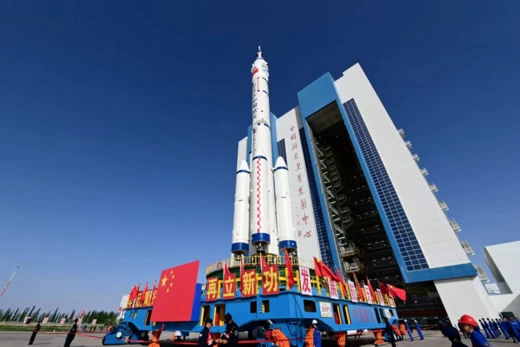
Shenzhou 10
China's fifth crewed mission and final expedition to Tiangong-1.

Shenzhou 10 was a crewed spaceflight of China's Shenzhou program, launched on 11 June 2013. It was China's fifth crewed space mission and the second and final expedition to the Tiangong-1 trial space laboratory module. The mission carried a crew of three astronauts: Nie Haisheng (mission commander), Zhang Xiaoguang, and Wang Yaping, the second Chinese female astronaut.
Quick Facts
- Mission Type
- Tiangong-1 crew transport
- Mission Duration
- 14 days, 14 hours, 29 minutes
- Spacecraft Type
- Shenzhou
- Manufacturer
- CASC
- Launch Rocket
- Long March 2F
- Launch Site
- Jiuquan LA-4/SLS
- Landing Site
- Inner Mongolia
- Crew Size
- 3
- Crew Members
- Nie Haisheng / Zhang Xiaoguang / Wang Yaping
- Crew Photo Caption
- (L-R) Haisheng, Xiaoguang and Yaping
- Orbit Epoch
- 12 June 2013
Facts from the source article.
Lore & Background
Shenzhou 10 was launched on 11 June 2013, at 09:38 UTC (17:38 local time) from the Jiuquan Satellite Launch Center in Inner Mongolia using a Long March 2F rocket. The spacecraft docked with Tiangong-1 on 13 June, and the crew conducted physical, technological, and scientific experiments. Wang Yaping taught a physics lesson to Chinese students via live television broadcast. On 23 June, Shenzhou 10 undocked and performed a manual re-docking. The mission returned to Earth on 26 June 2013.
Reader's Guide
Shenzhou 10 marked a significant step in China's human spaceflight program, being the longest Chinese mission to date at 15 days. It was the final mission to Tiangong-1, completing the trial phase of the Tiangong program. The mission included China's second female astronaut, Wang Yaping, who conducted scientific experiments and an educational broadcast. The presence of General Secretary Xi Jinping at the launch underscored the mission's national importance. The successful manual re-docking demonstrated China's growing proficiency in orbital rendezvous operations.
Did You Know?
- Wang Yaping, the second Chinese female astronaut, taught a physics lesson to Chinese students by live television broadcast.
- On 16 June 2013, Wang Yaping was one of only two women in space, the other being Karen Nyberg on the International Space Station.
- Nie Haisheng was a senior colonel at the time of Shenzhou 10; the first Chinese flag officer launched into space was Jing Haipeng (major general) on Shenzhou 11.
Origins & Heritage
China's ambitions to send humans beyond the atmosphere stretch back further than most realize. In 1967, the Shuguang program was conceived with a 1973 launch target, yet by 1972 the spacecraft was shelved and the broader initiative was dissolved entirely by 1980, strangled by insufficient funding. A successful uncrewed satellite launch in 1970 proved the nation could reach orbit, but the leap to crewed flight remained out of reach for over a decade. The program was reborn in 1992 under the banner of Project 921, and a pivotal 1995 agreement with Russia unlocked critical Soyuz-derived technology spanning life support, docking procedures, and pressure suits. The general design of the early vehicles was led by Qi Faren through Shenzhou 5, after which Zhang Bainan assumed the chief design role. This layered inheritance—Soviet engineering DNA wrapped in a distinctly Chinese program—gave the spacecraft a foundation that would carry it through two decades of missions.
Engineering & Design Philosophy
The Shenzhou architecture rests on a deceptively simple principle: minimize the mass that must survive the violent plunge back through the atmosphere. The vehicle is split into three distinct modules. The forward orbital module houses experimental equipment, crew-serviced instruments, and extra living volume. The central reentry module—shaped as a compromise between interior space and aerodynamic controllability—is the sole section that touches down. The aft service module carries life-support systems and propulsion hardware. Because the orbital and service modules are jettisoned before reentry, they need no heat shielding, freeing up mass budget for additional volume. Two pairs of solar arrays, totaling more than forty square metres, deliver over 1.5 kilowatts of average power, a clear step above Soyuz's 1.0 kilowatt. From Shenzhou 8 onward, the orbital module also hosts a docking mechanism derived from the joint Soviet-American Androgynous Peripheral Attach System, enabling rendezvous with the Tiangong station. The entire stack rides a Long March 2F rocket from Jiuquan, encased in a fairing with a launch-escape tower for the critical first minutes of flight.
Name & Cultural Resonance
The name Shenzhou is as much a piece of linguistic poetry as it is a designation. In Classical Chinese, the characters 神舟 can be read as 'the Divine vessel upon the Heavenly River,' where Heavenly River (天河) is the traditional name for the Milky Way. Simultaneously, the pronunciation is identical to 神州, an ancient poetic epithet for China itself—roughly 'the Divine realm.' The result is a deliberate pun: the spacecraft is both a vessel sailing the celestial river and a modern embodiment of the nation's storied identity. The name was selected by then-president Jiang Zemin after the maiden uncrewed flight on 19 November 1999, at which point Project 921/1 was formally renamed. That single act of naming wove the program into a cultural lineage stretching back millennia, framing every subsequent launch—whether the first crewed mission of Shenzhou 5 in October 2003 or the twenty-third flight in the series—as an extension of a story China has been telling about the heavens for centuries.
Operational Legacy & Future
Since that inaugural 1999 test flight, the Shenzhou family has accumulated twenty-three missions, seventeen of them crewed, making it the workhorse of China's human spaceflight effort. In its current operational role, two Shenzhou vehicles are typically berthed alongside the Tiangong modular space station, with Tianzhou cargo craft handling resupply. Earlier in the program's life, Shenzhou missions docked with the Tiangong-1 and Tiangong-2 prototypes. The spacecraft's single-use design means each mission represents a fresh build, a fact that underscores the industrial commitment behind every launch. All flights depart from Jiuquan Satellite Launch Center in Gansu Province and conclude with a landing near Dorbod Banner in Inner Mongolia. Looking ahead, the program is slated for a generational handoff: the next-generation Mengzhou spacecraft, currently in development, will adopt a two-module configuration and eventually retire the three-module Shenzhou design. Until that transition arrives, Shenzhou remains the thread connecting China's first tentative steps toward orbit with its present ambitions in low Earth orbit.
Frequently Asked Questions
Who flew on Shenzhou 10?
The three-astronaut crew was Nie Haisheng (commander), Zhang Xiaoguang, and Wang Yaping. Wang Yaping became the second Chinese woman to fly in space during this mission.
When did Shenzhou 10 launch and land?
The spacecraft lifted off on 11 June 2013 and returned to Earth on 26 June 2013, completing its orbital stay roughly two weeks later.
What was Shenzhou 10's mission objective?
It was China's fifth crewed spaceflight and the second—and final—crewed expedition to dock with the Tiangong-1 trial space laboratory module in low Earth orbit.
Why is Shenzhou 10 notable in the Shenzhou program?
It closed the Tiangong-1 era by being the last crewed visit to that early orbital laboratory. It also expanded China's astronaut experience by sending Wang Yaping, the program's second female flyer, into orbit.
How long did the Shenzhou 10 mission last?
From launch to splashdown, the crew spent 14 days, 14 hours, and 29 minutes in space.
More in Crewed Shenzhou missions 1-19
Spotted an error? Know more?
Reader corrections go straight into our review queue. Suggest an edit · How this site is sourced