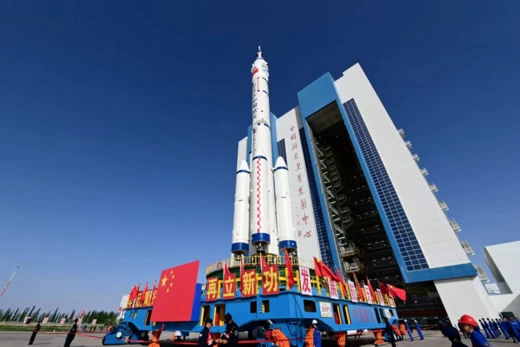
Shenzhou 13
Second crewed mission to Tiangong space station.

Shenzhou 13 was a Chinese spaceflight to the Tiangong space station, launched on 16 October 2021. It carried three People's Liberation Army Astronaut Corps (PLAAC) taikonauts and was the eighth crewed Chinese spaceflight and the thirteenth flight overall of the Shenzhou program. The mission was notable as the first planned six-month (180-day) duration flight to Tiangong, setting a standard for subsequent Shenzhou missions.
Quick Facts
- Mission Type
- Tiangong space station crew transport
- Operator
- China Manned Space Agency
- Spacecraft Type
- Shenzhou
- Manufacturer
- China Aerospace Science and Technology Corporation
- Crew Size
- 3
- Crew Members
- Zhai Zhigang / Wang Yaping / Ye Guangfu
- Crew Evas
- 2
- Crew Eva Duration
- 12 hours, 36 minutes
- Launch Date
- 15 October 2021, 16:23:56 UTC (16 October, 00:23:56 CST)
- Launch Rocket
- Long March 2F/G (Y13)
- Launch Site
- Jiuquan, LA-4/SLS
- Launch Contractor
- China Academy of Launch Vehicle Technology
Facts from the source article.
Lore & Background
The crew conducted two live 'space lectures' broadcast to classrooms across China. The first lecture (December 2021) included branch classrooms in Beijing, Nanning, Wenchuan, Hong Kong, and Macau. The second lecture (March 2022) included branch classrooms in Lhasa, Ürümqi, and other locations. Shenzhou 13 undocked on 15 April 2022 at 16:44 UTC and landed nine hours later at the Dongfeng landing site in Inner Mongolia.
Reader's Guide
Shenzhou 13 marked a significant step in China's human spaceflight program by demonstrating extended-duration crew operations aboard the Tiangong space station. Its six-month mission established the standard orbital duration for subsequent Shenzhou flights, enabling long-term habitation and research. The successful radial docking technique proved crucial for future crew rotations and cargo logistics, allowing multiple spacecraft to dock simultaneously. The mission also advanced gender representation in Chinese spaceflight: Wang Yaping became the first Chinese woman to perform a spacewalk and the first woman to visit Tiangong. The space lectures engaged millions of students across China and abroad, promoting science education. The interaction with American students, including a message from Elon Musk, highlighted potential for international cooperation. Overall, Shenzhou 13 validated key technologies and operational procedures for China's permanent space station.
Did You Know?
- Shenzhou 13 was the first Chinese spaceflight with a planned duration of six months (180 days).
- Wang Yaping became the first Chinese woman to perform a spacewalk during the mission on 7 November 2021.
- The spacecraft used a new radial docking method to the bottom of the Tianhe core module.
From Shuguang to Shenzhou: A Decade of Rebuilding
China's ambitions to send humans into orbit stretch back further than many realize. In 1967, the nation began developing the Shuguang spacecraft, targeting a 1973 launch. Despite successfully placing an uncrewed satellite in orbit in 1970, the Shuguang project was scrapped in 1972, and the broader crewed program was formally dissolved in 1980, with insufficient funding cited as the decisive factor. The program was resurrected in 1992 under the designation Project 921, and its Phase One vehicle deliberately mirrored the general architecture of the Russian Soyuz, with three separable modules. A pivotal 1995 agreement with Moscow brought in Soyuz-derived technology covering life support, docking procedures, and spacesuit design, which was then integrated into the Chinese vehicle. Qi Faren served as general designer through Shenzhou 5, after which Zhang Bainan assumed the role. Following the successful first uncrewed test on 19 November 1999, then-president Jiang Zemin bestowed the name Shenzhou upon the program.
Three Modules, One Philosophy
The Shenzhou spacecraft is built around a deceptively simple engineering principle: minimize the mass that must survive reentry. The vehicle is divided into three distinct sections. At the front sits the orbital module, a cylindrical compartment dedicated to scientific experiments, crew-serviced equipment, and additional living space. In the middle is the reentry module, the only section designed to endure the fiery descent back to Earth, its shape a careful compromise between crew comfort and aerodynamic control. At the rear, the service module houses life support systems, propulsion hardware, and power generation. Because the orbital and service modules are jettisoned before reentry, they need no heat shielding, freeing up volume without the penalty of extra structural mass. Two pairs of solar arrays spanning over 40 square metres deliver more than 1.5 kilowatts of electrical power, notably exceeding the roughly 1.0 kilowatt available on a Soyuz. The spacecraft also carries four propulsion engines and enough room for an inflatable raft in the unlikely event of a water landing, a safety margin Soyuz cosmonauts do not enjoy.
From Test Flights to Station Operations
The Shenzhou program has accumulated an impressive operational record: 23 flights since its debut, of which 17 have carried human crews. The maiden uncrewed test lifted off on 19 November 1999, followed by three additional uncrewed sorties before the program's defining moment arrived on 15 October 2003, when Shenzhou 5 carried its crew into orbit. Notably, the orbital module from that very first crewed mission continued functioning in space for six months after the reentry capsule had already returned to Earth. Every Shenzhou launch has used a Long March 2F rocket from the Jiuquan Satellite Launch Center in Gansu Province, with landings occurring near Dorbod Banner in Inner Mongolia. In its early days, Shenzhou craft docked with the Tiangong-1 and Tiangong-2 experimental stations. Today, the operational pattern has shifted: two Shenzhou vehicles are typically berthed alongside the Tiangong modular space station at any given time, complemented by Tianzhou cargo resupply flights. The most recent mission in the series is Shenzhou 23.
A Name, a Lineage, a Successor
The very name Shenzhou carries poetic weight. In Classical Chinese, the characters literally translate to 'the Divine vessel upon the Heavenly River,' where Heavenly River is the traditional name for the Milky Way. The term is also a deliberate pun on Shenzhou, the poetic epithet for China itself meaning 'Divine realm,' both sharing identical pronunciation. This naming, chosen by then-president Jiang Zemin after the 1999 test flight, encapsulates the program's dual identity as both a national symbol and a practical engineering vehicle. Looking ahead, Shenzhou is not the final chapter. It is slated to be succeeded by the next-generation Mengzhou spacecraft, currently in development, which will adopt a simpler two-module configuration. The Shenzhou's docking hardware, in use since Shenzhou 8, traces its lineage to the Androgynous Peripheral Attach System originally developed jointly by the Soviet Union and the United States. As a single-use vehicle, each Shenzhou is built, flown, and largely discarded, a design philosophy that has served China's crewed program faithfully for over two decades.
Frequently Asked Questions
What is Shenzhou 13?
Shenzhou 13 is a Chinese crewed spaceflight that launched on 16 October 2021 to service the Tiangong space station. It was the eighth crewed flight in China's Shenzhou program and the second crewed mission to dock with Tiangong.
What made Shenzhou 13 stand out among other Shenzhou flights?
It was the first Shenzhou mission designed for a full six-month stay in orbit and achieved the first radial docking of a Shenzhou capsule to the station. Wang Yaping also became the first Chinese woman to conduct a spacewalk during the mission.
Who flew on Shenzhou 13?
The crew consisted of three taikonauts selected from the People's Liberation Army Astronaut Corps. Wang Yaping was among the three, and her EVA made her the first Chinese woman ever to perform an extravehicular activity.
How long did the Shenzhou 13 crew stay in space?
The mission lasted roughly 180 days, making it the first planned six-month-duration crewed flight to Tiangong. That duration has since become the standard for every subsequent Shenzhou crewed rotation.
Why is Shenzhou 13 considered a milestone for China's space program?
It established the six-month crew-rotation model that underpins all later Tiangong station operations. It also delivered several program firsts, including a radial docking maneuver and a Chinese woman's first spacewalk.
More in Crewed Shenzhou missions 1-19
Spotted an error? Know more?
Reader corrections go straight into our review queue. Suggest an edit · How this site is sourced