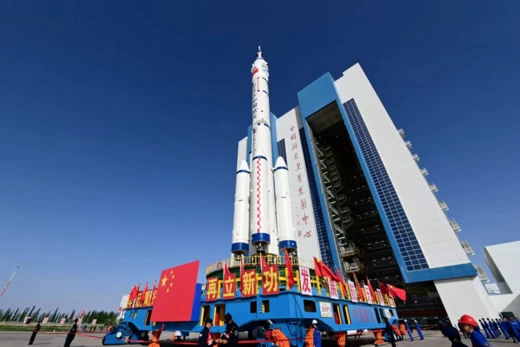
Shenzhou 12
First crewed mission to the Tiangong space station.

Shenzhou 12 (Chinese: 神舟十二号; pinyin: Shénzhōu shí'èr hào; lit. 'Divine Boat Number 12') was a Chinese crewed spaceflight that launched on 17 June 2021. It marked the seventh time China sent people into space and the twelfth flight in the Shenzhou program. The spacecraft carried three taikonauts from the People's Liberation Army Astronaut Corps to the Tiangong space station, making it the first Chinese crewed mission to visit that station and the first since Shenzhou 11 in 2016.
Originally, Shenzhou 12 was meant to be the second mission to the single-module Tiangong-2 space laboratory, following Shenzhou 11. However, those plans were cancelled in 2016, and the mission was reassigned as the first crewed flight to the larger, modular Tiangong space station. The station's first module, the Tianhe core module, had launched on 29 April 2021. The crew for Shenzhou 12 was announced on 16 June 2021.
The flight lifted off from the Jiuquan Satellite Launch Center at 01:22 UTC on 17 June 2021, after the Tianzhou 2 cargo spacecraft had already launched. About six and a half hours later, Shenzhou 12 docked with the forward port of the Tianhe core module. The crew entered the station at 10:48 UTC the same day, becoming its first visitors. Over three months, the crew activated the station, performed two spacewalks, and tested key technologies including robotic arm operation, resource recycling, and long-term life support.
The first spacewalk occurred on 4 July 2021, carried out by Liu Boming and Tang Hongbo. They tested an updated Feitian space suit, installed the station's robotic arm, and set up exterior equipment like a camera lifting bracket. This was only the second Chinese spacewalk ever, following Zhai Zhigang's on Shenzhou 7 nearly 13 years earlier. It lasted 6 hours and 46 minutes. The second spacewalk took place on 20 August 2021, with Nie Haisheng and Liu Boming. They tested spacecraft equipment, installed a backup thermal control pump, and set up and raised panoramic camera D on the Tianhe core module. That spacewalk lasted 5 hours and 55 minutes.
Shenzhou 12 undocked from Tiangong on 16 September 2021 at 00:56 UTC. After undocking, it performed a test of radial rendezvous procedures that would be used on the next mission, Shenzhou 13.
Quick Facts
- Mission Type
- Tiangong space station crew transport
- Operator
- China Manned Space Agency
- Orbits Completed
- 1,454
- Spacecraft Type
- Shenzhou
- Manufacturer
- China Aerospace Science and Technology Corporation
- Crew Size
- 3
- Crew Members
- Nie Haisheng / Liu Boming / Tang Hongbo
- Crew Evas
- 2
- Crew Eva Duration
- 12 hours, 41 minutes
- Launch Date
- 17 June 2021, 01:22:31 UTC (09:22:31 CST)
- Launch Rocket
- Long March 2F/G (Y12)
- Launch Site
- Jiuquan, LA-4/SLS-1
Facts from the source article.
Lore & Background
Shenzhou 12 was originally planned as the second mission to visit the single-module Tiangong-2 space laboratory, following Shenzhou 11. In 2016, plans for a second mission to Tiangong-2 were cancelled, and Shenzhou 12 was instead designated as the first crewed mission to the larger modular Tiangong space station, whose first module, the Tianhe core module, was launched on 29 April 2021. The crew of Shenzhou 12 was announced on 16 June 2021.
The flight launched from Jiuquan Satellite Launch Center on 17 June 2021 at 01:22 UTC, following the launch of the Tianzhou 2 cargo spacecraft. Just over 6.5 hours after launch, the spacecraft docked with the Tianhe core module's forward docking port. The crew entered the station later that same day at 10:48 UTC, becoming the first crew to visit Tiangong.
Reader's Guide
Shenzhou 12 marked a pivotal step in China's human spaceflight program, being the first crewed mission to the modular Tiangong space station and the first Chinese crewed spaceflight in five years. The mission demonstrated China's ability to sustain a crew in orbit for three months, verifying critical technologies including robotic arm operation, resource recycling, and long-term life support. The two spacewalks conducted during the mission—the second and third Chinese spacewalks ever—tested updated Feitian space suits and installed exterior equipment, including the station's robotic arm and a backup thermal control pump. The mission also included a radial rendezvous test after undocking, a procedure later used by Shenzhou 13. By successfully occupying and activating the Tianhe core module, Shenzhou 12 laid the groundwork for the continuous habitation and expansion of the Tiangong space station, establishing China as a sustained presence in low Earth orbit.
Did You Know?
- Shenzhou 12 was the first Chinese crewed spaceflight since Shenzhou 11 in 2016.
- The crew entered the Tiangong space station on 17 June 2021 at 10:48 UTC, becoming the first crew to visit it.
- The first spacewalk of the mission, on 4 July 2021, was the second ever Chinese spacewalk, after Zhai Zhigang's spacewalk on Shenzhou 7 nearly 13 years prior.
- After undocking, Shenzhou 12 performed a test of radial rendezvous procedures that would be utilized on Shenzhou 13.
Scheduling Shifts & Backup Readiness
The Shenzhou 23 mission underwent a notable acceleration in its timeline. Initially projected for a November 2026 liftoff, the flight was pulled forward to May 2026, a change driven by the earlier-than-planned departure of its predecessor, Shenzhou 22. This compression in the schedule was not merely administrative; it carried operational significance. By 19 January 2026, China Central Television confirmed that the Shenzhou 23 spacecraft had already reached the Jiuquan Satellite Launch Center, roughly two months ahead of the original delivery window. Equally important, the vehicle for the following Shenzhou 24 mission was on track for completion by summer. Together, the early arrival of both spacecraft and their paired Long March 2F launch vehicles restored what officials described as a "launch-on-need" posture, echoing the rapid-response capability demonstrated during Shenzhou 22. In practical terms, this meant a fully configured backup mission could be staged on short notice should any emergency arise, reinforcing the resilience of China's crewed spaceflight cadence.
Crew Composition & Division of Duties
Following the established tradition of revealing crew rosters just one day before the scheduled launch, the three-person team for Shenzhou 23 was announced with a clear hierarchy of responsibilities. At the helm sat Zhu Yangzhu, a veteran who had previously flown aboard Shenzhou 16. As mission commander, he bore overall accountability for the flight's success and the fulfillment of every stated objective. Zhang Zhiyuan, a former air force pilot, was tasked with executing mission goals and providing operational support throughout the spaceflight. The third seat carried particular historical weight: Lai Ka-ying, serving as payload specialist, became the first individual from Hong Kong to travel to space. Her duties centered on conducting scientific experiments aboard the station and overseeing the management and maintenance of payload hardware. This trio represented the 17th crewed Chinese spaceflight in total and the 23rd flight of the broader Shenzhou program, underscoring how the program had matured into a routine yet carefully differentiated crew structure.
A Year in Orbit & the Pakistani Visitor
One of the most distinctive features of Shenzhou 23 departed from the standard six-month rotation that had characterized earlier Tiangong crewed flights. The China Manned Space Agency confirmed that a single member of the three-person crew would remain aboard the station for a full year. The identity of that astronaut would not be fixed at launch; instead, the selection would be made later in the mission after thorough physical and psychological evaluations. This extended stay served a specific diplomatic and operational purpose: it created the crew complement needed to welcome a Pakistani astronaut for a short-duration visit. The visitor, either Muhammad Zeeshan Ali or Khurram Daud, would ride up with the Shenzhou 24 crew in October 2026 and return to Earth roughly one week later alongside two members of the Shenzhou 23 team. The remaining Shenzhou 23 astronaut would continue the year-long stay alongside the two Shenzhou 24 crew members who remained at the station.
Launch Vehicle & Station Docking
Shenzhou 23 lifted off atop a Long March 2F rocket, the workhorse launch vehicle that has powered China's crewed spaceflight program. After reaching orbit, the spacecraft executed a docking maneuver at the nadir port of the Tianhe core module, the central hub of the Tiangong space station. This particular port assignment placed the arriving crew directly into the station's main living and working volume, streamlining the transfer of personnel and cargo. The mission marked the 11th crewed flight to Tiangong, a milestone that reflected the station's evolution from a nascent outpost into a regularly visited orbital platform. In the wider context of the Shenzhou program, it was the 23rd flight overall, a number that speaks to the steady, incremental pace at which China has built its human spaceflight capability. The combination of the proven Long March 2F hardware, the standardized docking procedure at Tianhe's nadir port, and the growing frequency of crewed rotations all pointed to a maturing operational rhythm in China's space program.
Frequently Asked Questions
What was Shenzhou 12?
Shenzhou 12 was a Chinese crewed spaceflight that sent three taikonauts from the People's Liberation Army Astronaut Corps to the Tiangong space station. It launched on 17 June 2021 and remained in orbit for roughly three months.
Why is Shenzhou 12 a milestone in China's space history?
It was the very first crewed mission to dock with and live aboard the Tiangong space station, proving the station could support human habitation. It also closed a five-year gap between Chinese crewed flights, since Shenzhou 11 in 2016 had been the last one before it.
Who flew on Shenzhou 12?
The crew consisted of three taikonauts drawn from the People's Liberation Army Astronaut Corps. They were the first Chinese astronauts to reside inside the Tiangong station for an extended stay.
How does Shenzhou 12 fit into the wider Shenzhou program?
It was the twelfth flight in the Shenzhou series and the seventh occasion on which China carried humans into orbit. The mission was originally conceived as a follow-up to the single-module Tiangong-2 laboratory, but its role was repurposed for the new Tiangong station.
What did the crew accomplish during their three months aboard Tiangong?
The taikonauts conducted scientific experiments and tested the station's life-support and operational systems over an extended period. Their stay established the baseline for the long-duration crew rotation model that subsequent Shenzhou missions would follow.
More in Crewed Shenzhou missions 1-19
Spotted an error? Know more?
Reader corrections go straight into our review queue. Suggest an edit · How this site is sourced