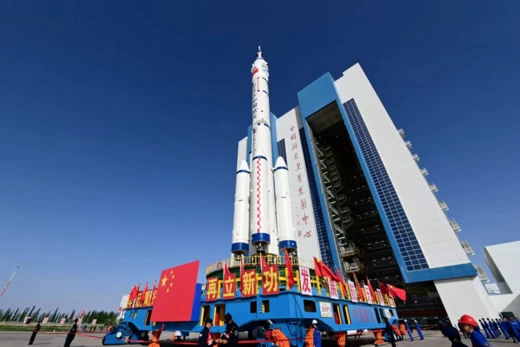
Shenzhou 5
China's first crewed spaceflight, launched 15 October 2003.

Shenzhou 5 marked China’s first crewed spaceflight, lifting off on 15 October 2003 atop a Long March 2F rocket. The mission followed four uncrewed Shenzhou tests dating back to 1999. With this flight, China became the third nation—after the Soviet Union/Russia and the United States—to achieve independent human spaceflight capability. As of the mission’s date, it remains the most recent solo orbital flight by a single astronaut.
The spacecraft launched at 09:00 local time from the Jiuquan Satellite Launch Center in the Gobi Desert, Gansu province. It reached an orbit 343 kilometers above Earth ten minutes later. On board was 38-year-old People’s Liberation Army lieutenant colonel and former fighter pilot Yang Liwei. The crewed program that made this possible had been underway since 1992. Neither the launch nor the reentry were broadcast live, though their scheduled times were announced in advance; China Central Television reported on both within minutes of their occurrence.
Shenzhou 5 completed 14 orbits and landed 21 hours after launch. Reentry began at 06:04 local time on 16 October 2003, with the parachute deploying normally. Yang reported feeling fine. The capsule touched down at 06:28 local time, just 4.8 kilometers from its intended landing site in Inner Mongolia. The orbital module remained in orbit, conducting automated experiments until 16 March 2004, and decayed on 30 May. Premier Wen Jiabao congratulated the nation’s first space traveler upon his safe return. Yang emerged from the capsule about 15 minutes later, waving to recovery personnel. The Beijing Aerospace Command and Control Center declared the mission a success after he exited.
During the flight, Yang wore a diaper. Asked about the experience, he said, “Better not to piss in diaper… Baby doesn’t like it, neither does an adult.” He also reported abnormal vibrations—pogo oscillation—starting 120 seconds after launch, which he called “very uncomfortable.” This led to design changes on the CZ-2F rocket for the subsequent Shenzhou 6 mission. Yang additionally heard unexplained “knockings” on the spacecraft, which he found unsettling. The sounds came and went for unknown reasons; similar knockings were later reported by taikonauts on Shenzhou 6 and Shenzhou 7, and their source remains unidentified.
The launch received extensive coverage in Chinese state media, more than any recent event. While portrayed as a triumph for science and technology, it was noted in both Chinese and Western outlets that Yang displayed the United Nations flag alongside the flag of the People’s Republic of China. State media also reported that crop seeds from Taiwan were carried aboard. The chief executives of Hong Kong and Macau sent congratulatory letters. General Secretary and President Hu Jintao, speaking at the Great Hall of the People, hailed the mission as “an honour for our great motherland” and “a historic step” in surmounting the peak of world science and technology. He added that the Party and people would not forget those who had set up “outstanding merit” in the space industry, and expressed congratulations on behalf of the CPC Central Committee, the State Council, and the Central Military Commission.
International praise followed. Japanese Prime Minister Junichiro Koizumi called the launch “a great feat.” U.S. President George W. Bush congratulated Hu and wished China continued success. A U.S. State Department spokesperson applauded China’s achievement. NASA Administrator Sean O’Keefe described it as an “important achievement in human exploration” and wished China a continued safe human spaceflight program. The spacecraft later appeared in festivities and commemorations both inside and outside China, including on official North Korean stamps alongside that country’s first satellite, Kwangmyŏngsŏng-1.
Quick Facts
- Mission Type
- Crewed test flight
- Operator
- China Manned Space Agency
- Orbits Completed
- 14
- Spacecraft Type
- Shenzhou
- Manufacturer
- China Aerospace Science and Technology Corporation
- Launch Mass
- 7840 kg
- Crew Size
- 1
- Crew Members
- Yang Liwei
- Launch Date
- 15 October 2003, 01:00:03 UTC (09:00:03 CST)
- Launch Rocket
- Long March 2F (Y5)
- Launch Site
- Jiuquan, LA-4/SLS-1
- Launch Contractor
- China Academy of Launch Vehicle Technology
Facts from the source article.
Lore & Background
Shenzhou 5 was launched at 09:00 (UTC+08:00) from Jiuquan Satellite Launch Center in the Gobi Desert, Gansu province, entering orbit 343 kilometers above Earth at 09:10 (UTC+08:00). The spacecraft made 14 orbits and landed 21 hours after launch, reentering Earth's atmosphere at 06:04 (UTC+08:00) on 16 October 2003. The landing occurred at 06:28 (UTC+08:00), just 4.8 km from the planned landing site in Inner Mongolia. The launch was televised live on China Central Television (CCTV), while the reentry was not broadcast live but was widely announced beforehand, with news appearing on CCTV within minutes after the event.
During the flight, Yang Liwei wore diapers and later stated, 'Better not to piss in diaper...Baby doesn't like it, neither does an adult.' He also reported abnormal vibrations (pogo oscillation) 120 seconds after launch, which he described as 'very uncomfortable,' leading to corrective measures on the CZ-2F rocket for Shenzhou 6. Yang additionally reported hearing unknown 'knockings' on the spacecraft, which other Shenzhou taikonauts also reported on Shenzhou 6 and Shenzhou 7; the source remains unknown.
The launch was widely heralded in Chinese state media, and Yang Liwei showed both the flag of the United Nations and the flag of the People's Republic of China. The mission received praise from world leaders including Japanese Prime Minister Junichiro Koizumi, U.S. President George W. Bush, and NASA Administrator Sean O'Keefe.
Reader's Guide
Shenzhou 5 marked a pivotal moment in space exploration, as China became the third nation to achieve independent human spaceflight capability, following the Soviet Union/Russia and the United States. The mission was the culmination of a crewed space program that began in 1992, following four uncrewed Shenzhou flights since 1999. As of September 2026, Shenzhou 5 remains the most recent time an astronaut was launched alone to conduct an entirely solo orbital mission. The flight demonstrated China's ability to launch, orbit, and safely return a human, and its success spurred further missions like Shenzhou 6 and Shenzhou 7. The mission also highlighted technical challenges, such as pogo oscillation and unexplained 'knockings,' which were addressed or noted for future flights. Politically, the launch was celebrated domestically and internationally, with General Secretary Hu Jintao hailing it as 'an honour for our great motherland' and a historic step in science and technology. The spacecraft's orbital module continued automated experiments until 16 March 2004 and decayed on 30 May.
Did You Know?
- Shenzhou 5 was launched on 15 October 2003 from Jiuquan Satellite Launch Center in the Gobi Desert.
- Astronaut Yang Liwei reported hearing unknown 'knockings' on the spacecraft, also heard on Shenzhou 6 and Shenzhou 7, whose source remains unknown.
- The orbital module of Shenzhou 5 stayed in orbit for automated experiments until 16 March 2004 and decayed on 30 May.
Scheduling & Operational Readiness
The Shenzhou 23 mission underwent a notable shift in its launch timeline. Initially slated for a November 2026 window, the departure was pulled forward to May 2026 as a direct consequence of its predecessor, Shenzhou 22, launching earlier than originally planned. This acceleration was not merely an administrative adjustment; it reflected a deliberate operational philosophy. By January 2026, state broadcaster CCTV confirmed that the Shenzhou 23 spacecraft had already reached the Jiuquan Satellite Launch Center roughly two months ahead of its original delivery schedule. Simultaneously, the vehicle designated for Shenzhou 24 was projected to be finished by summer. Together with their paired Long March 2F rockets, this early readiness meant that a fully prepared backup mission could be staged on very short notice. The arrangement echoes the launch-on-need posture that Shenzhou 22 had already demonstrated, reinforcing the program's capacity to respond to unforeseen circumstances without sacrificing safety or crew welfare.
Crew & Historic Milestones
Following the established convention of revealing crew assignments just one day before the planned launch, the Shenzhou 23 team brought together three individuals with distinct roles and backgrounds. Zhu Yangzhu, a veteran who had already flown aboard Shenzhou 16, assumed the command position, bearing overall responsibility for mission success and the achievement of all stated objectives. Zhang Zhiyuan, a former air force pilot, was tasked with executing mission goals and providing operational support throughout the flight. The most widely noted appointment, however, was that of Lai Ka-ying, who in effect became the first person from Hong Kong to travel to space. Serving as a payload specialist, her duties centered on conducting scientific experiments aboard the station and overseeing the management and maintenance of research payloads. The trio's complementary skill sets—command experience, flight operations, and scientific research—illustrate how China's crewed program continues to diversify both the professional backgrounds and the geographic origins of its astronauts.
Extended Stay & International Collaboration
A defining departure from prior six-month crewed rotations, the Shenzhou 23 mission introduced a full-year stay for one of its three astronauts. The China Manned Space Agency confirmed this extended-duration arrangement, which would see a single crew member remain aboard Tiangong for approximately twelve months alongside two members of the incoming Shenzhou 24 team. The identity of the long-duration astronaut is not predetermined; instead, the selection will be made later in the mission after thorough physical and psychological evaluations of all three crew members. This extended presence serves a strategic purpose: it creates the station capacity for a short-duration international visit. In October 2026, a Pakistani astronaut—either Muhammad Zeeshan Ali or Khurram Daud—will launch aboard Shenzhou 24 to visit Tiangong, spending roughly one week in orbit before returning to Earth with two of the Shenzhou 23 crew. The arrangement marks a significant step in China's growing international space cooperation.
Spacecraft Logistics & Program Context
Shenzhou 23 occupies a specific place within the broader architecture of China's crewed spaceflight program. It is the seventeenth crewed Chinese spaceflight and the twenty-third flight in the Shenzhou series overall, while also representing the eleventh crewed mission to the Tiangong space station. The spacecraft lifted off atop a Long March 2F rocket and subsequently docked with the nadir port of the Tianhe core module, the central element of the orbital laboratory. The mission's expected duration of approximately six months aligns with the standard rotation cadence, though the year-long stay for one crew member extends the practical timeline. The program's operational tempo is further evidenced by the concurrent preparation of the Shenzhou 24 vehicle and its launch rocket, both expected to be ready by mid-2026. This parallel development pipeline ensures that the station can maintain continuous crewed presence while preserving the ability to execute a rapid backup launch should any contingency arise.
Frequently Asked Questions
Who flew on Shenzhou 5?
Yang Liwei was the sole crew member, a 38-year-old lieutenant colonel in the People's Liberation Army with a background as a fighter pilot. He became the first Chinese citizen to travel to space.
When did Shenzhou 5 launch?
The spacecraft lifted off on 15 October 2003, opening the chapter of crewed spaceflight in China's national program. It was the first time the country sent a human beyond the atmosphere.
How long was Shenzhou 5 in orbit?
The entire flight lasted about 21 hours, during which Yang Liwei completed 14 full revolutions around Earth. Though brief by later standards, it proved the full crewed mission chain worked end to end.
Why is Shenzhou 5 considered a landmark?
It made China the third nation, following the Soviet Union and the United States, to independently place a person into orbit. The success confirmed that China had developed every critical technology for crewed spaceflight without foreign assistance.
What rocket carried Shenzhou 5 into space?
A Long March 2F two-stage launch vehicle, purpose-built for crewed missions, sent the spacecraft and Yang Liwei into orbit. It was the maiden flight of that dedicated crewed-launcher family.
More in Crewed Shenzhou missions 1-19
Spotted an error? Know more?
Reader corrections go straight into our review queue. Suggest an edit · How this site is sourced