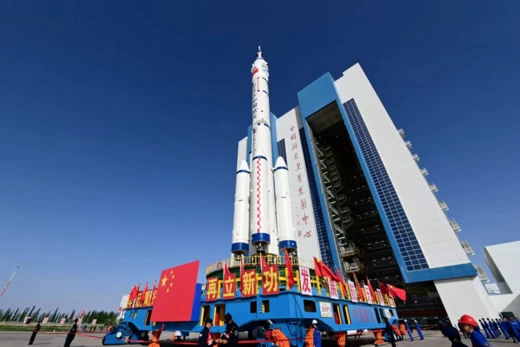
Shenzhou 14
Third crewed flight to Tiangong, began permanent habitation.

Shenzhou 14 was a Chinese spaceflight to the Tiangong space station, launched on 5 June 2022. It carried three People's Liberation Army Astronaut Corps (PLAAC) taikonauts and was the ninth crewed Chinese spaceflight and the fourteenth flight overall of the Shenzhou program. The mission marked the beginning of Tiangong being permanently inhabited, with Shenzhou 14 departing after the arrival of Shenzhou 15.
Quick Facts
- Mission Type
- Tiangong space station crew transport
- Operator
- China Manned Space Agency
- Spacecraft Type
- Shenzhou
- Manufacturer
- China Aerospace Science and Technology Corporation
- Crew Size
- 3
- Crew Members
- Chen Dong / Liu Yang / Cai Xuzhe
- Crew Eva Duration
- 15 hours, 53 minutes
- Launch Date
- 5 June 2022, 02:44:10 UTC (10:44:10 CST)
- Launch Rocket
- Long March 2F/G (Y14)
- Launch Site
- Jiuquan, LA-4/SLS-1
- Launch Contractor
- China Academy of Launch Vehicle Technology
- Landing Date
- 4 December 2022, 12:09:29 UTC
Facts from the source article.
Lore & Background
The crew of Shenzhou 14 was announced on 4 June 2022. The flight launched from Jiuquan Satellite Launch Center on 5 June 2022 at 02:44 UTC, following the launch of the Tianzhou 4 cargo resupply spacecraft. Just under 7 hours after launch, the spacecraft docked with the Tianhe core module's nadir docking port, and the crew entered the station later the same day at 12:50 UTC. Prior to launch, the Shenzhou 14 spacecraft was maintained in a state of near-readiness if needed as a lifeboat for the Shenzhou 13 crew.
Reader's Guide
Shenzhou 14 was the third spaceflight to the Tiangong space station and the second with a planned duration of six months. Its crew oversaw the expansion of Tiangong with the addition of the Wentian and Mengtian laboratory cabin modules, which arrived in July and October 2022 respectively. The crew carried out three spacewalks, worked on payloads both inside and outside the station, and conducted a live space lecture on 12 October 2022. Shenzhou 14 returned to Earth on 4 December 2022, undocking from Tiangong at 03:01 UTC and landing at the Dongfeng landing site at 12:09 UTC. The mission's significance lies in establishing continuous human presence on Tiangong, with Shenzhou 14 departing after the arrival of Shenzhou 15, a pattern repeated on subsequent expeditions.
Did You Know?
- Liu Yang became the second Chinese woman to carry out a spacewalk during this mission.
- The crew conducted a live space lecture on 12 October 2022 with classrooms in Beijing, Zhengzhou, Heze, and Dali.
From Abandoned Dreams to Orbital Reality
China's ambition to send humans into space stretches back further than most realize. The Shuguang spacecraft program, initiated in 1967, was projected to fly by 1973, yet it was quietly shelved in 1972 and formally terminated in 1980, primarily because the nation simply lacked the funding to sustain it. A successful uncrewed satellite launch in 1970 proved the underlying rocketry was sound, but the crewed component never materialized. Decades of dormancy ended in 1992 when Project 921 breathed new life into the effort. A pivotal 1995 agreement with Russia brought over critical Soyuz-derived technology spanning life support, docking procedures, and spacesuit design, which engineers then integrated into their own airframe. Qi Faren led the overall design through the early flights, after which Zhang Bainan assumed the role. The program's first uncrewed test lifted off on 19 November 1999, and just under four years later, on 15 October 2003, a human being rode the vehicle into orbit for the first time.
A Three-Part Machine Built for Efficiency
The Shenzhou spacecraft is divided into three distinct sections, each serving a specialized purpose. At the front sits the orbital module, a cylindrical compartment that houses experimental equipment, crew-operated instruments, and additional living space. Since Shenzhou 8, this module also carries the docking mechanism derived from the Androgynous Peripheral Attach System, a joint Soviet-American design. In the center is the reentry module, the sole section that survives the fiery descent back to Earth; its shape balances crew comfort with the aerodynamic control needed during atmospheric reentry. At the rear, the service module packs life-support systems, propulsion, and electrical generation. Two pairs of solar arrays, one on the service module and one on the orbital module, cover more than forty square metres and deliver over 1.5 kilowatts of power. A key design philosophy underpins this layout: only the reentry capsule needs heat shielding, so the other two sections can be larger without adding the penalty of ablative material. Before reentry, the orbital and service modules are jettisoned.
Fleet Operations and Station Duties
Since its debut, the Shenzhou vehicle has completed twenty-three missions, seventeen of them carrying crews, with the most recent being Shenzhou 23. Every single launch has used a Long March 2F rocket from the Jiuquan Satellite Launch Center in Gansu Province, and every recovery has taken place near Dorbod Banner in Inner Mongolia. The spacecraft is a single-use vehicle: once its orbital and service modules are discarded, the reentry capsule comes down and the vehicle's life ends. In its current operational role, two Shenzhou craft are typically berthed alongside China's Tiangong modular space station at any given time, working in tandem with Tianzhou cargo vehicles to keep the outpost supplied and crewed. Earlier in the program, the vehicle docked with the Tiangong-1 and Tiangong-2 experimental stations. For safety during the most dangerous phase of flight, each Shenzhou is enclosed in a protective fairing and equipped with a launch escape system. Looking ahead, the program is set to transition to the next-generation Mengzhou spacecraft, which will adopt a two-module configuration.
A Name Steeped in Poetry
The designation Shenzhou is far more than a technical label. In classical Chinese, the characters 神舟 literally translate to 'the Divine vessel upon the Heavenly River,' where Heavenly River is the traditional name for the Milky Way. The name is also a deliberate pun: it sounds identical to 神州, an ancient poetic epithet for China itself, meaning 'the Divine realm.' This wordplay fuses the nation's identity with its aspiration to reach the stars, embedding a sense of cultural destiny into the very name of the spacecraft. The name was selected by then-President Jiang Zemin following the successful first uncrewed flight in November 1999, at which point the project was officially renamed from its earlier designation. The choice reflects a broader tradition in Chinese astronomy and theology, where celestial imagery permeates language and national symbolism. In a program that began as a Soviet-influenced engineering exercise, the name injects a distinctly Chinese philosophical voice, framing human spaceflight not merely as a technological achievement but as a continuation of an ancient conversation between the earthbound and the heavens.
Frequently Asked Questions
Who flew on Shenzhou 14?
Three taikonauts from the People's Liberation Army Astronaut Corps made up the crew. The flight was the ninth crewed Chinese spaceflight and the fourteenth mission in the overall Shenzhou series.
When did Shenzhou 14 launch and how long did it stay in orbit?
The spacecraft lifted off on 5 June 2022 and remained docked at the Tiangong station for 182 days before the crew returned to Earth.
Why is Shenzhou 14 considered a milestone for China's space program?
As the third crewed visit to Tiangong, it was the first to establish continuous, permanent habitation of the station. From that point onward, Tiangong would always have a crew aboard.
How did Shenzhou 14's stay end?
The crew departed once Shenzhou 15 arrived at the station and took over the permanent-crew role. This handover pattern became the standard operating model for ongoing Tiangong rotations.
What was Shenzhou 14's place in the broader Shenzhou program?
It was the fourteenth flight in the Shenzhou series and the ninth to carry humans. It built directly on the earlier uncrewed and crewed test flights that had assembled the Tiangong modules.
More in Crewed Shenzhou missions 1-19
Spotted an error? Know more?
Reader corrections go straight into our review queue. Suggest an edit · How this site is sourced