Shenzhou 11
China's sixth crewed mission, longest until Shenzhou 12.

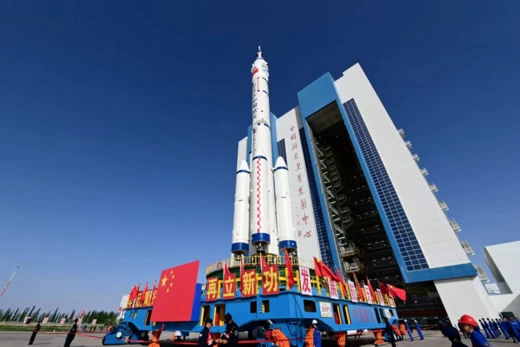
Shenzhou 11 carried two taikonauts—a smaller crew than usual to stretch supplies for a longer stay. Launched on 17 October 2016 (16 October UTC) from Jiuquan aboard a Long March 2F rocket, it was China’s sixth crewed mission. At 33 days, it set a national endurance record until Shenzhou 12’s three-month flight. Two days after liftoff, the spacecraft performed five orbit adjustments to get 52 kilometers behind the Tiangong-2 space lab, which had launched a month earlier. It then autonomously docked with the lab at an altitude of 393 kilometers. The crew’s main job was to live aboard Tiangong-2 for about 30 days, testing its life-support systems and gaining residency experience. Commander Jing Haipeng turned 50 while in orbit. After undocking on 17 November, the reentry module landed in Dorbod Banner, Inner Mongolia, the following day around 2:15 p.m. local time. This was the first and only crewed visit to Tiangong-2 in that phase of the Tiangong program.
Quick Facts
- Mission Type
- Tiangong-2 crew transport
- Operator
- China Manned Space Agency
- Orbits Completed
- 507
- Spacecraft Type
- Shenzhou
- Manufacturer
- China Aerospace Science and Technology Corporation
- Crew Size
- 2
- Crew Members
- Jing Haipeng / Chen Dong
- Launch Date
- 16 October 2016, 23:30:31 UTC (17 October, 07:30:31 CST)
- Launch Rocket
- Long March 2F/G (Y11)
- Launch Site
- Jiuquan, LA-4/SLS-1
- Launch Contractor
- China Academy of Launch Vehicle Technology
- Landing Date
- 18 November 2016, 05:59:38 UTC
Facts from the source article.
Lore & Background
Shenzhou 11 launched at 07:30 on 17 October 2016 local time from the Jiuquan Satellite Launch Center using a Long March 2F rocket. The crew consisted of two taikonauts, with the mission selecting two instead of three to extend supplies and increase mission length. Commander Jing Haipeng celebrated his 50th birthday while in orbit. Two days after launch, the spacecraft changed its orbit five times to arrive 52 kilometers behind the Tiangong-2 space lab, then autonomously rendezvoused and docked with it at 3:24 p.m. EDT on 18 October 2016, at an altitude of 393 kilometers.
Reader's Guide
Shenzhou 11 holds significance as China's sixth crewed space mission and the first and only expedition to the Tiangong-2 space laboratory. Its primary objective was to rendezvous and dock with Tiangong-2 and gain experience from a 30-day residence, testing life-support systems. The mission's 33-day duration made it the longest Chinese crewed spaceflight until the subsequent Shenzhou 12 mission, which lasted three months. The successful docking and extended stay demonstrated China's growing capability in human spaceflight and orbital operations, paving the way for longer-duration missions. The crew's safe landing in Inner Mongolia on 18 November 2016 after undocking the previous day marked a successful conclusion to a key step in China's space station development.
Did You Know?
- Shenzhou 11 was China's sixth crewed space mission.
- The mission lasted 33 days, the longest until Shenzhou 12.
- The crew consisted of two taikonauts instead of three to extend supplies.
Origins & Russian Heritage
China's crewed spaceflight ambitions trace back to 1967 with the Shuguang program, yet financial shortfalls forced its cancellation by 1980 despite a successful uncrewed satellite launch in 1970. The effort was reborn in 1992 as Project 921, and a pivotal 1995 agreement with Russia delivered Soyuz technology spanning life-support systems, docking hardware, and spacesuits. The general design of the earliest Shenzhou vehicles (flights one through five) was led by Qi Faren, before Zhang Bainan assumed overall design responsibility from Shenzhou 6 onward. The resulting spacecraft, while clearly inspired by Soyuz's three-module philosophy, grew roughly ten percent larger and heavier, gaining a wider cylindrical orbital module and four propulsion engines. This blend of borrowed architecture and domestic expansion set the engineering template that every subsequent crewed mission would inherit.
Engineering & Modular Architecture
The Shenzhou spacecraft is built around a deliberate weight-saving principle: only the central reentry module must survive atmospheric descent, so the forward orbital module and aft service module are jettisoned before reentry. The orbital module houses experiment bays, crew-operated equipment, and in-orbit living space, while the service module carries life-support systems and two pairs of solar panels totalling over forty square metres, generating more than 1.5 kilowatts of average power—well above Soyuz's 1.0 kW. A notable distinction from its Russian counterpart is that the orbital module retains its own propulsion, electrical, and control systems, enabling autonomous flight after separation. In uncrewed test flights, orbital modules were left operating in orbit for days or even months; the Shenzhou 5 module stayed active for a full six months. The reentry module itself is shaped as a compromise between maximising crew volume and providing aerodynamic stability during descent.
Operational History & Launch Routine
Since its maiden uncrewed launch on 19 November 1999, the Shenzhou vehicle has completed twenty-three flights, seventeen of them crewed beginning with the historic Shenzhou 5 mission on 15 October 2003. Every single launch has used a Long March 2F rocket from the Jiuquan Satellite Launch Center in Gansu Province, with landing near Dorbod Banner in Inner Mongolia. For added safety during ascent, each craft is enclosed in a fairing and fitted with a launch escape system. The spacecraft's docking mechanism, introduced with Shenzhou 8, is derived from the joint Soviet-American Androgynous Peripheral Attach System. Two Shenzhou vehicles are typically berthed alongside China's Tiangong modular station, with Tianzhou cargo craft supplementing resupply operations. The program is now preparing to hand over to the next-generation Mengzhou, a two-module design still in development.
Etymology & Cultural Identity
The name Shenzhou—神舟—carries a layered poetic meaning that reflects China's deep astronomical and literary heritage. Literally rendered as 'the Divine vessel on the Heavenly River,' it invokes the Classical Chinese term for the Milky Way (天河). The spelling deliberately echoes 神州, a poetic epithet for China meaning 'Divine realm,' creating a pun that fuses national identity with celestial ambition. The name was selected by then President Jiang Zemin after the first uncrewed flight in 1999, when Project 921 was formally renamed. This linguistic choice was no accident: it wove the spacecraft into a tradition of Chinese poetry and theology that treats the sky as a sacred river, positioning a modern engineering achievement within a millennia-old cultural narrative of divine geography.
Frequently Asked Questions
Who flew on Shenzhou 11?
Two taikonauts made up the crew, a deliberately smaller team than the usual three so that onboard supplies could stretch over a longer in-space stay.
How long did Shenzhou 11 stay in orbit?
The mission lasted 33 days, holding China's crewed endurance record until Shenzhou 12 later pushed the mark to a full three months.
Where did Shenzhou 11 go and how did it reach its target?
Two days after liftoff the spacecraft executed five orbit adjustments to slot itself 52 kilometers behind the Tiangong-2 lab, then completed an autonomous docking at roughly 393 kilometers altitude.
When and how did Shenzhou 11 launch?
It lifted off from the Jiuquan site on 17 October 2016 (16 October UTC) riding a Long March 2F rocket, making it China's sixth crewed spaceflight.
Why was the Shenzhou 11 crew only two people instead of three?
Trimming the crew to two was a deliberate trade-off: with fewer mouths to feed, the same supply load could sustain the 33-day duration that was the mission's central objective.
More in Crewed Shenzhou missions 1-19
Spotted an error? Know more?
Reader corrections go straight into our review queue. Suggest an edit · How this site is sourced