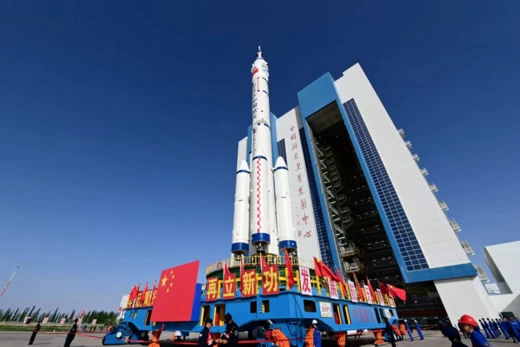
Shenzhou 17
Sixth crewed mission to Tiangong space station.

Shenzhou 17 was a Chinese spaceflight to the Tiangong space station, launched on 26 October 2023. It was the twelfth crewed Chinese spaceflight and the seventeenth flight overall of the Shenzhou program, carrying three People's Liberation Army Astronaut Corps taikonauts. The mission lasted just over six months and included two spacewalks for maintenance of the station's solar panels.
Quick Facts
- Mission Type
- Tiangong space station crew transport
- Operator
- China Manned Space Agency
- Spacecraft Type
- Shenzhou
- Manufacturer
- China Aerospace Science and Technology Corporation
- Crew Size
- 3
- Crew Members
- Tang Hongbo / Tang Shengjie / Jiang Xinlin
- Crew Evas
- 2
- Crew Eva Duration
- 15 hours, 17 minutes
- Launch Date
- 26 October 2023, 03:14:02 UTC (11:14:02 CST)
- Launch Rocket
- Long March 2F/G (Y17)
- Launch Site
- Jiuquan, LA-4/SLS-1
- Launch Contractor
- China Academy of Launch Vehicle Technology
Facts from the source article.
Lore & Background
Shenzhou 17 launched from Jiuquan Satellite Launch Center on 26 October 2023 at 09:46 UTC, near the end of the Shenzhou 16 mission. Approximately 6.5 hours after launch, it docked with the Tianhe core module's forward docking port. The crew entered the station and were greeted by the Shenzhou 16 crew, sharing a four-day overlap before Shenzhou 16 departed. The two crews sent a televised message to Mission Control as part of a handover ceremony, livestreamed by CCTV.
The crew consisted of Commander Tang Hongbo, who became the first person to visit the station twice (having previously flown on Shenzhou 12), Tang Shengjie, a former Air Force pilot responsible for science operations, and Jiang Xinlin, a former pilot responsible for maintenance. The spacecraft had entered the launch area in April 2023 and was maintained in a state of near-readiness as a potential lifeboat for the Shenzhou 16 crew.
Two spacewalks were conducted. The first, on 21 December 2023, was carried out by Tang Hongbo and Tang Shengjie through the Wentian lab module's airlock, lasting 7 hours and 25 minutes, and included a repair test of the Tianhe core module's solar panels damaged by space debris and micrometeoroids. The second, on 2 March 2024, was carried out by Tang Hongbo and Jiang Xinlin, lasting 7 hours and 52 minutes, involving maintenance of the solar panels, evaluation of power generation performance, and inspection of station modules.
Reader's Guide
Shenzhou 17 represents a continuation of China's sustained human presence in low Earth orbit, being the sixth flight to the Tiangong space station. Its significance lies in demonstrating routine crew rotation and handover procedures between expeditions, as well as the ability to perform extravehicular maintenance on the station's infrastructure. The mission's spacewalks specifically addressed the real-world challenge of space debris and micrometeoroid impacts on solar panels, a critical issue for long-duration orbital habitats. Commander Tang Hongbo's second visit to Tiangong highlighted the growing experience base within the PLAAC. The mission also underscored the logistical capability of maintaining a spacecraft in near-readiness as a lifeboat for a previous crew. By ending with a landing near the launch site in Inner Mongolia, Shenzhou 17 completed a full operational cycle, contributing to the long-term viability of China's space station program.
Mission Profile & Schedule
Shenzhou 23 represents the seventeenth crewed flight in China's space program and the twenty-third mission under the broader Shenzhou umbrella, carrying three taikonauts to and from the Tiangong space station. The mission profile calls for an approximately six-month stay in orbit, consistent with the standard duration of recent Chinese crewed sorties. However, the timeline shifted notably from its original plan. What was initially slated for a November 2026 launch was pulled forward to May 2026, a change driven by the earlier-than-expected departure of its predecessor, Shenzhou 22. As the eleventh crewed visit to Tiangong, the flight launched atop a Long March 2F rocket and achieved docking at the nadir port of the station's Tianhe core module. This scheduling flexibility underscores how China's space operations have matured into a rhythm where mission cadence can be adjusted in response to the needs of the station rather than rigidly following a fixed calendar.
Crew Composition & Historic Milestones
Following the established convention of revealing crew assignments just one day before the planned launch window, the Shenzhou 23 team brought together a blend of experienced spaceflight veterans and a trailblazer. Zhu Yangzhu assumed the command role, returning to the station after his earlier flight aboard Shenzhou 16; as commander he bears overall responsibility for mission execution and the achievement of all stated objectives. Zhang Zhiyuan, a former air force pilot, serves in the role of completing mission objectives and providing operational support throughout the flight. Perhaps the most historically significant appointment belongs to Lai Ka-ying, who in doing so became the first individual from Hong Kong to travel to space. Her designated role is that of payload specialist, tasked with conducting scientific experiments aboard the station as well as managing and maintaining the various payloads carried up. This combination of seasoned leadership, military discipline, and a new regional first gives the crew a distinctive character within the broader Shenzhou lineage.
The One-Year Stay & International Partnership
A defining distinction of Shenzhou 23 from prior six-month Chinese crewed missions is the announcement that one member of the three-person team will remain aboard Tiangong for a full year. The CMSA confirmed this extended-duration arrangement, which was not a feature of earlier standard rotations. The selection of which crew member would undertake the year-long stay is not predetermined; instead it will be decided later in the mission following physical and psychological evaluations of all three astronauts. This extended presence serves a specific diplomatic and operational purpose: it creates the crewing capacity for a Pakistani astronaut to make a short-duration visit to the station during the Shenzhou 24 mission, scheduled for October 2026. The visiting Pakistani taikonaut, either Muhammad Zeeshan Ali or Khurram Daud, would launch alongside Shenzhou 24 and return roughly one week later with two members of the Shenzhou 23 crew, while the remaining Shenzhou 23 member continues the year-long stay alongside the two Shenzhou 24 crewmates.
Logistics, Readiness & Backup Capability
The operational backbone of Shenzhou 23 was laid well before the launch itself. On 19 January 2026, China Central Television reported that the spacecraft had already arrived at the Jiuquan Satellite Launch Center, roughly two months ahead of the original delivery schedule. This early arrival was not an isolated event; the spacecraft designated for the follow-on Shenzhou 24 mission was also projected to be completed by summer 2026. Together with their respective Long March 2F launch vehicles, the early readiness of both spacecraft restores what observers describe as a launch-on-need capability, a flexibility first demonstrated during the Shenzhou 22 window. In practical terms, this means that should an emergency or operational requirement arise, a backup crewed mission can be assembled and launched on very short notice. The dual-vehicle, dual-spacecraft posture at Jiuquan thus represents a significant maturity milestone for China's crewed launch infrastructure, ensuring that the station's crew rotation is never left dependent on a single point of failure.
Frequently Asked Questions
Who flew on Shenzhou 17?
Three taikonauts selected from the People's Liberation Army Astronaut Corps made up the crew. They became the sixth crewed team to dock with and live aboard the Tiangong space station.
When did Shenzhou 17 launch and splash down?
The spacecraft lifted off on 26 October 2023 and returned to Earth on 30 April 2024, giving the crew a total in-orbit stay of just over six months.
How many spacewalks did the Shenzhou 17 crew complete?
The crew performed two extravehicular activities during their rotation. Both walks were dedicated to servicing and repairing the station's solar-panel arrays to keep power generation running smoothly.
Where does Shenzhou 17 fit in the overall Shenzhou program?
It was the seventeenth Shenzhou flight of any kind and the twelfth crewed mission in the series, continuing China's steady pace of sending rotating teams to its orbital laboratory.
Why is Shenzhou 17 significant for Tiangong station operations?
As the sixth crewed expedition to the station, it helped maintain an unbroken human presence aboard Tiangong and ensured the laboratory stayed operational through hands-on hardware upkeep.
More in Crewed Shenzhou missions 1-19
Spotted an error? Know more?
Reader corrections go straight into our review queue. Suggest an edit · How this site is sourced