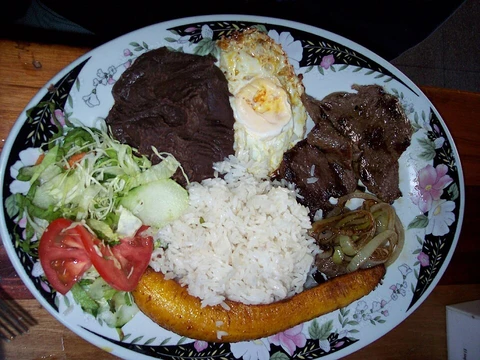
Picadillo
A minced meat dish with regional variations across the Americas and Asia.

Picadillo (pronounced pikaˈðiʝo, meaning "mince") is a dish found across several Latin American countries, including Mexico and Cuba, as well as in the Philippines. It typically consists of ground meat—most often beef—combined with tomatoes (or tomato sauce as a substitute), raisins, olives, and other regional ingredients. The term derives from the Spanish verb *picar*, which means "to mince." While picadillo can be eaten on its own, it is commonly served with rice. It also works as a filling for tacos, empanadas, alcapurrias, and various savory pastries or croquettes, and may be incorporated into dishes like pastelón, chiles en nogada, and arroz a la cubana.
The dish was already common in Hispanic cultures before the 1800s. A 19th-century California recipe for pasteles a la argentina describes a filled pastry with layers of beef picadillo and chicken cooked in a green chili and onion sauce with olive oil and raisins. Picadillo was not always beef-based; "picadillo de ave" was a minced fowl dish with white sauce. Another historical preparation, pasteles de pollos y pichones, was a savory pie alternating chicken and squab with a picadillo of minced veal, bacon, and ham fried in lard with onion, mushrooms, apples, artichokes, tomatoes, and seasonings.
In Costa Rica, picadillo is named after its main vegetable ingredient—such as potato picadillo or ayote picadillo—which is chopped and cooked with bell peppers, onions, stock, herbs, and spices. Protein is optional, and it is often served with tortillas or rice. A variant, picadillo de plátano verde, uses green plantains as the base.
Cuban picadillo features ground beef with bell pepper or ají cachucha, onions, garlic, oregano, cumin, bay leaf, tomato sauce, olives, and capers, typically sautéed in olive oil and white wine. Raisins are traditional but often omitted by preference. It is served over long-grain white rice or used as stuffing for papa rellena, empanadas, and pastelitos de carne. During Cuba’s Special Period in the 1990s, a famine version emerged that substituted plantain peels for ground beef.
In the Dominican Republic, picadillo includes cubanelle peppers, red onions, cilantro, garlic, tomato paste, and lippia, with optional olives, capers, raisins, and hard-boiled egg. It is served over rice or used as a filling for pasteles, empanadas, kibbeh, and cabbage rolls.
- Origin
- Latin America and Philippines
- Main ingredient
- Ground meat (most commonly beef)
- Common accompaniments
- Rice, tortillas, or as filling for pastries
- Name meaning
- From Spanish 'picar' (to mince)
- Variants
- Regional variations in Costa Rica, Cuba, Dominican Republic, Mexico, Peru, Puerto Rico, Philippines
Lore & Background
Although the dish was common in Hispanic cultures before the 19th century, a 19th-century recipe from California for pasteles a la argentina is given for a filled pastry with layers of beef picadillo and chicken cooked in a green chili and onion sauce with olive oil and raisins. 'Picadillo' was not always made with beef; 'picadillo de ave' was a minced fowl with white sauce. Pasteles de pollos y pichones (chicken and squab pastry) was made as a savory pie with alternating layers of chicken and squab with a picadillo of minced veal, bacon, ham fried in lard with onion, mushrooms, apples, artichokes, tomatoes, and a layer of seasonings.
Reader's Guide
Picadillo holds significance as a versatile and widespread dish that reflects the culinary adaptations of Hispanic and Filipino cultures. Its core ingredients—ground meat, tomatoes, raisins, and olives—are adjusted regionally, with Costa Rica emphasizing vegetable-based versions, Cuba incorporating capers and white wine, and Mexico adding carrots and potatoes. In the Philippines, picadillo is also known as giniling and appears in both soupy and dry forms, often served with rice and fried eggs as arroz a la cubana. The dish's adaptability is evident in its use as a filling for empanadas, tacos, pastelón, and chiles en nogada, as well as its role in famine food during Cuba's Special Period, where plantain peels substituted for beef. Picadillo's legacy lies in its ability to bridge diverse culinary traditions while maintaining a recognizable core identity.
Did You Know?
- During Cuba's Special Period in the 1990s, a famine food variant of picadillo used plantain peels instead of ground beef.
- In Costa Rica, picadillo always includes the name of the main vegetable ingredient, such as potato picadillo or ayote picadillo.
- The Filipino version of picadillo, called giniling, does not include olives or capers as in Latin American versions.
- A 19th-century California recipe for pasteles a la argentina used layers of beef picadillo and chicken in a green chili and onion sauce.
Frequently Asked Questions
What exactly is Picadillo?
Picadillo is a minced-meat dish rooted in Latin American and Filipino cooking, most often built around ground beef mixed with tomatoes, raisins, and olives. The name comes from the Spanish verb 'picar,' which simply means 'to mince.'
What's the main ingredient in Picadillo?
Ground meat—typically beef—forms the backbone of the dish. It's combined with tomatoes or tomato sauce, raisins, olives, and whatever regional extras a cook adds.
How do people in Costa Rica actually eat Picadillo?
It's most commonly plated alongside a side of rice, but it also shows up tucked inside tacos, empanadas, alcapurrias, and various savory pastries or croquettes. You can absolutely eat it straight up on its own, though.
Where does Picadillo come from?
The dish has no single origin point; it appears across multiple Latin American countries including Mexico, Cuba, and Costa Rica, as well as in the Philippines. Each region tweaks the recipe with local ingredients, so no two versions are identical.
Is Picadillo the same in every country?
Not at all—while the core idea of seasoned minced meat stays consistent, the specific add-ins shift from place to place. Costa Rica, Cuba, the Dominican Republic, Mexico, Peru, Puerto Rico, and the Philippines each have their own take on the dish.
More in Costa Rican cuisine 1-24
Spotted an error? Know more?
Reader corrections go straight into our review queue. Suggest an edit · How this site is sourced