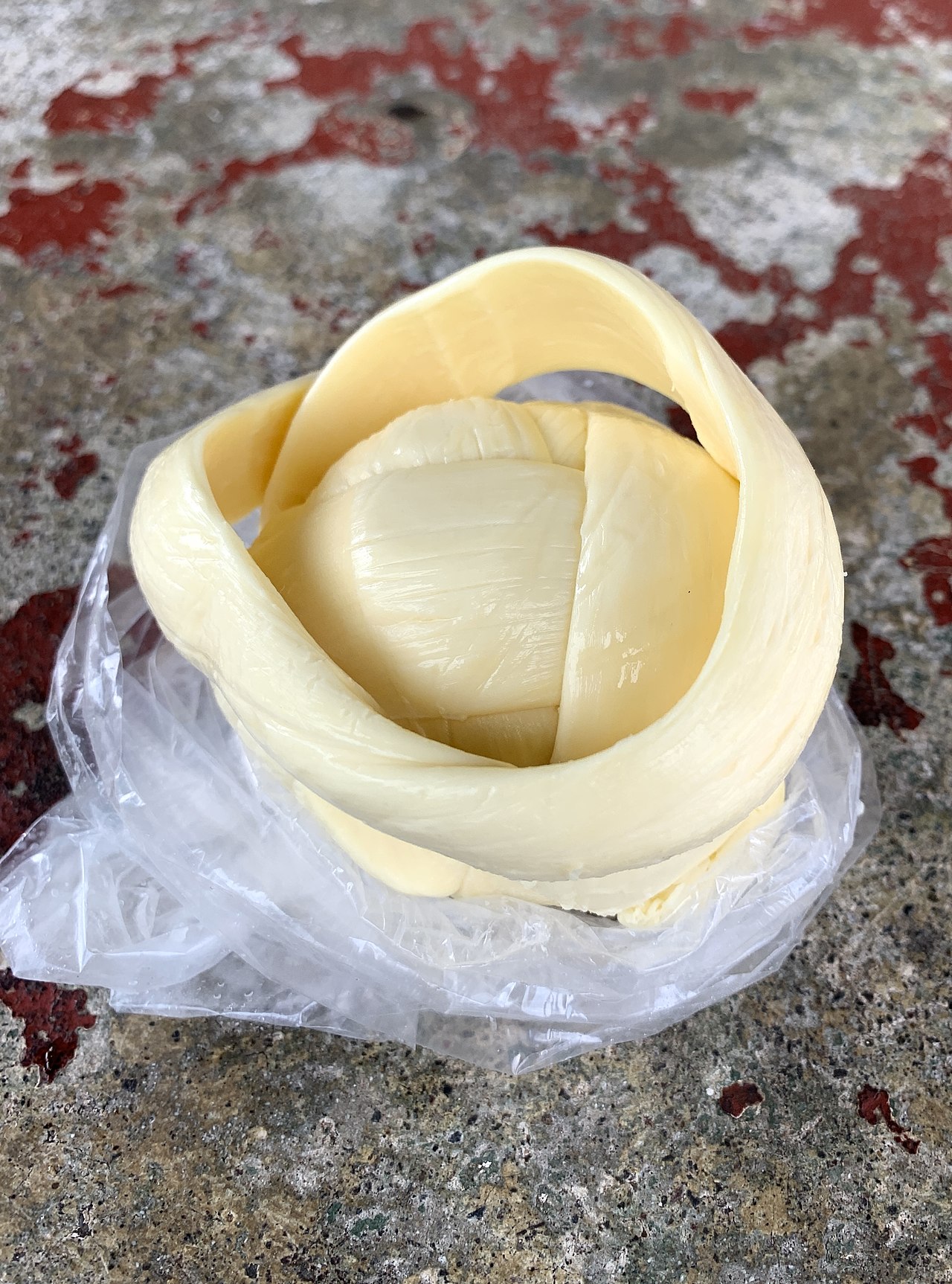
Palmito cheese
A knotted string cheese from Costa Rica, light and salty.

LittleT889 · CC BY-SA 4.0
Palmito cheese, known in Spanish as *queso palmito*, is a fresh cheese from Costa Rica. It looks like a knotted ball of string cheese and is described as light, salty, and stringy, with a texture similar to mozzarella. It belongs to the stretched-curd family, made using the pasta filata technique, a method believed to have been introduced by Italian immigrants.
The cheese originated in Cutris, a district in San Carlos, one of Costa Rica’s largest dairy-producing areas. It was first called *queso arrollado* ("rolled cheese") but wasn’t very popular. Production later moved to La Palmito de Naranjo, where it became known as *queso palmito*. The name *palmito* refers to heart of palm, which the cheese’s appearance also resembles. Today, the main production area is the canton of Zarcero in Alajuela province.
Dairy farming in Costa Rica has grown over recent decades. About 95% of cows are Holstein, Jersey, or a cross of the two. Milk production increased by 1.15 times between 2005 and 2009. Per capita cheese consumption is about 8.4 kg per year, with 95% consumed as fresh cheeses and 5% as mature cheeses—a trend common across Central America. Costa Rica’s Official Standard for Cheese, established in 1988, sets definitions and guidelines. The artisanal cheese sector is the most important in the market, with Turrialba, Bagaces, and Palmito as the three main cheeses. All use rennet for coagulation but differ in curd treatment and pressing, affecting moisture, fat, and salt content.
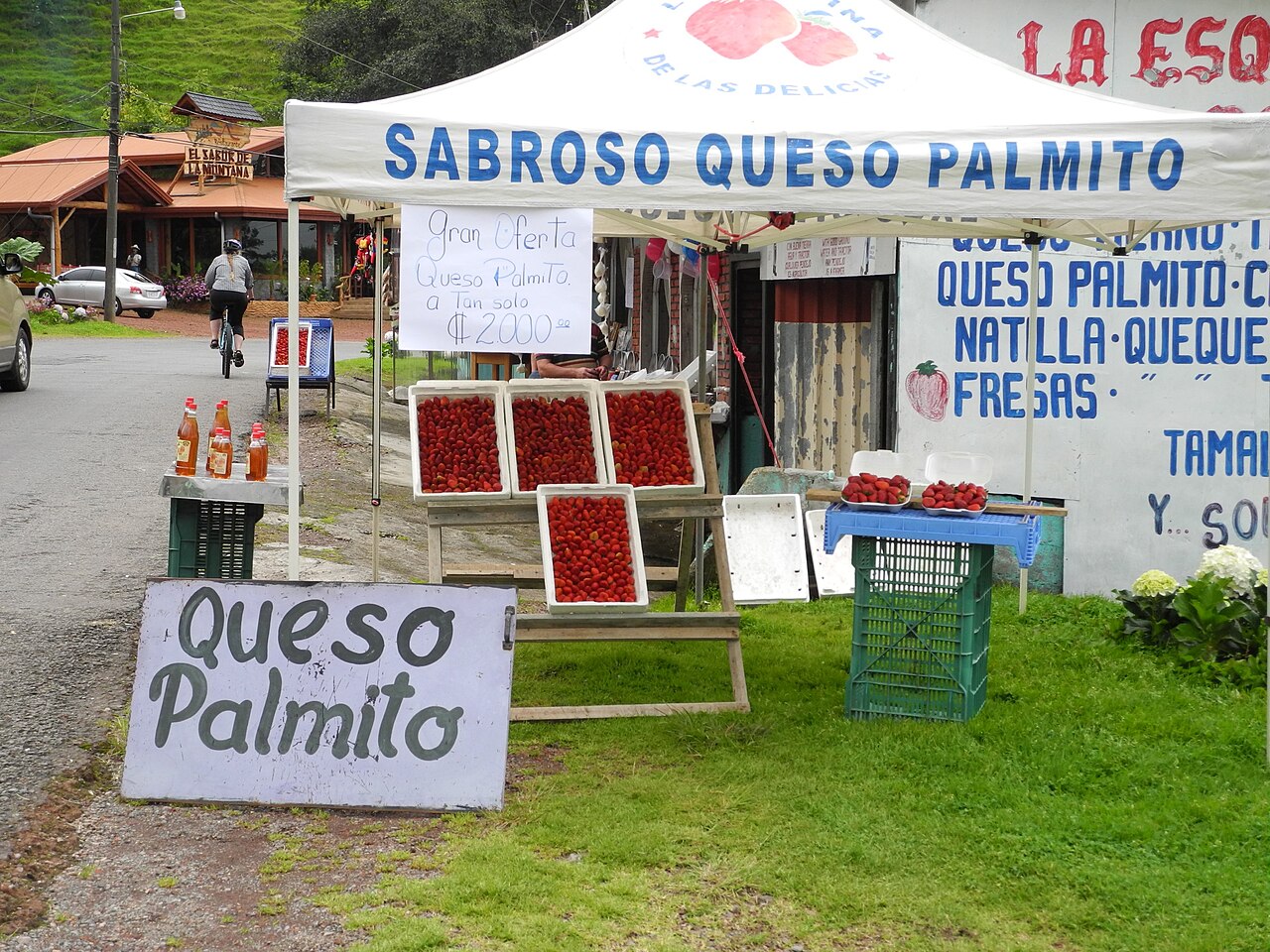
Palmito cheese is mainly produced in the canton of Zarcero in Alajuela province, with additional production in San Carlos, Santa María de Pocosol, Nuevo Arenal, Venado, Guatuso, Patasto, Aguas Zarcas, and Coopevega. It is sold in supermarkets, shops, roadside stands, and farmers markets.
The cheese is a type of string cheese with a shiny surface and no rind. It is an acidic fresh cheese with a pH of 6.6, made from fresh whole cow’s milk. Its fat content ranges from 16 to 24%, and moisture from 46 to 58%, making it a medium-fat, semi-hard cheese. It is compact and hard to cut, with a creamy white to slightly yellow color.
A high proportion of palmito cheese is made artisanal by small producers. Raw milk is collected and pasteurized by heating to 50–55°C for 30 minutes with constant stirring, then cooled to 35–37°C.
Quick Facts
- Country
- Costa Rica
- Source
- Cow, usually Holestein, Jersey, or a crossbreed
- Pasteurised
- Sometimes
- Texture
- Semi-hard
- Fat
- 16-24%
Facts from the source article.
Lore & Background
Palmito cheese originates from Cutris, a district in San Carlos, one of the largest dairy producers in Costa Rica. It was first named queso arrollado ('rolled cheese') and did not enjoy much popularity. The production then moved to La Palmito de Naranjo, and later became known as queso palmito. The word palmito refers to heart of palm, which the cheese's appearance also resembles. Today, the main production area is the canton of Zarcero in the province of Alajuela.
Palmito cheese is mainly produced in the canton of Zarcero in the province of Alajuela, with additional production in San Carlos, Santa María de Pocosol, Nuevo Arenal, Venado, Guatuso, Patasto, Aguas Zarcas and Coopevega. It can be purchased at supermarkets, shops, roadside stands, and farmers markets. At an expo in Zarcero in 2007, a 132 kg ball of palmito cheese was created by local cheesemakers.
Reader's Guide
Palmito cheese is a significant part of Costa Rica's artisanal cheese-making sector, which is considered the most important in the cheese market. Alongside Turrialba and Bagaces, Palmito is one of the three main cheeses produced in the country. It reflects the overall trend in Central America where about 95% of cheese consumption is fresh cheeses. The cheese is made with fresh whole cow's milk, using the pasta filata technique, and is produced largely by small producers in an artisanal way. Its production involves pasteurization, fermentation, curd cutting, kneading, and manual rolling to give it its characteristic shape. The cheese has a compact, hard-to-cut texture with a creamy white to slightly yellow color. Its popularity is evident from the large 132 kg ball created at a 2007 expo in Zarcero. Palmito cheese is similar to Oaxaca cheese in Mexico and is a staple in Costa Rican markets and roadside stands.
From Cutris to the National Table
Palmito cheese traces its roots to Cutris, a district within San Carlos, a region long recognized as one of Costa Rica's most significant dairy-producing areas. In its earliest days, the product carried the humble name queso arrollado, meaning rolled cheese, and it failed to capture widespread attention from consumers. The turning point came when production shifted to La Palmito de Naranjo, where the cheese acquired the name it still bears today. The word palmito literally translates to heart of palm, a nod to the cheese's visual resemblance to that vegetable. The stretched-curd method used to create it, known as pasta filata, is widely attributed to Italian immigrants who brought their cheesemaking knowledge to Central America. This same technique underpins Oaxaca cheese in neighboring Mexico, linking Palmito to a broader tradition of hand-stretched dairy products across the region. What began as an overlooked local product in a single district eventually grew into a signature fresh cheese recognized throughout the country.
The Artisanal Craft of Making
Most Palmito cheese is still produced by small-scale artisans rather than industrial facilities, preserving a hands-on approach to cheesemaking. The process begins with raw milk collected directly from the cow. The milk is pasteurized by heating it to between 50 and 55 degrees Celsius for roughly thirty minutes while being continuously agitated, then allowed to cool to a range of 35 to 37 degrees Celsius. Fermentation and curdling follow, with rennet coagulating the casein proteins. The curd is cut and left to rest for forty-five to sixty minutes before the whey is drained away. At this stage the curd is kneaded by hand, then shaped through manual rolling. A brief immersion in cold water sets the cheese's distinctive knotted form. The final steps involve rolling, salting, and molding the cheese before it is packaged and stored. Every batch reflects the individual touch of the maker, which is why no two balls of Palmito are exactly alike.
Texture, Taste, and Classification
Palmito presents as a shiny, rind-free string cheese with a creamy white to faintly yellow hue. It is classified as a medium-fat semi-hard fresh cheese, with a fat content ranging from 16 to 24 percent and moisture between 46 and 58 percent. Its pH sits at 6.6, giving it a mildly acidic character. Tasters describe the flavor as light and distinctly salty, while the texture is stringy in a way that draws comparisons to mozzarella. The cheese is notably compact and resists easy cutting, a trait that speaks to its dense, cohesive structure. Its defining visual feature is the knotted, ball-like shape that evokes a twisted bundle of string cheese. Because it is made exclusively from fresh whole cow's milk and processed through the pasta filata stretching method, Palmito occupies a specific niche among Costa Rica's fresh cheeses, standing apart from aged or heavily pressed varieties while sharing its stretched-curd lineage with Mexico's Oaxaca cheese.
Palmito in the Broader Dairy Landscape
Costa Rica's dairy sector has expanded considerably over the past two decades, with milk output rising by a factor of 1.15 between 2005 and 2009. Roughly 95 percent of the national herd consists of Holstein, Jersey, or crossbred animals, providing the raw material base for the country's cheese industry. Per capita cheese consumption hovers around 8.4 kilograms per person annually, and an overwhelming 95 percent of that intake takes the form of fresh cheeses, mirroring a pattern seen across Central America. Within this market, the artisanal segment is regarded as the most important, and Palmito ranks alongside Turrialba and Bagaces as one of the three principal cheeses produced. All three rely on rennet for casein coagulation but differ in curd treatment and pressing, which shifts their moisture, fat, and salt levels. Palmito is manufactured across the canton of Zarcero in Alajuela province and surrounding regions, and it can be found in supermarkets, roadside stands, and farmers markets. In 2007, local cheesemakers at a Zarcero expo crafted a single 132-kilogram ball of the cheese, a testament to its cultural prominence.
Gallery
Frequently Asked Questions
What is Palmito cheese?
Palmito cheese (queso palmito) is a fresh, stretched-curd cheese native to Costa Rica, shaped into a distinctive knotted ball of string. It sits in the same family as mozzarella and is known for its light, salty flavor.
Where did Palmito cheese come from?
The cheese first appeared in Cutris, a district within San Carlos, where it was originally called queso arrollado ("rolled cheese"). Production eventually shifted to La Palmito de Nara, and today it is most closely associated with the Canton of Zarcero in Alajuela province.
How is Palmito cheese made?
It uses the pasta filata technique, a stretched-curd method that Italian immigrants are credited with bringing to the region. The curd is pulled and hand-shaped into its signature knotted form.
What does Palmito cheese taste and feel like?
Fans describe it as light, salty, and pleasantly stringy, with a texture very close to fresh mozzarella. Its fat content ranges from 16 to 24 percent, keeping it on the lighter side.
Why is Palmito cheese notable in Costa Rican food culture?
It is one of the country's signature fresh cheeses, tied to one of Costa Rica's biggest dairy-producing areas. Its unusual knotted shape and Italian-influenced stretching technique make it a uniquely Costa Rican dairy product.
More in Costa Rican cuisine 1-24
Spotted an error? Know more?
Reader corrections go straight into our review queue. Suggest an edit · How this site is sourced