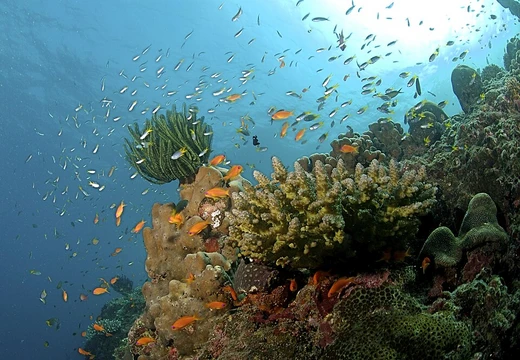
Tubbataha Reef
A pristine atoll reef sanctuary in the Sulu Sea.

Tubbataha Reef, also known as the Tubbataha Reefs Natural Park, is a protected marine and bird sanctuary located in the middle of the Sulu Sea, Philippines. It consists of two large atolls (North Atoll and South Atoll) and the smaller Jessie Beazley Reef, covering a total area of 97,030 hectares. It is notable for being a UNESCO World Heritage Site, a Ramsar wetland of international importance, and part of the Coral Triangle, recognized as a center of marine biodiversity.
Quick Facts
- Location
- Cagayancillo, Palawan, Philippines
- Criteria
- (vii), (ix), (x)(vii), (ix), (x)
- Year
- 1993
- Extension
- 2009
- Area
- 96828 ha
Facts from the source article.
Lore & Background
The word 'tubbataha' combines two Sama–Bajau words meaning 'a long reef exposed at low tide.' Historically, the Sama-Bajau people and inhabitants of Cagayancillo visited the reef. The atolls are situated on the Cagayan Ridge, an extinct underwater volcano, and were formed as fringing reefs around volcanic islands, following Charles Darwin's theory of atoll formation. The uninhabited islands lack freshwater, preventing permanent settlement. In the 1980s, increased motorized fishing led to overfishing and destructive practices like cyanide and dynamite fishing, prompting environmentalists and divers to campaign for protection. President Corazon Aquino declared the area a national marine park in 1988, and it was expanded in 2006 to include Jessie Beazley Reef, reclassified as a natural park. The park is guarded by armed rangers 24/7, housed in a styrofoam-reinforced concrete structure on the Southeast Islet.
Reader's Guide
Tubbataha Reef's significance lies in its status as a pristine coral reef ecosystem within the Coral Triangle, containing 75% of described coral species and 40% of the world's reef fish. It was declared a UNESCO World Heritage Site in 1993 for being a unique atoll reef with high marine species density, a spectacular 100-meter perpendicular wall, extensive lagoons, and nesting sites for birds and turtles. Ramsar listed it in 1999 as a wetland of international importance. The reef hosts over 600 fish species, 360 coral species, 11 shark species, 13 dolphin and whale species, and 100 bird species, and serves as a nesting ground for Hawksbill and Green sea turtles. It is managed by the Tubbataha Management Office in Puerto Princesa, with rotating rangers from the Philippine Navy, Coast Guard, and local municipality. In 2015, it was declared an ASEAN Heritage Park, and in 2017, a Particularly Sensitive Sea Area by the International Maritime Organization. The reef faces threats from overfishing and destructive practices, but its isolation and enforcement help preserve it.
Did You Know?
- Tubbataha Reef is located 150 kilometers southeast of Puerto Princesa, Palawan.
- The park was first declared a national marine park on August 11, 1988, by President Corazon Aquino.
- It contains at least 600 fish species and 360 coral species.
More in Coral Reefs, Part 2 1-24
Spotted an error? Know more?
Reader corrections go straight into our review queue. Suggest an edit · How this site is sourced