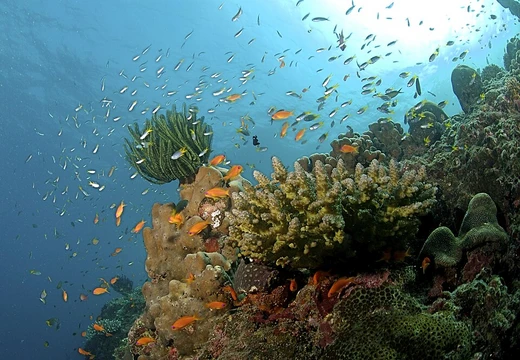
Marine wildlife of Baa Atoll
A UNESCO Biosphere Reserve since 2011, rich in corals and marine life.

Baa Atoll is a circular archipelago in the Maldives, forming the southern part of Maalhosmadulu Atoll and serving as an administrative division. In 2011, UNESCO designated it a biosphere reserve. The atoll measures about 38 by 46 kilometers, with a total area of 1,127 square kilometers. Its emerged land, however, covers only 5.5 square kilometers—sandy islands that rise no higher than 3.19 meters, and half of them are smaller than 10 hectares. The administrative subdivision of Baa houses 11,910 residents spread across 13 of its 75 islands, with 8 others operating as island resorts; the capital is Eydhafushi.
The shallow waters here are exceptionally rich in coral and fish, as well as turtles and dolphins, making the atoll a popular spot for seaside and underwater tourism. The ecosystem boasts a very high rate of coral cover, highly diverse and dominated by table, digitate, and branched corals of the genus *Acropora*. Large marine animals like manta rays and whale sharks add spectacular encounters to the area’s natural beauty. Scientific studies indicate that the faunistic composition can vary greatly between neighboring atolls, particularly regarding benthic fauna.
- Location
- Baa Atoll, Maldives (southern part of Maalhosmadulu Atoll)
- Area
- 1,127 km2
- Dimensions
- approximately 38 km by 46 km
- Emerged land
- 5.5 km2
- Maximum island height
- 3.19 m
- Population
- 11,910 inhabitants
- Capital
- Eydhafushi
Lore & Background
The shallow waters of Baa Atoll are particularly rich in coral and fish, as well as turtles and dolphins, making it a favored place for seaside and underwater tourism. The ecosystem is characterized by a very high rate of coral cover, highly diverse and dominated by table, digitate and branched corals of the genus Acropora. The presence of huge animals such as manta rays and whale sharks add spectacular encounters to the beauty of the place.
Reader's Guide
The marine wildlife of Baa Atoll is notable for its designation as a UNESCO Biosphere Reserve in 2011, highlighting its ecological importance. The atoll's shallow waters support a very high rate of coral cover, dominated by Acropora corals, and a diverse fish population. Scientific studies suggest that the faunistic composition can vary greatly between neighbor atolls, especially in terms of benthic fauna. The atoll's rich marine life, including turtles, dolphins, manta rays, and whale sharks, has made it a destination for underwater tourism. The administrative subdivision of Baa shelters 11,910 inhabitants distributed on 13 of the 75 islands, with 8 other islands being island resorts; the capital is Eydhafushi. The atoll's emerged land consists of sandy islands not higher than 3.19 m, half of which do not exceed an area of 10 hectares.
Did You Know?
- Baa Atoll was named a UNESCO Biosphere Reserve in 2011.
- The atoll covers 1,127 km2 but has only 5.5 km2 of emerged land.
- Manta rays and whale sharks are among the large animals found in the atoll.
Geographic Framework of a Tiny Archipelago
Baa Atoll occupies the southern portion of Maalhosmadulu Atoll in the Maldives, forming a circular ring of islands roughly 38 by 46 kilometers in extent. Despite enclosing a surface area of 1,127 square kilometers, the atoll shelters a remarkably small amount of dry land—just 5.5 square kilometers of sandy islands, none rising above 3.19 meters. Of the 75 islands that make up the archipelago, half cover no more than 10 hectares. Human settlement is concentrated on only 13 of these islands, home to 11,910 residents, with Eydhafushi serving as the administrative capital. An additional eight islands have been developed as resort properties. This extreme contrast between the vast surrounding lagoon and the minuscule landmass creates a marine environment where the underwater world dwarfs the terrestrial one, making the atoll's waters the true subject of its ecological story.
A Coral-Dominated Underwater Landscape
The shallow waters surrounding Baa Atoll host an ecosystem distinguished by an exceptionally high rate of coral cover. The reef community is highly diverse and structurally dominated by table, digitate, and branched growth forms of the genus Acropora, giving the seafloor a complex three-dimensional architecture. Beyond corals, the atoll supports rich assemblages of reef fish, sea turtles, and dolphins. Perhaps most spectacularly, the waters are frequented by large pelagic visitors such as manta rays and whale sharks, whose presence transforms routine dives into extraordinary encounters. Scientific research indicates that the faunistic composition—particularly the benthic fauna—can differ markedly even between neighboring atolls, suggesting that Baa's specific combination of species represents a locally distinct assemblage rather than a generic Maldivian reef community.
UNESCO Recognition and Scientific Interest
In 2011, UNESCO designated Baa Atoll as a Biosphere Reserve, formally acknowledging the ecological significance of its marine environment. This designation placed the archipelago within the broader Man and the Biosphere framework, linking local conservation to international scientific and educational objectives. The atoll has since become a focus for biodiversity research, with comprehensive studies examining its species composition, resource use, and conservation needs. A key reference in this field is the 2012 Atoll Research Bulletin volume edited by Serge Andréfouët, which documents the biodiversity, resources, and conservation challenges of the reserve. The scientific literature also draws on foundational works such as Veron's Corals of the World, Lieske and Myers' guide to coral reef fishes, and Coleman's Marine Life of the Maldives, all of which provide taxonomic and ecological context for the atoll's inhabitants.
Tourism, Conservation, and Coexistence
The very qualities that make Baa Atoll ecologically remarkable—its shallow, coral-rich waters and the presence of charismatic megafauna—have also established it as a premier destination for seaside and underwater tourism. The atoll's eight resort islands cater to visitors seeking close encounters with manta rays, whale sharks, turtles, and dolphins amid vibrant Acropora-dominated reefs. This tourism economy coexists with the administrative reality of 11,910 residents spread across 13 inhabited islands, creating a landscape where human livelihoods, resort development, and marine conservation intersect. The 2011 UNESCO Biosphere Reserve designation adds a layer of international stewardship to this dynamic, encouraging management approaches that balance recreational access with the preservation of the atoll's high coral cover and its locally distinct benthic communities. The challenge, inherent to any small archipelago of just 5.5 square kilometers of land, is ensuring that the marine environment sustaining both residents and visitors remains intact.
Frequently Asked Questions
What is Baa Atoll and where is it located?
Baa Atoll is a circular island chain in the Maldives that forms the southern portion of the larger Maalhosmadulu Atoll. It also functions as an administrative district within the country's atoll-based governance system.
How large is Baa Atoll compared to other Maldivian atolls?
The atoll spans roughly 38 by 46 kilometers, giving it a total area of about 1,127 square kilometers. Despite that footprint, only 5.5 square kilometers of land actually breaks the water's surface, making it one of the most ocean-dominated atolls in the region.
Why is Baa Atoll's marine wildlife considered special?
UNESCO granted Baa Atoll Biosphere Reserve status in 2011 specifically because of its extraordinary diversity of coral species and associated marine life. The shallow, warm lagoons surrounding the low-lying islands create ideal nursery and feeding grounds for a wide range of reef organisms.
How many people live on Baa Atoll and how are the islands used?
About 11,910 residents call the atoll home, spread across 13 of its 75 islands. Eight additional islands operate as tourist resorts, while the vast majority remain uninhabited and serve as habitat for marine and coastal ecosystems.
What do the islands of Baa Atoll actually look like?
The emerged land consists of low sandy islets that rise no more than 3.19 meters above sea level, with half of them covering less than 10 hectares. This extremely low elevation means the islands sit just above the surrounding reef flat, making the boundary between land and lagoon remarkably thin.
More in Coral Reefs, Part 2 1-24
Spotted an error? Know more?
Reader corrections go straight into our review queue. Suggest an edit · How this site is sourced