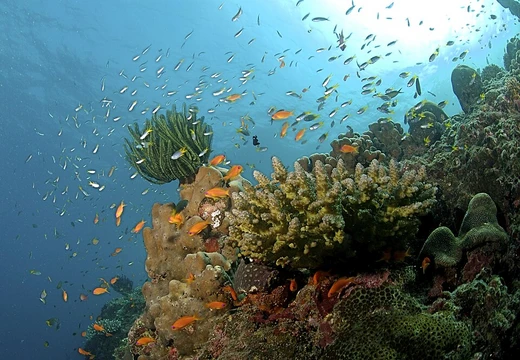
Mesophotic coral reef
Mesophotic reefs are light-dependent ecosystems at middle depths.

A mesophotic coral reef, also called a mesophotic coral ecosystem (MCE), gets its name from the Latin *meso* (middle) and *photic* (light). These reefs exist in waters deeper than typical coral reefs, where light levels range from bright to nearly absent, and they host both light-dependent corals and algae alongside organisms adapted to dim conditions. The term MCE is now widely used to avoid confusion with older, interchangeable labels like "deep coral reef communities" or "twilight zone."
Many fish and coral species are found only in MCEs, making these ecosystems vital for global biodiversity. They also act as a possible refuge for shallow-water corals and sponges. Recent advances in technology—such as remotely operated vehicles (ROVs) and autonomous underwater vehicles (AUVs)—have allowed scientists to study and monitor these hard-to-reach environments. MCEs serve as a transition zone between shallow and deep-sea habitats, creating a specialized and unique mix of life. They typically occur between 30 and 150 meters (roughly 100 to 490 feet) deep in tropical and subtropical waters. The community is divided into an upper zone (30 to 60 meters) and a lower zone (60 to 150 meters), with light and temperature being the main factors shaping these layers. In places like American Samoa, mesophotic reefs hold 80% of the corals, while the rest live in shallow reefs. Although MCEs are found worldwide, they remain mostly understudied, with limited knowledge about their species, depth ranges, habitat preferences, and distribution.
**Species**
The most common organisms in mesophotic reefs are corals, sponges, and algae. These corals can overlap with deep-water corals but are distinguished by their symbiotic zooxanthellae and need for light. Scientists once thought MCEs were just an extension of shallow-water reefs, and some coral species do cross between the two. However, studies show that MCEs host distinct habitats and communities of corals, sponges, and fish that differ significantly from their shallow-water relatives. In the Red Sea, two *Alveopora* coral species are found only in mesophotic zones. Other unique MCE residents include *Symbiodinium* algae, brachyuran crabs, the coral *Porites astreoides*, and *Acropora tenella*. Some species live in both shallow and mesophotic reefs but are more abundant or have higher reproductive output in the deeper zone.
- Depth range
- 30 to 40 meters (130 ft) up to 150 meters (490 ft)
- Upper mesophotic
- 30 m to 60 m
- Lower mesophotic
- 60 m to 150 m
- Coral cover in american samoa
- 80% of corals in mesophotic reefs, rest in shallow reefs (30 m to 0 m)
- Ideal temperature range
- 23 to 29 °C
- Temperature limit for survival
- 15 to 16 °C
- Temperature difference from surface
- around 5 °C
Lore & Background
Mesophotic coral ecosystems occur in tropical and subtropical waters, normally between 30 and 40 meters up to 150 meters in depth. They serve as a transition zone between shallow and deep-sea environments, creating specialized and unique biodiversity. Community zonation is driven primarily by light and temperature, broadly corresponding to the upper mesophotic (30 m to 60 m) and lower mesophotic (60 m to 150 m). In some areas, such as American Samoa, mesophotic reefs contain 80% of corals while the rest inhabit shallow reefs. These ecosystems are distributed globally but remain mostly understudied, with limited basic information on taxonomic composition, depth range, habitat preferences, and abundance.
The oldest known mesophotic coral ecosystems have been described from the Silurian of Sweden, and such ecosystems are also known from the Devonian. The oldest scleractinian-dominated mesophotic ecosystems are known from the Triassic. Historically, research on mesophotic coral reefs was limited until the 20th century due to the difficulty of observing them. Advances in technologies such as remotely operated underwater vehicles (ROVs) and autonomous underwater vehicles (AUVs) have enabled further research and monitoring.
Reader's Guide
Mesophotic coral reefs are significant as a crucial part of coral reef systems, serving as a potential refuge area for shallow coral reef taxa such as coral and sponges. Many species of fish and corals are endemic to MCEs, making these ecosystems a crucial component in maintaining global diversity. The mesophotic zone also serves as a transition zone between shallow and deep-sea environments, creating specialized and unique biodiversity. Due to recent anthropogenic impacts, it was thought that MCEs are less affected by human development and climate change and could be used as a source for reseeding shallow water coral species. However, recent analyses show that mesophotic ecosystems face significant impacts from climate change. Research on these reefs remains highly biased by location and region, with the best studied areas being the northern coast of Jamaica, the Bahamas, the northern Gulf of Mexico, and Puerto Rico. The Pacific mesophotic coral reefs remain understudied, and little to no research has been conducted in the regions of South East Asia and India.
Did You Know?
- The term 'mesophotic' comes from Latin 'meso' (middle) and 'photic' (light).
- In the Red Sea, two species of Alveopora are exclusively found in the mesophotic region.
- Sponges become the dominant species at depths over 50 meters in mesophotic reefs.
- Internal waves can cause temperature fluctuations in mesophotic reefs from 10 to 20 °C.
Naming, Depth, and Global Reach
The term mesophotic draws from Latin roots meaning middle and light, capturing the essence of ecosystems that exist in waters where light penetration is reduced yet still present. The preferred modern designation, mesophotic coral ecosystem, was adopted to replace ambiguous labels such as deep coral reef communities or twilight zone, which had become muddled through interchangeable use. These ecosystems typically span from roughly 30 to 40 meters down to about 150 meters in tropical and subtropical waters, encompassing a gradient from brightly lit upper zones to areas where sunlight barely penetrates. While distributed globally, they remain largely understudied, with basic information on taxonomic composition, depth ranges, habitat preferences, and species abundance still limited. Community zonation within these reefs is primarily governed by light availability and temperature, broadly dividing the upper mesophotic layer from the lower mesophotic layer. In some locations, such as American Samoa, mesophotic reefs harbor up to eighty percent of all corals, while the remaining twenty percent occupy the shallow zone above thirty meters.
Endemic Life and the Transition Zone
Mesophotic coral ecosystems function as a biological bridge between shallow reef habitats and the deep sea, fostering a specialized biodiversity that sets them apart from both. Many coral, sponge, and fish species are endemic to these mid-depth waters, having been outcompeted in shallower zones by faster-photosynthesizing taxa. In the Red Sea, two Alveopora species exist exclusively in the mesophotic range, while other unique inhabitants include Symbiodinium, Brachyuran crabs, Porites astreoides, and Acropora tenella. Predatory fish such as sharks, groupers, and snappers call the mesophotic zone home but migrate daily into shallower waters to hunt. These corals also carry zooxanthellae and require light, distinguishing them from deep-water coral species despite overlapping depth ranges. The oldest known mesophotic ecosystems date to the Silurian period in Sweden, with scleractinian-dominated examples appearing in the Triassic, underscoring their ancient evolutionary significance.
Reef Builders: Sponges, Algae, and Corals
Beyond corals, which form the structural backbone of mesophotic reefs, two other groups play pivotal ecological roles. Sponges rank as the second most dominant taxon in many coral reefs and are largely dependent on planktonic food, both dissolved and particulate, drawn in as water passes through their bodies. They are primarily mixotrophic or heterotrophic, prefer colder water, and thus become crucial inhabitants of the lower mesophotic zone. Their filter-feeding activity generates benthic diversity and creates essential habitat for invertebrates and fish. Many sponge species in mesophotic ecosystems differ from their shallow-water relatives and remain undescribed. Macroalgae, encompassing red, brown, and green forms, contribute by capturing carbon and producing oxygen. Their distribution in mesophotic reefs is shaped by temperature gradients, with a preference for warmer conditions, and by the availability of carbon, nitrogen, and photosynthetic potential. Competition between macroalgae and coral communities can contribute to coral bleaching, highlighting the delicate balance within these mid-depth habitats.
Research Frontiers and Conservation Concerns
For decades, mesophotic coral ecosystems were considered relatively insulated from human development and climate change, leading researchers to view them as potential refuges where shallow-reef corals and sponges could find shelter. They were even proposed as sources for reseeding degraded shallow-water reefs. However, recent analyses have revealed that these mid-depth habitats face significant climate-change impacts, complicating their role as sanctuaries. Advances in remotely operated underwater vehicles and autonomous underwater vehicles have opened new windows into these hard-to-reach environments, enabling more detailed research and ongoing monitoring. Despite this technological progress, fundamental knowledge gaps persist: taxonomic composition, precise depth ranges, habitat preferences, and the abundance and distribution of species remain poorly documented across most of the globe. The fact that these ecosystems have existed since at least the Silurian period, yet remain mostly understudied, underscores both their scientific importance and the urgency of filling these knowledge gaps before conditions shift further.
Frequently Asked Questions
Who is Mesophotic coral reef?
Mesophotic coral reef is a marine ecosystem occupying the intermediate depth band of the ocean, where sunlight fades from moderate to nearly zero. Its name blends the Greek 'meso' (middle) with 'photic' (light) to flag this transitional zone between shallow reefs and the deep sea.
What are Mesophotic coral reef's powers/role?
It acts as a biodiversity reservoir, harboring numerous fish and coral species that occur nowhere else in the ocean. It also serves as a refuge for shallow-reef organisms during thermal stress, because the slightly cooler, dimmer water at depth buffers against the worst of bleaching events.
Why is Mesophotic coral reef important?
In regions such as American Samoa, about 80 percent of all coral biomass is found on mesophotic reefs rather than in the shallow zone, making it the dominant coral habitat there. Globally, it adds an entire layer of species richness that would be lost if conservation efforts focused only on shallow reefs.
Where does Mesophotic coral reef live?
It spans roughly 30 to 150 meters (130–490 ft) below the surface, with the upper mesophotic zone covering 30–60 m and the lower mesophotic zone extending from 60 m to 150 m. This places it squarely between the sunlit shallow reef and the aphotic deep sea.
More in Coral Reefs, Part 2 1-24
Spotted an error? Know more?
Reader corrections go straight into our review queue. Suggest an edit · How this site is sourced