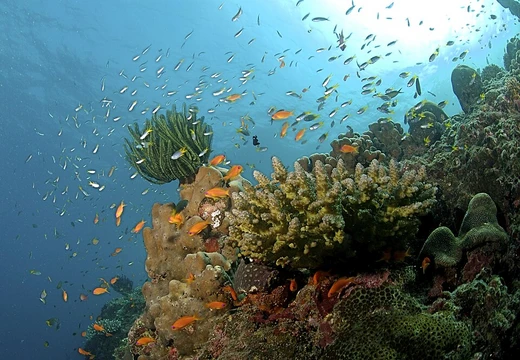
Mexico Rocks
A shallow patch reef complex of boulder star corals off Ambergris Caye.

Mexico Rocks sits in the Caribbean Sea as part of the Belize Barrier Reef system, just off the far northern tip of Ambergris Caye. This shallow complex is made up of about 100 Holocene patch reefs that cluster atop a Pleistocene limestone ridge, with boulder star corals (Montastraea annularis) dominating the composition. The reef built up in water only 2.5 to 5 metres deep over the last 420 years, under stable sea levels. First recommended for marine preserve status in 1978, it was finally approved in 2015 as a section of the Hol Chan Marine Reserve. Snorkelers and SCUBA divers frequent the site, which is considered a key addition to Ambergris Caye’s ecotourism offerings.
Patch reefs made mostly of Montastraea annularis are unusual in Belize—the only other similar formations are at Glover’s Reef. Staghorn coral (Acropora cervicornis) grows on both the windward and leeward sides of the ridge. In total, thirty species of hard coral have been recorded at Mexico Rocks. The reef teems with fish and invertebrates. Common fish include Atlantic blue tang (Acanthurus coeruleus), yellowtail snapper (Ocyurus chrysurus), and southern stingray (Dasyatis americana). Nurse sharks (Ginglymostoma cirratum) and green moray eels (Gymnothorax funebris) also appear. Spiny lobster, conch, arrow crab, banded shrimp, and many sponge species live there as well.
- Location
- off the far northern tip of Ambergris Caye, Belize Barrier Reef system, Caribbean Sea
- Number of patch reefs
- approximately 100
- Depth
- 2.5 to 5 metres (8 to 16 ft)
- Age of accumulation
- over the last 420 years
- Sea level conditions
- static
- Year recommended as marine preserve
- 1978
- Year approved as part of hol chan marine
- 2015
Lore & Background
Mexico Rocks is a shallow patch reef complex located off the far northern tip of Ambergris Caye, part of the Belize Barrier Reef system. The site consists of approximately 100 Holocene patch reefs clustered on a Pleistocene ridge of limestone and is composed predominantly of boulder star corals (Montastraea annularis). The reef has accumulated in shallow water, about 2.5 to 5 metres deep, over the last 420 years, under static sea level conditions. The site was recommended for designation as a marine preserve in 1978, and was approved in 2015 as a part of the Hol Chan Marine Reserve. The reef is popular among snorkelers and SCUBA divers, and it is seen as an important addition to Ambergris Caye's ecotourism attractions.
Reader's Guide
Mexico Rocks is significant as a rare occurrence of patch coral reefs predominantly consisting of Montastraea annularis in Belize; the only other such patch reefs in the country are located at Glover's Reef. The site also hosts staghorn coral (Acropora cervicornis) on the ridge's windward and leeward flanks, and thirty species of hard coral have been identified there. The reef is abundant in fish and invertebrate life, including Atlantic blue tang, yellowtail snapper, southern stingray, nurse sharks, green moray eel, spiny lobster, conch, arrow crab, banded shrimps, and many sponge species. Its legacy includes being recommended as a marine preserve in 1978 and approved in 2015 as part of the Hol Chan Marine Reserve, and it is popular among snorkelers and SCUBA divers, contributing to Ambergris Caye's ecotourism attractions.
Frequently Asked Questions
What is Mexico Rocks?
Mexico Rocks is a shallow coral reef complex in the Caribbean Sea, positioned just off the northernmost point of Ambergris Caye within the Belize Barrier Reef network. It consists of roughly 100 small patch reefs that rest on an older Pleistocene limestone foundation.
How deep is Mexico Rocks and what does it look like?
The reef complex sits in water ranging from about 8 to 16 feet deep, making it very accessible for snorkelers and recreational divers. The dominant coral species is the boulder star coral (Montastraea annularis), which gives the site its characteristic rocky, boulder-strewn appearance.
How old is Mexico Rocks?
The coral accumulation at this site has been building over roughly 420 years, during a period of stable sea levels. These Holocene patch reefs grew on top of a much older Pleistocene limestone ridge.
Is Mexico Rocks a protected area?
Yes, it became part of the Hol Chan Marine Reserve in 2015, after being first proposed for conservation status back in 1978. This long gap between recommendation and approval means the site spent nearly four decades without formal protection.
Why is Mexico Rocks popular with divers?
Its shallow depth of 2.5 to 5 metres makes it one of the most approachable reef sites in the Belize Barrier Reef system, ideal for both snorkelers and SCUBA divers. The dense clustering of about 100 patch reefs creates a compact, easy-to-navigate underwater landscape.
More in Coral Reefs, Part 2 1-24
Spotted an error? Know more?
Reader corrections go straight into our review queue. Suggest an edit · How this site is sourced