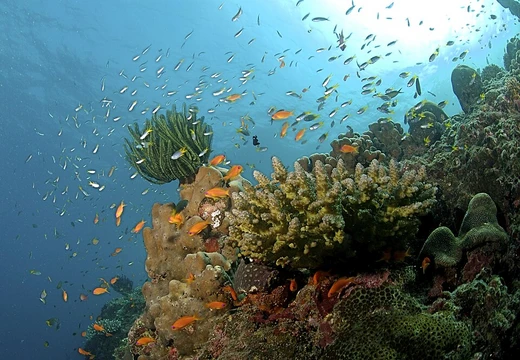
Leaf plate montipora
A common SPS coral forming flat plating colonies.

Montipora capricornis, called the leaf plate montipora, vase coral, cap coral, or plating montipora, is a small polyp stony (SPS) coral belonging to the family Acroporidae. It grows into flat, plate-like colonies that expand by adding to their base and spreading outward. The individual polyps look like small bumps on the skeleton’s surface; at night, they emerge to feed on plankton. These polyps are usually transparent with faint patches of color from zooxanthellae, the symbiotic algae living inside the coral’s tissue.
This coral is very common in the Indian and Pacific Oceans and in Red Sea reefs. It typically lives in the upper half of the reef where photosynthesis can happen, and it will extend from its foundation toward areas with enough sunlight. It inhabits coral reefs and prefers warm, sunny temperatures.
In the aquarium trade, M. capricornis is one of the more common SPS corals and comes in red, green, and orange color variations. It is considered a good beginner’s SPS coral because it is more tolerant of less-than-ideal conditions than its relative Acropora. In captivity, it prefers a reef aquarium with a stable water temperature between 75 and 80 °F (24 to 27 °C). It does best under strong lighting, such as metal halides, though even modest compact fluorescent lighting can be sufficient.
Quick Facts
- Taxon
- Montipora capricornis
Facts from the source article.
Lore & Background
M. capricornis forms flat, plating colonies that expand by adding to their foundations and further spreading out. The individual polyps appear as small bumps on the surface of the skeleton; at night, they emerge to feed on plankton. The polyps are usually transparent with slight patches of color due to zooxanthellae, symbiotic algae living in the coral's tissue.
This coral is very common in the Indian and Pacific oceans, as well as in reefs of the Red Sea. It usually inhabits the top half of the reef where photosynthesis can occur, and will branch out from its foundation into an area with adequate sunlight. It lives in coral reefs and enjoys warm sunny temperatures.
In the aquarium trade, M. capricornis is one of the more common SPS corals available, coming in red, green, and orange color variations. It is considered a good beginner's SPS coral because it is much more tolerant of under-ideal conditions than its relative, Acropora.
Reader's Guide
M. capricornis holds significance as a very common species of coral, particularly in the Indian and Pacific oceans and the Red Sea, where it typically inhabits the top half of the reef to maximize photosynthesis. Its ability to branch out toward adequate sunlight underscores its adaptation to reef environments. In the aquarium trade, it is notable as one of the more common SPS corals available, offered in red, green, and orange color variations. Its legacy as a good beginner's SPS coral stems from its greater tolerance of under-ideal conditions compared to its relative Acropora. For captive care, it prefers a stable water temperature of 75 to 80 °F (24 to 27 °C) and strong lighting such as that from metal halides, though even modest compact fluorescent lighting can be sufficient. This coral's widespread availability and hardiness have made it a staple in reef aquariums, allowing hobbyists to keep a representative of the Acroporidae family with relative ease.
Shaped by Tides and Trade Winds
Nikumaroro stretches roughly seven and a half kilometres in length and two and a half in width, forming a remote triangular coral atoll in the western Pacific. Its rim is punctuated by two narrow gateways: Tatiman Passage, still threaded by tidal currents, and Baureke Passage, which once channeled water but now lies dry. A broad fringing reef lines both entrances, revealing a coral beach whenever the sea retreats. Beyond that reef the ocean plunges to great depth, making anchoring a delicate affair. The sole reliable anchorage sits at the atoll's western tip, across the reef from the crumbling remnants of Karake, a mid-twentieth-century British colonial settlement. Even there, safety depends on the southeast trade winds, and landing parties have historically found it easier to approach from the south. On occasion, larger vessels have moored beside the hull of the SS Norwich City, which struck the reef in 1929. Above the waterline, dense Pisonia forest and thick scrub blanket the land, their canopies reaching fifteen metres and shedding decomposing leaf litter into the soil. Coconut palms dot the landscape, survivors of plantation ventures attempted in the 1890s and again between 1938 and 1963.
A Living Reef in an Iron-Poor Sea
The waters surrounding Nikumaroro shelter a remarkable diversity of marine life, and the atoll's coral communities have been the subject of careful scientific survey. In 2000, David Obura and his team documented live coral cover ranging from twenty-five to forty percent on the leeward reef, with some shallow platforms exceeding seventy-five percent. Windward sites showed roughly seventy percent coverage, while the steeper lower slope held about thirty percent, dominated by Halimeda and plates of Porites rus. Among the most abundant coral species recorded were staghorn corals of the family Acroporidae, Acropora cytherea, Montipora efflorescens, Favites pentagona, Leptastrea purpurea, Pocillopora verrucosa, and two Pavona species. The region is naturally iron-poor, yet the 1929 wreck of the SS Norwich City and other anchor gear have leached iron into the water, fueling turf algae, benthic bacterial blooms, and what researchers call black reefs. Monitoring between 2000 and 2015 tracked this degradation spreading a full kilometre northward from the wreck site. Beyond the reef, sharks, bottlenose dolphins, coconut crabs, and large colonies of red-tailed tropicbirds all call the area home.
Names, Claims, and Failed Colonies
Before it bore the name Nikumaroro, the atoll appeared on early charts under a confusing array of labels: Kemins' Island, Kemis Island, Motu Oonga, Motu Oona, and Mary Letitia's Island. The first documented European sighting came in 1824, when Captain C. Kemiss aboard the British whaler Eliza Ann noted the atoll. In 1840, the USS Vincennes of the U.S. Exploring Expedition confirmed its position and recorded the name Gardner Island, a designation originally applied in 1825 by Joshua Coffin of the Nantucket whaler Ganges; some accounts credit U.S. Congressman Gideon Gardner, the vessel's owner. In 1856, a Connecticut firm staked a claim under the American Guano Islands Act, though no guano was ever actually harvested. The United Kingdom asserted sovereignty on 28 May 1892 during a visit by HMS Curacoa, and a licence was promptly issued to a Pacific entrepreneur. More ambitiously, Britain attempted to colonize the island between 1938 and 1963, a project that ultimately collapsed under the weight of the atoll's severe fresh-water scarcity. Today the island stands uninhabited, its colonial village of Karake reduced to ruins.
Whispers of the Past: Earhart and the Ancient Settlers
Perhaps no remote Pacific atoll has captured the public imagination quite like Nikumaroro. Since July 1937, when pilot Amelia Earhart and navigator Fred Noonan vanished during their attempt to circumnavigate the globe, the island has been the focus of intense speculation and repeated expeditions. In 1989, the TIGHAR team identified what they interpreted as fish traps and a basalt adze on the shore, evidence they linked to long-forgotten Pacific inhabitants. More recently, trace artifactual and osteological material has surfaced that appears more consistent with a Euro-American woman castaway than with any previously known resident or visitor. Yet no aircraft wreckage and no definitive proof of Earhart's specific presence has ever been recovered from the island or its surrounding waters. The prehistoric record is equally thin. Nearby atolls such as Manra and Orona show settlements dating to roughly 1000 BC, with basalt artifacts traced to Samoa, the Marquesas, and the Cook Islands. Evidence suggests two distinct settler groups, one eastern Polynesian and one Micronesian, may have reached Nikumaroro, though the archaeological trail remains slim and unsubstantiated.
Frequently Asked Questions
What is Leaf plate montipora?
Leaf plate montipora is the common name for Montipora capricornis, a small polyp stony coral in the family Acroporidae. It is also widely known as vase coral, cap coral, or plating montipora.
How does Leaf plate montipora grow and what does it look like?
It builds flat, plate-shaped colonies by adding new material at the base and spreading outward over time. The individual polyps appear as tiny bumps on the skeleton surface and are usually transparent, showing faint color patches from the symbiotic zooxanthellae living in the tissue.
Where can I find Leaf plate montipora in the wild?
This species is very common throughout the Indian and Pacific Oceans as well as the Red Sea. It typically occupies the upper half of the reef where sufficient light reaches for photosynthesis.
How does Leaf plate montipora feed?
By day it depends on photosynthesis performed by the zooxanthellae embedded in its tissue, but once night falls the polyps extend outward to capture plankton drifting through the water.
What water temperature and color variations does Leaf plate montipora have?
It prefers water between 75 and 80 °F (24 to 27 °C). In the wild, colonies display a range of hues including red, green, and orange.
More in Coral Reefs, Part 2 1-24
Spotted an error? Know more?
Reader corrections go straight into our review queue. Suggest an edit · How this site is sourced