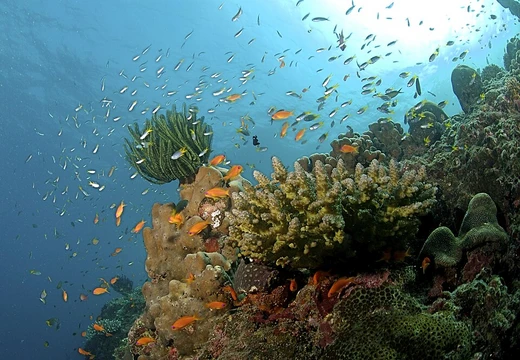
Southeast Asian coral reefs
Southeast Asian coral reefs are the most biodiverse marine ecosystems on Earth.

Southeast Asia’s coral reefs are the most biologically diverse marine ecosystems on Earth. They provide a living for subsistence fishers and are also used for jewelry and construction materials. Corals grow in coastal waters on every continent except Antarctica, with the greatest concentration of reefs found along the shores of Indonesia, the Philippines, and Thailand. These structures are built from the carbonate skeletons of various animals and algae, gradually accumulating over time until they reach the ocean’s surface. Reefs thrive in shallow, warm saltwater where sunlight penetrates clear water, enabling microscopic organisms to live and reproduce. The reefs themselves are made up of tiny, fragile animals called coral polyps. Their biodiversity is crucial: even as fish numbers decline, the remaining reefs host more unique sea creatures than any other environment. In Southeast Asia, an estimated 70 to 90 percent of caught fish depend on coral reefs, and these ecosystems support over a quarter of all known marine species.
Despite their importance, Southeast Asian coral reefs face severe threats. Overfishing, sedimentation, pollution, bleaching, ocean acidification, and human activities all take a toll. Bleaching occurs when rising sea temperatures force corals to expel the algae living in their tissues, turning them white and often leading to death. Ocean acidification, driven by increased carbon dioxide absorption, weakens coral skeletons and slows their growth. Coastal development and tourism further damage these fragile ecosystems, sometimes irreversibly. Urgent conservation is needed to protect the reefs and the countless marine species that rely on them.
In Indonesia, the marine area covers 2,915,000 square kilometers, with 51,020 square kilometers of reef—17 percent of the world’s total. Of that, 82 percent is at risk. Although blast fishing has been illegal since 1985 and cyanide fishing since 1995, both continue. Indonesia is also the world’s largest coral exporter, shipping about 500 tons per year. The COREMAP program works in 9 of Indonesia’s 32 provinces to combat reef destruction. Its goals include strengthening law enforcement, setting up monitoring and information systems for research, developing community-based management, improving institutional coordination, and raising public awareness to encourage sustainable use.
- Indonesia reef area sq km
- 51020
- Indonesia percent reef at risk
- 82
- Indonesia percent of world coral reef ar
- 17
- Philippines reef area sq km
- 26000
- Thailand reef area sq km
- 153
- Southeast asia fish dependent on reefs p
- 70-90
- Global marine species supported by reefs
- over 25
Lore & Background
Southeast Asian coral reefs have the highest levels of biodiversity for the world's marine ecosystems. They are developed by the carbonate-based skeletons of a variety of animals and algae, slowly building up to the surface in oceans. These reefs are found in shallow, warm salt water, where sunlight filters through clear water and allows microscopic organisms to live and reproduce. Coral reefs are actually composed of tiny, fragile animals known as coral polyps. An estimation of 70-90% of fish caught are dependent on coral reefs in Southeast Asia and reefs support over 25% of all known marine species.
Despite their importance, Southeast Asian coral reefs are under severe threat from various factors, including overfishing, sedimentation, pollution, bleaching, ocean acidification, and human impacts. Bleaching events, triggered by rising sea temperatures, cause corals to expel the algae living in their tissues, leading to their whitening and eventual death. Ocean acidification, resulting from increased carbon dioxide absorption, weakens coral skeletons and hinders their growth. Human activities, such as coastal development and tourism, further exacerbate the degradation of coral reefs, disrupting fragile ecosystems and causing irreparable damage.
In Indonesia, blast fishing (illegal since 1985) and cyanide fishing (illegal since 1995) still occur. Indonesia is the world's largest exporter of corals, exporting about 500 tons per year. The Philippines, with more than 7,000 islands, has about 26,000 square kilometers of coral reef. Thailand's coastline and 300 small islands are home to 153 square kilometers of coral. Large bleaching events in 1998 and 2010 resulted in massive loss of corals in the Gulf of Thailand, but some corals showed resilience and displayed lower mortality.
Reader's Guide
Southeast Asian coral reefs are significantly important because of their biodiversity. Although the number of fish are decreasing, the remaining coral reefs contain more unique sea creatures. The variety of species living on a coral reef is greater than anywhere else in the world. An estimation of 70-90% of fish caught are dependent on coral reefs in Southeast Asia and reefs support over 25% of all known marine species. These reefs serve many functions, such as forming the livelihood for subsistence fishermen and even function as jewelry and construction materials.
In the Philippines, coral reefs break waves from eroding the coastline, act as buffer zones decreasing the power of typhoons and hurricanes, and provide economic benefits through fishing and tourism such as diving tours and snorkeling. In Thailand, recognition of both the economic and ecological value of coral reefs and their rapid degradation due to tourism has led to consideration of new ways to protect reefs, including limiting tourist numbers and implementing fees. Coral restoration efforts, like the New Heaven Reef Conservation Program on Koh Tao, often incorporate the local community creating positive social change as well as ecological change.
Urgent conservation efforts are necessary to safeguard the future of Southeast Asian coral reefs and the countless marine species that depend on them. COREMAP is helping Indonesia with their combat against destruction of corals by working in 9 of the 32 provinces, aiming to heighten law enforcement, establish monitoring systems, develop community-based management, increase institutional capacity, and enhance public knowledge. The Philippines has established the Sumilon Island marine reserve, resulting in a marked comeback of fish in adjacent areas, and there is hope via boosts in ecotourism, though it is stifled by a limited budget and the challenge of patrolling 7,000 islands for destructive fishing techniques.
Did You Know?
- Indonesia holds 17% of the world's total coral reef areas.
- The first ever mass-bleaching event in the Philippines was reported in 1998–99.
More in Coral Reefs, Part 2 1-24
Spotted an error? Know more?
Reader corrections go straight into our review queue. Suggest an edit · How this site is sourced