Rigs-to-Reefs
Converting decommissioned oil rigs into artificial reefs.

Rigs-to-Reefs, or RTR, turns old offshore oil and petroleum rigs into artificial reefs after they are taken out of service. These underwater habitats have been made from oil platforms in the United States, Brunei, and Malaysia. The practice began in the U.S. and is most common there, where it operates as a national program run by the former Minerals Management Service (now the Bureau of Safety and Environmental Enforcement, part of the U.S. Department of the Interior).
The program is widely supported by fishers, the oil industry, and government regulators in the Gulf of Mexico, where platforms naturally develop into coral reefs. As of September 2012, 420 former oil platforms—about 10 percent of those decommissioned—had become permanent reefs. On the U.S. West Coast, opposition in California has blocked a rigs-to-reefs program. Environmental opposition has also prevented its use in the North Sea.
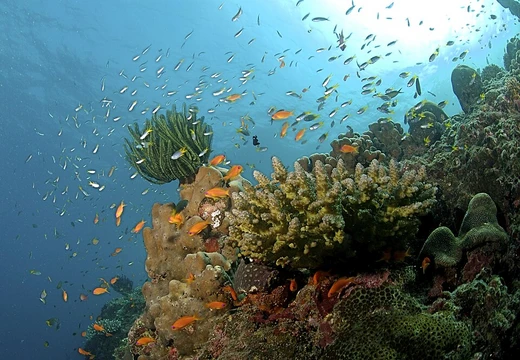
Marine life inevitably attaches to the underwater parts of oil platforms, turning them into artificial reefs. Platforms stay in use as long as the oil below them is profitable. Once they stop producing, they must be decommissioned and removed (within one year in the U.S.). Instead of full removal, the RTR program offers an alternative. All U.S. coastal states have artificial reef programs to boost ocean fisheries, but not all take part in RTR. The steel structures are stable and durable, creating shelter for marine life in open water where none existed before. (Note: Production platforms are often called “rigs,” though in the industry a “rig” specifically has a derrick for drilling and servicing wells; most production platforms lack such equipment.)
When a rig stops producing at economic rates, the site is typically abandoned. In the U.S., the Minerals Management Service requires removal within a year of abandonment and lease end, but it supports RTR as an alternative. The program recognizes that significant marine life has grown on and around the structure during its productive years. RTR preserves much of that life and encourages more growth. The operator saves the high cost of removal—cumulative removal costs reached an estimated $1 billion by 2000. The structure’s shape and complexity can also boost species diversity.
Decommissioning officially means removing the rig according to regulations, which includes flushing, plugging, and cementing wells for safety.
- Countries with rtr reefs
- United States, Brunei, Malaysia
- Us platforms converted as of september 2
- 420
- Percentage of decommissioned platforms c
- about 10 percent
- Estimated cumulative removal costs by 20
- $1 billion
- Louisiana artificial reef program donati
- $9.7 million
- Minimum explosive placement depth below
- 5 metres (16 ft)
Lore & Background
Offshore drilling began in California in the late 1800s from piers built out over the ocean. The United States began extracting oil offshore in the early 20th century and the first offshore oil platform in the Gulf of Mexico was built in 1947 off the Louisiana coast. The US Congress passed the Outer Continental Shelf Lands Act (OCSLA) in 1953, to control leasing of exploration rights in the Outer Continental Shelf. The 1969 Santa Barbara oil spill triggered the National Environmental Policy Act (NEPA), which required that every major federal action required an Environmental Impact Statement. In 1982, the U.S. Department of the Interior created the Minerals Management Service (MMS) to monitor development on the Outer Continental Shelf. In 1984 Congress passed the National Fishing Enhancement Act (NFEA) which provided the basis for artificial reef programs, spawning the National Artificial Reef Plan of 1985. This plan cleared the way for government-endorsed artificial reef projects and subsequently the MMS's Rigs-to-Reef program.
The program has been generally popular with fishers, the oil industry, and government regulators in the Gulf of Mexico, where offshore platforms develop into coral reefs. Opposition in California has prevented a rigs-to-reefs program on the West Coast of the US. Similarly, environmental opposition has prevented implementation of Rigs-to-Reefs in the North Sea. Following a number of hurricanes from 2004 to 2008 that damaged oil production platforms, the federal government placed a moratorium on Rigs-to-Reefs, requiring unused platforms to be speedily decommissioned by removal. In June 2013, the BSEE lifted its moratorium on Rigs-to-Reefs, subject to Coast Guard determination that the structure would not pose a threat to navigation, and acceptance of ownership and liability by the state government.
Reader's Guide
The Rigs-to-Reefs program represents a notable alternative to the complete removal of decommissioned oil platforms. In the United States, the Minerals Management Service (MMS) requires the operator to remove the rig within a year of abandonment and lease end, but MMS supports and encourages RTR as an alternative. The operator benefits by avoiding the substantial cost of removal, which had reached an estimated $1 billion by the year 2000. If the Rigs-to-Reefs option is expected to be less expensive than removal, the platform owner pays half the estimated savings to the state agency receiving the former platform. In Louisiana, costs and risk are the primary factors in determining how to decommission rigs; if savings are large enough, the operator typically chooses reefing and donates half the savings to maintain the reef. Decommissioning a shallow water rig typically costs $10–15 million. The Louisiana Artificial Reef program from its inception through 1998 received roughly $9.7 million in donations and has not taken taxpayer money. The more than 4,500 oil production platforms in the US portion of the Gulf of Mexico are the largest concentration of offshore platforms in the world, having more offshore platforms than the rest of the world combined, and have been called the largest artificial reef complex in the world. The first platform jacket was donated by Tenneco and towed from Louisiana to Pensacola.
Did You Know?
- As of September 2012, 420 former oil platforms, about 10 percent of decommissioned platforms, had been converted to permanent reefs in the United States.
- The shell mound surrounding a rig can contain toxic metals including arsenic, cadmium, chromium, copper, nickel, PCBs, lead, zinc, and poly-nuclear hydrocarbons.
More in Coral Reefs, Part 2 1-24
Spotted an error? Know more?
Reader corrections go straight into our review queue. Suggest an edit · How this site is sourced