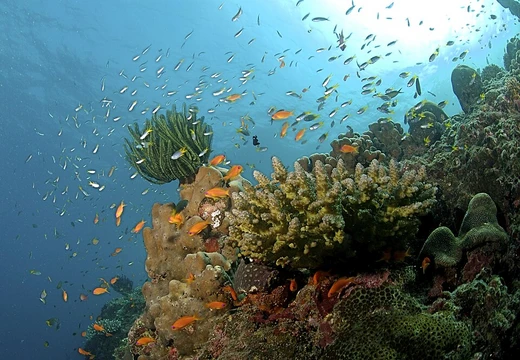
Pavona maldivensis
A variable stony coral with bright orange fluorescence.

Pavona maldivensis is a colonial stony coral belonging to the family Agariciidae. It can grow in encrusting, massive, or mixed forms, sometimes forming clumps over a meter across, though colonies smaller than 30 cm are more typical. On shallow reef slopes with strong wave action, it often develops cylindrical, finger-like branches; in calmer areas, it may form horizontal plates with leafy edges. Its corallites are circular, irregular in size, and have indistinct individual walls. The coral is usually grayish-brown or green, but can also appear bright orange.
Despite its name, which means "of the Maldives," this species is widely distributed across tropical and subtropical waters. Its range includes the Red Sea, Gulf of Aden, and Madagascar, through the southwestern and central Indian Ocean, northern Australia, southern Japan, the South China Sea, and into the western, central, and eastern Pacific Ocean.
As a zooxanthellate coral, *P. maldivensis* hosts symbiotic algae in its tissues that provide some of its nutrition. These algae contain chlorophyll, typically giving the coral brown or green hues. However, this species also contains an additional pigment, phycoerythrin, which absorbs light at one wavelength and re-emits it at another, producing a bright orange fluorescence in daylight.
In reef aquariums, *Pavona maldivensis* and related species are considered easy small stony corals, suitable for beginners.
Quick Facts
- Genus
- Pavona
- Species
- maldivensis
Facts from the source article.
Lore & Background
Pavona maldivensis can be encrusting or massive, or a mixture of the two, and can form clumps over a metre in diameter, although colonies smaller than 30 cm across are more usual. In areas with strong water movement they tend to form cylindrical, finger-like growths while elsewhere they may form horizontal plates, often with 'leafy' edges. The corallites are circular and of irregular sizes, and have individual but indistinct stony walls. This coral is usually some shade of greyish-brown or green but can be bright orange.
Though named 'of the Maldives' (maldivensis), P. maldivensis has a wide distribution in tropical and subtropical waters. Its range extends from the Red Sea, Gulf of Aden and Madagascar, through the southwestern and central Indian Ocean, northern Australia, southern Japan and the South China Sea, to the western, central and eastern Pacific Ocean.
Pavona maldivensis is a zooxanthellate species of coral; this means that its tissues contain symbiotic single celled algae which provide part of its nutritional requirements. These contain chlorophyll and tend to be some shade of brown or green, but in this coral there is an additional photosynthetic pigment, phycoerythrin. In daylight, this absorbs light at one wavelength and transmits it at another, giving a bright orange fluorescence.
Reader's Guide
Pavona maldivensis is significant as a widely distributed coral in tropical and subtropical waters, found from the Red Sea and Madagascar across the Indian and Pacific Oceans to the eastern Pacific. Its ability to thrive on shallow reef slopes with strong wave action and on vertical surfaces highlights its ecological adaptability. The species is notable for its variable morphology—forming finger-like growths in turbulent water and horizontal plates elsewhere—which reflects its response to environmental conditions. Its bright orange fluorescence, caused by the pigment phycoerythrin, distinguishes it from many other corals and contributes to its visual appeal. In reef aquariums, Pavona maldivensis and other species in this genus are said to be easy small stony corals for beginners to care for, indicating its role in the aquarium trade. The species' legacy includes its use as a model for understanding coral-algal symbiosis and pigment function, as well as its representation of the diversity within the family Agariciidae.
Did You Know?
- In areas with strong water movement, it tends to form cylindrical, finger-like growths.
- Its bright orange fluorescence comes from an additional photosynthetic pigment called phycoerythrin.
- Despite its name meaning 'of the Maldives', it has a wide distribution from the Red Sea to the eastern Pacific.
More in Coral Reefs, Part 2 1-24
Spotted an error? Know more?
Reader corrections go straight into our review queue. Suggest an edit · How this site is sourced