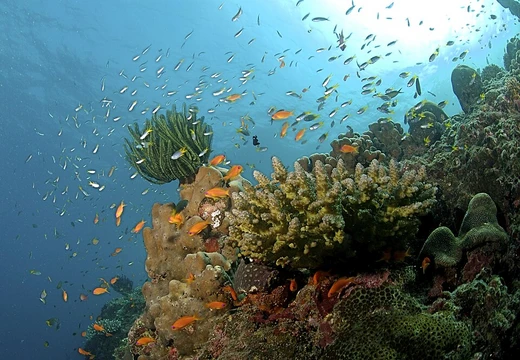
Pavona cactus
A thin-fronded stony coral of Indo-Pacific reefs and lagoons.

Pavona cactus, also called cactus coral, potato chip coral, or leaf coral, is a type of colonial stony coral belonging to the family Agariciidae. It lives in shallow reef and lagoon environments in tropical parts of the Indo-Pacific.
The colonies form upright, irregular, two-sided fronds about 5 cm tall and no more than 5 mm thick. The corallites that hold the polyps are very shallow and arranged in widely spaced rows that run parallel to the frond edges. The lower parts of the fronds may be dead while the upper sections stay alive, supported by the skeleton below. Fronds can cluster into a supercolony made from one or more individual colonies, spreading several meters across the seafloor. This coral is zooxanthellate, hosting symbiotic microscopic algae in its tissues, and appears olive green or brownish.
Its range covers the tropical Indo-Pacific, from the Red Sea and East African coast to Japan, Tahiti, and Australia. It thrives in turbid but calm waters, on upper reef slopes and in shallow lagoons, at depths down to 40 meters.
At night, the polyps extend their tentacles to catch plankton. They also gain nourishment from the intracellular zooxanthellae, which use sunlight to turn simple substances into complex carbohydrates; the coral uses the surplus nutrients. In return, the algae get a protected, well-lit spot clear of the seabed and receive nitrogenous waste from the coral. Pavona cactus can reproduce sexually, releasing gametes into the sea for fertilization. The resulting egg hatches into a free-swimming planula larva that settles on the seabed, metamorphoses into a polyp, and buds to form a new colony. It can also reproduce asexually through fragmentation: if a broken piece lodges in a suitable spot, it can grow and bud into a new colony.
Though common and widespread, the International Union for Conservation of Nature lists this species as "Vulnerable" on its Red List. Under stress like rising sea temperatures, the coral may expel its zooxanthellae and bleach, becoming more vulnerable to disease. Coral reefs generally face threats from habitat decline due to mechanical damage, pollution, sedimentation, ocean acidification, and global warming. Pavona cactus also faces collection for the aquarium trade.
Quick Facts
- Taxon
- Pavona cactus
Facts from the source article.
Lore & Background
Colonies of Pavona cactus form vertical, irregular, two-sided fronds about 5 cm tall and less than 5 mm thick. The corallites are very shallow and arranged in widely separated rows parallel to the frond margins. The bases of the fronds may be dead while the upper parts remain alive, supported by the underlying skeleton. Multiple fronds can cluster into supercolonies extending several metres across the seabed. This species is zooxanthellate, hosting symbiotic algae that give it an olive green or brownish colour.
Pavona cactus is found in the tropical Indo-Pacific, from the Red Sea and East African coast to Japan, Tahiti, and Australia. It inhabits turbid but calm waters on upper reef slopes and in shallow lagoons, at depths down to 40 metres. The polyps extend tentacles at night to catch plankton and also obtain nourishment from intracellular zooxanthellae, which produce carbohydrates using sunlight; the coral uses surplus nutrients, while the algae receive protection and nitrogenous waste.
Reproduction can be sexual, with gametes released into the sea for fertilization, leading to a free-swimming planula larva that settles and metamorphoses into a polyp that buds to form a new colony. Asexual reproduction occurs via fragmentation: a broken piece of coral wedged in a suitable spot can grow and bud into a new colony.
Reader's Guide
Pavona cactus is a common, wide-ranging coral in the Indo-Pacific, yet the International Union for Conservation of Nature lists it as Vulnerable on its Red List of Threatened Species. Under adverse conditions such as a rise in sea temperature, the coral may expel its zooxanthellae and become bleached, making it more susceptible to disease. Coral reefs in general face threats from habitat degradation due to mechanical damage, pollution, sedimentation, ocean acidification, and global warming. Pavona cactus faces an additional threat from collection for the aquarium trade. Its ability to reproduce both sexually and asexually, including through fragmentation, contributes to its persistence in suitable habitats, but the cumulative pressures on reef ecosystems place this species at risk. The symbiotic relationship with zooxanthellae is central to its nutrition and survival, and any disruption to that partnership—such as from warming waters—can have severe consequences. The species' presence in turbid, calm waters suggests some tolerance to sedimentation, but overall its vulnerability highlights the broader challenges facing coral reef biodiversity.
Did You Know?
- The fronds of Pavona cactus are not more than 5 mm thick.
- This coral can form supercolonies extending several metres across the seabed.
- It reproduces asexually by fragmentation, where a broken piece can grow into a new colony.
- Pavona cactus is collected for the aquarium trade.
More in Coral Reefs, Part 2 1-24
Spotted an error? Know more?
Reader corrections go straight into our review queue. Suggest an edit · How this site is sourced