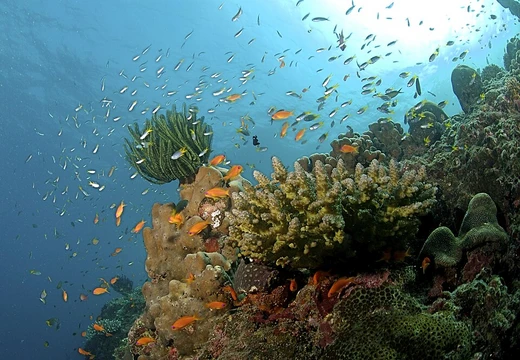
Pavona bipartita
A vulnerable colonial stony coral of Indo-Pacific reef slopes.

Pavona bipartita, also called leaf coral, is a colonial stony coral belonging to the family Agariciidae. It grows in shallow waters, typically on reef slopes and vertical surfaces, across the tropical western and central Indo-Pacific. Colonies can be submassive or encrusting, reaching up to a meter across. The corallites appear as shallow depressions with indistinct walls, spread evenly over the colony’s undulating surface, separated by a network of uneven, raised ridges. The columellae are small, and the septacostae extend over the ridges in two alternating orders. The coral is usually a shade of brown. Its range extends from East Africa and the Red Sea to Japan, the East China Sea, the Philippines, Papua New Guinea, and eastern Australia. It is an uncommon species, found at depths down to about 20 meters. The International Union for Conservation of Nature lists it as vulnerable. The population trend is unknown, but the coral is susceptible to bleaching, and the number of mature colonies is likely declining due to habitat destruction on reefs.
Quick Facts
- Taxon
- Pavona bipartita
Facts from the source article.
Lore & Background
Colonies of Pavona bipartita are either submassive or encrusting, and can be a metre across. The corallites are shallow depressions with poorly defined walls, evenly distributed over the undulating surface of the colony, with a network of uneven raised ridges between them. The columella are small and the septacostae extend over the ridges and are arranged in two alternating orders. This coral is usually some shade of brown.
Pavona bipartita is native to the western and central Indo-Pacific region. Its range extends from East Africa and the Red Sea to Japan, the East China Sea, the Philippines, Papua New Guinea and eastern Australia. It is an uncommon species and occurs on reef slopes and vertical surfaces, at depths down to about 20 metres.
The conservation status of Pavona bipartita has been assessed by the International Union for Conservation of Nature as being vulnerable. The population trend is unknown, but this coral is susceptible to bleaching, and it is likely that the number of mature colonies is decreasing as a result of destruction of its reef habitats.
Reader's Guide
Pavona bipartita, known as leaf coral, is a colonial stony coral of the family Agariciidae. Its significance lies in its role as an uncommon species on reef slopes and vertical surfaces in the western and central Indo-Pacific, from East Africa and the Red Sea to Japan and eastern Australia. The species is notable for its submassive or encrusting colony form, which can reach a metre across, and its characteristic brown coloration with shallow corallites and alternating septacostae. The International Union for Conservation of Nature has assessed it as vulnerable, reflecting its susceptibility to bleaching and the likely decline of mature colonies due to destruction of reef habitats. Although the population trend is unknown, the species' vulnerability underscores the broader threats facing coral reef ecosystems. Its presence on vertical surfaces and reef slopes highlights the diversity of microhabitats within Indo-Pacific reefs. The lack of precise population data and the ongoing threat of habitat destruction make Pavona bipartita a species of conservation concern, emblematic of the challenges faced by many corals in the region.
Did You Know?
- Pavona bipartita is sometimes known as leaf coral.
- It belongs to the family Agariciidae.
- Its colonies can be up to a metre across.
More in Coral Reefs, Part 2 1-24
Spotted an error? Know more?
Reader corrections go straight into our review queue. Suggest an edit · How this site is sourced