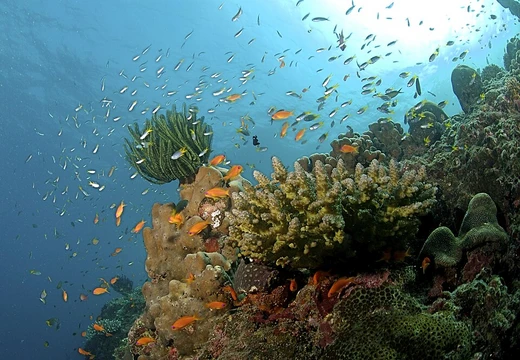
Orbicella franksi
A near-threatened stony coral native to Caribbean and Atlantic waters.

Orbicella franksi, called boulder star coral, is a colonial stony coral belonging to the family Merulinidae. It lives in shallow waters across the Caribbean Sea, the Gulf of Mexico, the Bahamas, Bermuda, and Florida, and the International Union for Conservation of Nature lists it as near threatened.
Until recently, scientists considered this coral, along with Orbicella faveolata, to be a variant of Orbicella annularis. Although the three look very similar, studies have revealed differences in corallite structure, life history, allozymes, and distribution. All three members of this species complex were once placed in the genus Montastraea.
Colonies of Orbicella franksi typically form massive, uneven clumps, but they can also grow as plates or, in shaded spots, as encrusting sheets. Their general color is orange-brown, greenish-brown, or greyish-brown, though the tips of the lumps are often pale or white. The corallites—the cups that hold the polyps—are small, about 3.5 mm (0.14 in) across. Unlike its close relative Orbicella faveolata, which has evenly spaced corallites at its growing edges, this coral’s growing edges have both large and small corallites.
This coral is native to the Caribbean Sea and the Gulf of Mexico, including Florida, the Bahamas, and Bermuda. It typically grows on fore reefs, where it can be the most common coral species, and its depth range is 5 to 50 meters (16 to 164 ft), though it is usually found between 15 and 30 meters (49 to 98 ft).
Orbicella franksi appears more resistant to coral diseases than some other members of its genus, but it remains vulnerable to coral plague, yellow-band disease, black band disease, and coral bleaching. The main threats it faces are climate change, ocean acidification, and destruction of its reef habitat. The International Union for Conservation of Nature has rated its conservation status as near threatened.
Quick Facts
- Taxon
- Orbicella franksi
Facts from the source article.
Lore & Background
Until recently, Orbicella franksi, along with Orbicella faveolata, was thought to be a variety of Orbicella annularis. There is very little morphological difference between them, but studies have shown differences in corallite structure, life history, allozymes and distribution. All three members of this species complex used to be placed in the genus Montastraea.
Colonies of Orbicella franksi usually form massive clumps with uneven surfaces, but sometimes form plates, and in shady positions may be encrusting. The general colour is orange-brown, greenish-brown or greyish-brown, but the extremities of the lumps are often pale or white. The corallites measure 3.5 mm across. The growing edges bear both large and small corallites, in contrast to the closely related Orbicella faveolata, which has regularly spaced corallites at its growing edges.
Orbicella franksi typically grows on fore reefs, where it may be the most common species of coral. Its depth range is 5 to 50 metres, but it is typically found at depths of between 15 and 30 metres.
Reader's Guide
Orbicella franksi is notable for its role as a dominant coral on fore reefs in the Caribbean and adjacent regions, where it may be the most common species. Its near-threatened status reflects vulnerability to climate change, ocean acidification, and destruction of reef habitat. The species is more resistant to coral diseases than some members of its genus, but remains susceptible to coral plague, yellow-band disease, black band disease, and coral bleaching. Its taxonomic history is significant: until recently it was considered a variety of Orbicella annularis, and all three members of the species complex were formerly placed in the genus Montastraea. The subtle morphological differences among them, resolved through studies of corallite structure, life history, allozymes, and distribution, highlight the complexity of coral taxonomy. The species' ability to form massive clumps, plates, or encrusting growths depending on light conditions demonstrates its adaptive morphology. Its conservation listing by the International Union for Conservation of Nature underscores ongoing threats to Caribbean reef ecosystems.
Did You Know?
- Orbicella franksi was until recently thought to be a variety of Orbicella annularis.
- It may be the most common species of coral on fore reefs in its range.
More in Coral Reefs, Part 2 1-24
Spotted an error? Know more?
Reader corrections go straight into our review queue. Suggest an edit · How this site is sourced