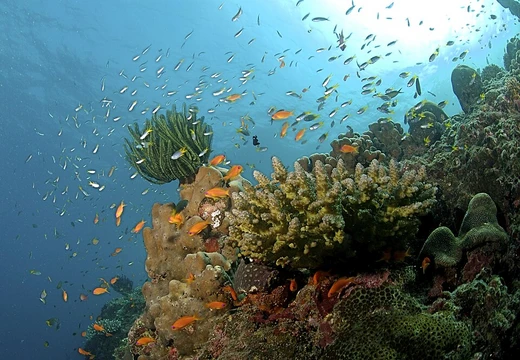
Orbicella faveolata
A slow-growing Caribbean coral endangered by disease and bleaching.

Orbicella faveolata, also called mountainous star coral, is a colonial stony coral belonging to the family Merulinidae. This species is found along the coral coast of the Caribbean Sea and the Gulf of Mexico, and the International Union for Conservation of Nature lists it as endangered. It was previously classified under the genus Montastraea as Montastraea faveolata.
The colonies are solid and very large, forming a mound with a skirt-like edge. The surface is smooth and wavy, dotted with small bumps, bulges, or lobes. The corallites—the stony cups housing the polyps—measure about 5 mm across and cover the entire colony. Colors range from pale brown, yellowish green, or grey to deep brown, often with fluorescent green highlights. This coral is part of a species complex that includes the closely related Orbicella annularis and Orbicella franksi. Orbicella annularis has more distinct nodules or small columns, while Orbicella franksi has a more irregular, lumpy surface.
Orbicella faveolata lives in shallow waters of the Caribbean Sea and the Gulf of Mexico, including Florida (United States), the Bahamas, Venezuela, and possibly Bermuda. It grows on both back reef and fore reef slopes of fringing reefs, down to depths of 40 meters. On fore reef slopes between 10 and 20 meters, it is often the most abundant coral species.
Like other corals, Orbicella faveolata has a symbiotic relationship with dinoflagellates from the family Symbiodiniaceae, commonly called zooxanthellae. These symbionts live in large numbers within the coral’s living tissue. Different species of Symbiodiniaceae associate with the coral depending on light intensity reaching the surface. When researchers artificially shaded parts of the coral for weeks, the endosymbionts in the shaded area died. After light was restored, zooxanthellae returned, but often a different species of Symbiodiniaceae replaced the original one. The coral also hosts a diverse microbiome of bacteria, archaea, and other microorganisms, which shift with the coral’s health. Orbicella corals are affected by several diseases, including yellow-band disease.
This species is related to lobed star coral (Orbicella annularis) and boulder star coral (Orbicella franksi), all found in the Caribbean Sea and Gulf of Mexico, including the Bahamas and Bermuda.
Quick Facts
- Taxon
- Orbicella faveolata
Facts from the source article.
Lore & Background
Orbicella faveolata forms solid, very large mound-shaped colonies with a skirt, a smooth undulating surface, and small lumps, bulges, or lobes. The corallites cover the entire surface and are about 5 mm in diameter. Its color is usually pale brown, yellowish green, or grey, but may be deep brown with fluorescent green highlights. This coral is part of a species complex that includes the closely related Orbicella annularis and Orbicella franksi; O. annularis has more distinct nodules or small columns, while O. franksi has a more irregular, lumpy surface.
It occurs in shallow waters of the Caribbean Sea and the Gulf of Mexico, including Florida, the Bahamas, Venezuela, and possibly Bermuda. It is found on both back reef and fore reef slopes of fringing reefs at depths up to 40 m, and is often the most abundant coral species on fore reef slopes between 10 and 20 m. Like other corals, it has a symbiotic relationship with dinoflagellates in the family Symbiodiniaceae (zooxanthellae). Different species of Symbiodiniaceae associate with the coral depending on light intensity; artificial shading caused the endosymbionts to die out, and when light was restored, the original species was sometimes replaced by a different species.
Reader's Guide
Orbicella faveolata is notable as a slow-growing, endangered species whose rate of new colony formation is less than the rate of mature colony death. It is susceptible to bleaching and several coral diseases, including stony coral tissue loss disease, yellow-band disease, black band disease, and white plague. Numbers are believed to have declined by over 50% in the last thirty years, leading to its endangered status by the International Union for Conservation of Nature. The coral hosts a diverse microbiome of zooxanthellae, bacteria, and archaea that are dynamic and affected by the coral's health. It is related to lobed star coral (Orbicella annularis) and boulder star coral (Orbicella franksi), all found in the Caribbean Sea and Gulf of Mexico. The species Paramontastraea saleborsa and Astrea curta have similarly sized corallites, and P. saleborsa was also formerly placed in the genus Montastraea. Its ecological role as a dominant species on fore reef slopes between 10 and 20 m depth underscores its importance in Caribbean reef ecosystems.
Did You Know?
- Orbicella faveolata was formerly known as Montastraea faveolata.
- Artificial shading caused its symbiotic zooxanthellae to die out, and when light returned, the original species was sometimes replaced by a different species of Symbiodiniaceae.
More in Coral Reefs, Part 2 1-24
Spotted an error? Know more?
Reader corrections go straight into our review queue. Suggest an edit · How this site is sourced