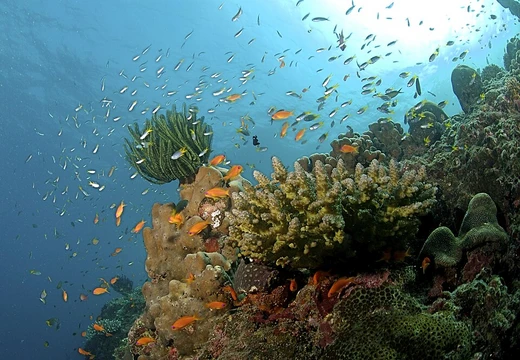
Ningaloo Coast
Australia's largest fringing coral reef, close to land.

The Ningaloo Coast is a World Heritage Site located in the north west coastal region of Western Australia, approximately 1,200 kilometres north of Perth along the East Indian Ocean. It is notable for the 260-kilometre-long Ningaloo Reef, Australia's largest fringing coral reef and the only large reef positioned very close to a landmass.
Quick Facts
- Location
- Western Australia, Australia
- Criteria
- (vii), (x)(vii), (x)
- Year
- 2011
- Area
- 705,015 ha
Facts from the source article.
Lore & Background
The coast and reef draw their name from the Wajarri language word ningaloo, meaning 'promontory', 'deep water', or 'high land jutting into the sea'. The Yamatji peoples of the Baiyungu and Yinigudura are the traditional owners of the area. In 1987, the reef and surrounding waters were designated as the Ningaloo Marine Park. World Heritage status was created and negotiated in 2011, and the adopted boundary included several marine parks, coastal parks, Cape Range National Park, and the Learmonth Air Weapons Range. The site was gazetted on the Australian National Heritage List on 6 January 2010 under the Environment Protection and Biodiversity Conservation Act 1999.
During the early 2000s, significant controversy arose over the proposed construction of a resort at Mauds Landing, a crucial nesting ground for the loggerhead turtle. Author Tim Winton, who lives in the area, was vocal in his opposition. In 2002, when he won the WA Premier's Book Award, he donated the A$25,000 prize money to the community campaign to save the reef. Ultimately the planned resort did not go ahead. In 2011 and 2025, the reef was hit by bleaching events caused by marine heatwaves.
Reader's Guide
The Ningaloo Coast World Heritage Site covers 7,050 square kilometres and is located approximately 1,200 kilometres north of Perth. The 260-kilometre-long Ningaloo Reef is Australia's largest fringing coral reef and the only large reef positioned very close to a landmass. Although most famed for its whale sharks which feed there during March to August, the reef is also rich in coral and other marine life. During winter months, the reef is part of migratory routes for dolphins, dugongs, manta rays and humpback whales. The beaches are an important breeding ground for loggerhead, green and hawksbill turtles. The reef supports 500 species of fish, 300 species of corals, 600 species of molluscs and many other marine invertebrates. In 2006, researchers discovered gardens of sponges in deeper waters thought to be species completely new to science. The short-nosed sea snake, thought extinct for 17 years, was found on Ningaloo Reef in December 2015. As of 2025, the reef attracts 200,000 tourists each year. The Ningaloo Collaboration Cluster, a research initiative from 2006 to 2011, aimed to create a dynamic model integrating socioeconomic factors and environmental impacts to facilitate sustainable resource use.
Did You Know?
- The reef is less than 500 metres offshore in some areas, such as Coral Bay.
- The reef was hit by bleaching events in 2011 and 2025 caused by marine heatwaves.
Frequently Asked Questions
Who is Ningaloo Coast?
Ningaloo Coast is a World Heritage marine site on the north-western shore of Western Australia, sitting roughly 1,200 km north of Perth in the East Indian Ocean. It is home to the 260-kilometre Ningaloo Reef, the largest fringing coral reef in Australia.
What are Ningaloo Coast's powers/role?
Its standout trait is being the only large reef system positioned this close to a landmass, hugging the coastline for 260 km. It shelters around 500 fish species and welcomes approximately 200,000 visitors every year.
Why is Ningaloo Coast important?
Covering 705,015 hectares, it is Australia's biggest fringing reef and a critical near-shore marine habitat. Its unusual proximity to land makes it a rare, accessible large-reef ecosystem for both science and tourism.
Where does Ningaloo Coast appear and what is its setting?
It runs along the north-western coast of Western Australia in the East Indian Ocean, about 1,200 kilometres north of Perth. The reef forms a continuous 260-km band parallel to the shoreline.
More in Coral Reefs, Part 2 1-24
Spotted an error? Know more?
Reader corrections go straight into our review queue. Suggest an edit · How this site is sourced