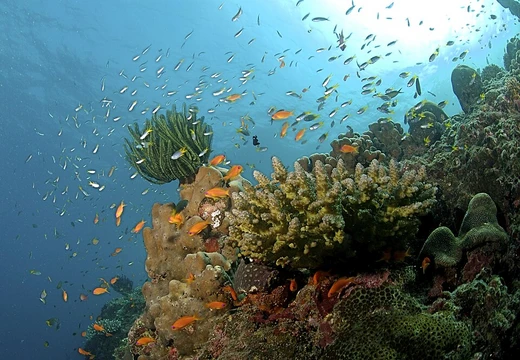
New Caledonian barrier reef
Longest continuous barrier reef, third largest globally.

The New Caledonian barrier reef, in the South Pacific, is the world’s longest continuous barrier reef and ranks third in size, behind Australia’s Great Barrier Reef and the Mesoamerican Barrier Reef. It encircles Grande Terre—New Caledonia’s main island—along with Île des Pins and several smaller islands, stretching 1,500 kilometers (930 miles). This reef encloses a lagoon covering 24,000 square kilometers (9,300 square miles), with an average depth of 25 meters (82 feet). The reef sits up to 30 kilometers (19 miles) from the shore, but extends nearly 200 kilometers (120 miles) northwest to the Entrecasteaux reefs, wrapping around the Belep Islands and other sand cays. Several natural passages open to the ocean; the Boulari passage, leading to the capital and main port of Nouméa, is marked by the Amédée lighthouse. In 2008, the barrier reef and its lagoon were added to the UNESCO World Heritage List for their striking beauty, the unique geography of a reef that completely encircles Grande Terre, and exceptional marine diversity, particularly in corals.
The reef systems here are considered the second largest globally, after Australia’s Great Barrier Reef, and host the longest continuous barrier reef at 1,600 kilometers, with the world’s largest lagoon at 24,000 square kilometers. Along with Fiji, this ecosystem contains the most diverse concentration of reef structures—146 types based on a global classification—and matches or surpasses the much larger Great Barrier Reef in coral and fish diversity. Species diversity is high, with significant endemism. A total of 2,328 fish species from 248 families have been recorded. The reef also supports the third-largest population of endangered dugongs (Dugong dugon) on Earth and serves as an important nesting site for green sea turtles (Chelonia mydas). The lagoons host over 2,000 species of molluscs and a thriving population of humpback whales.
Most reefs are generally considered healthy, though some eastern sections have been damaged by nickel mining runoff from Grand Terre. Sedimentation from mining, agriculture, and grazing has impacted reefs near river mouths, worsened by the destruction of mangrove forests that help trap sediment. Some reefs have been buried under several meters of silt.
Quick Facts
- Location
- New Caledonia (state party: France)
- Criteria
- (vii), (ix), (x)(vii), (ix), (x)
- Year
- 2008
- Area
- 1574300 ha
- Buffer Zone
- 1287100 ha
Facts from the source article.
Lore & Background
The New Caledonian barrier reef surrounds Grande Terre, the Ile des Pins, and several smaller islands. The reefs lie up to 30 kilometres from the shore but extend almost 200 kilometres to the Entrecasteaux reefs in the northwest, enclosing the Belep Islands and other sand cays. Several natural passages open out to the ocean, including the Boulari passage, which leads to Nouméa, the capital and chief port of New Caledonia, and is marked by the Amédée lighthouse. In 2008, the barrier reef and its enclosing lagoon was inscribed on the UNESCO World Heritage List for its outstanding beauty, its unique geography as a reef entirely encircling Grande Terre, and its exceptional marine diversity, in particular its coral diversity. The reef systems of New Caledonia are considered to be the second largest in the world after the Great Barrier Reef of Australia, the longest continuous barrier reef in the world with a length of 1,600 km and its lagoon, the largest in the world with an area of 24,000 square kilometers. This ecosystem hosts along with Fiji, the world's most diverse concentration of reef structures, 146 types based on a global classification system, and they equal or even surpass the much larger Great Barrier Reef in coral and fish diversity. The reef has great species diversity with a high level of endemism. In total, there have been 2,328 fish species observed, belonging to 248 families. The reef is home to the third-largest population of endangered dugongs on Earth and is an important nesting site for green sea turtles. The lagoons contain over 2,000 species of molluscs and a thriving population of humpback whales.
Reader's Guide
The New Caledonian barrier reef is notable for being the longest continuous barrier reef in the world and the third largest overall. Its lagoon, at 24,000 square kilometres, is the largest in the world. The reef's unique geography—entirely encircling Grande Terre—and its exceptional marine diversity, particularly coral diversity, led to its inscription on the UNESCO World Heritage List in 2008. The reef systems host, along with Fiji, the world's most diverse concentration of reef structures, with 146 types based on a global classification system, and they equal or surpass the much larger Great Barrier Reef in coral and fish diversity. The reef supports a high level of endemism, with 2,328 observed fish species, the third-largest population of endangered dugongs, and important nesting sites for green sea turtles. The lagoons also contain over 2,000 species of molluscs and a thriving population of humpback whales. Most reefs are generally thought to be in good health, but some eastern reefs have been damaged by effluent from nickel mining on Grand Terre. Sedimentation from mining, agriculture, and grazing has affected reefs near river mouths, worsened by the destruction of mangrove forests. Some reefs have been buried under several metres of silt. In 2008, an assessment of northwest near-shore reefs concluded that many would be dead within years, or at best decades, if present trends relating to mining sediment and silt run-off continued. There are 13 local management committees, composed of tourist operators, fishermen, politicians and chiefs of local tribes, which work with the community to monitor the health of the lagoons. Scuba diving is common, with several dive sites including the Prony needle, the Shark Pit and the Cathedral.
Did You Know?
- The New Caledonian barrier reef is the longest continuous barrier reef in the world, at 1,500 kilometres.
- The reef encloses a lagoon of 24,000 square kilometres, the largest in the world.
Frequently Asked Questions
What exactly is the New Caledonian barrier reef?
It is a massive, unbroken wall of living coral that wraps around New Caledonia's main island, Grande Terre, in the South Pacific. At 1,500 kilometres of continuous structure, it holds the record as the longest single barrier reef on Earth.
How does the New Caledonian barrier reef rank against the other famous reefs?
It sits in third place globally, trailing only Australia's Great Barrier Reef and the Mesoamerican Barrier Reef in overall size. What sets it apart from both is that it forms one single, uninterrupted ring rather than a scattered chain of segments.
What are the key dimensions fans should know?
The reef encloses a lagoon of roughly 24,000 square kilometres with an average depth of about 25 metres, and the coral wall can sit up to 30 kilometres offshore. In its northwestern stretch it reaches almost 200 kilometres out to the Entrecasteaux reefs, making that segment extraordinarily wide.
What kind of marine life does the reef support?
Surveys have documented 2,328 distinct fish species spread across 248 families within the lagoon and on the reef itself. That level of biodiversity is a direct result of the reef's sheer scale and the varied habitats it creates from shallow lagoon flats to deep outer slopes.
Why do fans and marine biologists consider this reef so important?
Because it is the only barrier reef of its length that remains largely undisturbed, it serves as a living baseline for how coral ecosystems function before heavy human impact. Its enclosed lagoon also shelters a rich mosaic of atolls, seagrass beds, and mangrove fringes that together sustain thousands of species.
More in Coral Reefs, Part 2 1-24
Spotted an error? Know more?
Reader corrections go straight into our review queue. Suggest an edit · How this site is sourced