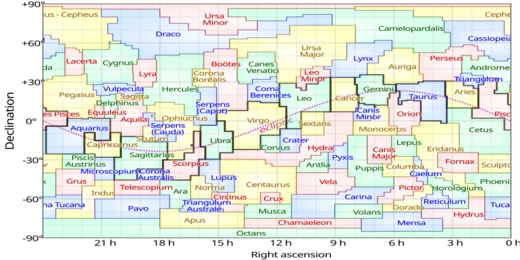
Virgo (constellation)
Second-largest constellation, home to Spica and the Virgo Cluster.

Virgo is one of the constellations of the zodiac. Its name means 'maiden' in Latin. It is the second-largest constellation in the sky (after Hydra) and the largest constellation in the zodiac, lying between Leo to the west and Libra to the east. The ecliptic intersects the celestial equator within this constellation and Pisces, and the Sun passes directly overhead of the equator within Virgo at the September equinox.
Quick Facts
- Abbreviation
- Vir
- Genitive
- Virginis
- Pronounce
- ˈ · v · ɜːr · ɡ · oʊ, / genitive ˈ · v · ɜːr · dʒ · ᵻ · n · ᵻ · s
- Symbolism
- the Maiden
- Ra
- 13
- Dec
- −4
- Family
- Zodiac
- Quadrant
- SQ3
- Areatotal
- 1294
- Arearank
- 2nd
- Numbermainstars
- 9, 15
- Numberbfstars
- 96
Facts from the source article.
Lore & Background
In Babylonian astronomy (c. 10th century BC), part of Virgo was known as 'The Furrow,' representing the goddess Shala and her ear of grain. The star Spica retains this tradition as Latin for 'ear of grain.' The constellation became associated with fertility. In Hipparchus's time, Virgo corresponded to two Babylonian constellations: the 'Furrow' in the east and the 'Frond of Erua' in the west, the latter depicted as a goddess holding a palm-frond. Greek and Roman mythology identified Virgo with the goddesses Demeter and Persephone, as well as Astraea, a goddess of justice who left Earth during the end of the Silver Age and fled to the sky. Erigone, daughter of Icarius of Athens, was also associated; after her father's death she hanged herself in grief, and Dionysus placed father and daughter in the stars as Boötes and Virgo. In Hyginus's Poeticon Astronomicon, Parthenos is the daughter of Apollo and Chrysothemis, who died a maiden and was placed among the stars. Diodorus Siculus gives an alternative account where Parthenos and her sister Molpadia were saved by Apollo after a mishap and deified. During the Middle Ages, Virgo was associated with the Virgin Mary. In Hindu astrology, it is known as Kanyā, the sixth sign of the sidereal zodiac, ruled by the planet Budha (Mercury), and classified as an earth sign with a dual (mutable) nature.
Reader's Guide
Virgo is notable for its bright star Spica, which makes the constellation easy to locate by following the curve of the Big Dipper to Arcturus in Boötes and then continuing to Spica. The constellation contains 35 verified exoplanets orbiting 29 stars, including systems around 70 Virginis, Chi Virginis, 61 Virginis, and PSR B1257+12. The star 70 Virginis has one of the first known extrasolar planetary systems, with a planet 7.5 times Jupiter's mass. Chi Virginis hosts one of the most massive planets ever detected, at 11.1 Jupiter masses. The sun-like star 61 Virginis has three known planets: a super-Earth and two Neptune-mass planets.
Virgo is especially rich in galaxies due to the Virgo Cluster, located 5° to 12° west of ε Virginis. Notable members include Messier 87, the largest galaxy in the cluster, which is a major radio source with a jet of electrons from its central supermassive black hole. On April 10, 2019, astronomers released the first direct image of a black hole, the one at M87's center, with a mass of at least 7.2 billion Suns. Other galaxies include the Sombrero Galaxy (M104), an edge-on spiral with a prominent dust lane, and NGC 4639, a face-on barred spiral used to calibrate type Ia supernovae. The quasar 3C 273, the first quasar ever identified and the optically brightest in the sky, also lies in Virgo.
Did You Know?
- The Sun takes 44 days to pass through Virgo, longer than any other zodiac constellation.
- The star Chi Virginis has one of the most massive planets ever detected, with a mass of 11.1 times that of Jupiter.
- M87 in Virgo was the site of the first direct image of a black hole, released on April 10, 2019.
- The quasar 3C 273, the first quasar ever identified, is located in Virgo and is the optically brightest quasar in the sky.
More in Constellations, Part 2 1-24
Spotted an error? Know more?
Reader corrections go straight into our review queue. Suggest an edit · How this site is sourced