Hydra (constellation)
The largest constellation, a water snake straddling the celestial equator.

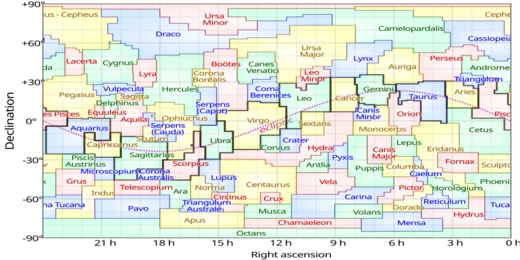
Hydra is the biggest of the 88 modern constellations, covering 1,303 square degrees, and it is also the longest, stretching more than 100 degrees. Its southern tip touches Libra and Centaurus, while its northern end meets Cancer. The 2nd-century astronomer Ptolemy included it among his list of 48 constellations. It is usually depicted as a water snake and lies across the celestial equator.
In Western mythology, the Greek Hydra came from a Babylonian constellation. The Babylonian star catalog MUL.APIN includes a "serpent" constellation (MUL.DINGIR.MUŠ) that roughly matches Hydra. It was one of two Babylonian serpent constellations—the other became the Greek Serpens—and was a mix of serpent, lion, and bird. Hydra’s shape looks like a twisting snake, and it appears in some Greek myths. One story links it to a water snake that a crow gave to Apollo in a cup after being sent to fetch water. Apollo saw the trick and angrily threw the crow, cup, and snake into the sky. Another myth ties it to the many-headed Hydra monster killed by Hercules, represented by another constellation. Legend says that if one head was cut off, two more grew back. Hercules’ nephew Iolaus burned the necks with a torch to stop regrowth, letting Hercules defeat the Hydra. In Chinese astronomy, Hydra’s stars fall within the Vermilion Bird and the Azure Dragon. In Arabic folklore, the head of Hydra was called "Min al Az'al," meaning "belonging to the uninhabited spot."
Despite its size, Hydra has only one moderately bright star: Alphard (Alpha Hydrae), an orange giant with magnitude 2.0, 177 light-years away. Its name means "the solitary one." Beta Hydrae is a blue-white star of magnitude 4.3, 365 light-years away. Gamma Hydrae (Naga) is a yellow giant of magnitude 3.0, 132 light-years away. Hydra has one bright binary star, Epsilon Hydrae, which is hard to split with amateur telescopes; its period is 1,000 years, and it is 135 light-years away. The primary is a yellow star of magnitude 3.4, and the secondary is a blue star of magnitude 6.7. There are also dimmer double and binary stars. 27 Hydrae is a triple star: two parts are visible in binoculars, and three in small amateur telescopes. The primary is a white star of magnitude 4.8, 244 light-years away.
Quick Facts
- Abbreviation
- Hya
- Genitive
- Hydrae
- Pronounce
- ˈ · h · aɪ · d · r · ə / genitive ˈ · h · aɪ · d · r · iː
- Symbolism
- the sea serpent
- Ra
- 8 · 10 · 56.2029–15 · 02 · 31.3847
- Dec
- 6.6302376–-35.6938896
- Family
- Hercules
- Quadrant
- SQ2
- Areatotal
- 1303
- Arearank
- 1st
- Numbermainstars
- 17
- Numberbfstars
- 75
Facts from the source article.
Lore & Background
The Greek constellation of Hydra is an adaptation of a Babylonian constellation: the MUL.APIN includes a 'serpent' constellation (MUL.DINGIR.MUŠ) that loosely corresponds to Hydra. It is one of two Babylonian 'serpent' constellations (the other being the origin of the Greek Serpens), a mythological hybrid of serpent, lion and bird. The shape of Hydra resembles a twisting snake, and features as such in some Greek myths. One myth associates it with a water snake that a crow served Apollo in a cup when it was sent to fetch water. Apollo saw through the fraud and angrily cast the crow, cup and snake into the sky. It is also associated with the monster Hydra, with its many heads, killed by Hercules, represented in another constellation. According to legend, if one of the Hydra's heads was cut off, two more would grow in its place. However, Hercules' nephew, Iolaus, seared the necks with a torch to prevent them from growing back and thus enabled Hercules to overcome the Hydra. In Chinese astronomy, the stars that correspond to Hydra are located within the Vermilion Bird and the Azure Dragon. The head of Hydra was collectively known as 'Min al Az'al,' meaning 'belonging to the uninhabited spot' in Arabic.
Reader's Guide
Despite its size, Hydra contains only one moderately bright star, Alphard, designated Alpha Hydrae, an orange giant of magnitude 2.0, 177 light-years from Earth, whose traditional name means 'the solitary one'. Other notable stars include Beta Hydrae, Gamma Hydrae (Naga), and the binary star Epsilon Hydrae, which is difficult to split in amateur telescopes. Hydra is home to several variable stars, including R Hydrae, a Mira variable that is one of the brightest at its maximum of magnitude 3.5, and V Hydrae, an unusually vivid red variable star. The constellation also contains GJ 357, an M-type main sequence star with three confirmed exoplanets, one of which, GJ 357 d, is considered a 'Super-Earth' within the circumstellar habitable zone. Hydra contains three Messier objects: M83 (the Southern Pinwheel Galaxy), M68 (a globular cluster), and M48 (an open star cluster). Other deep-sky objects include the planetary nebula NGC 3242, nicknamed the 'Ghost of Jupiter', and the galaxy pair NGC 3314a and NGC 3314b, which appear superimposed but are not related. The Sigma Hydrids meteor shower peaks on December 6 and is very active, with its parent body believed to be Comet Nishimura (C/2023 P1).
Did You Know?
- Hydra is the largest of the 88 modern constellations, measuring 1303 square degrees.
- The brightest star in Hydra is Alphard, an orange giant whose traditional name means 'the solitary one'.
- The planetary nebula NGC 3242 in Hydra is nicknamed the 'Ghost of Jupiter' due to its resemblance to the planet.
- The Sigma Hydrids meteor shower, peaking on December 6, is believed to originate from Comet Nishimura (C/2023 P1).
Ancient Roots & Ptolemaic Heritage
Hydra belongs to a lineage of star patterns whose origins stretch back to the ancient Mesopotamian and Greek civilizations. These early sky-watchers established the bulk of the northern constellations that remain in international use today, and the Roman-Egyptian astronomer Ptolemy later catalogued them in his celebrated list of forty-eight figures. Hydra, as one of these ancient designs, carries that deep heritage forward into the modern era. The tradition it represents is so foundational that even when later European explorers charted the southern skies and proposed entirely new constellations to fill gaps between the traditional ones, the older patterns retained their primacy. Every constellation in the current IAU catalogue, including Hydra, bears a Latin name as a direct legacy of this Roman and European scholarly tradition. Thus, when an astronomer today refers to Hydra, they are invoking a naming convention and a celestial framework that has been continuously refined for over two millennia, from Mesopotamian observations through Ptolemy's synthesis to the present day.
The Modern Celestial Framework
Hydra occupies a defined region of the sky within the system of eighty-eight constellations officially recognized by the International Astronomical Union. Each of these regions is bordered by precise arcs of right ascension and declination, and together they cover the entire celestial sphere without gaps or overlaps. The boundaries for Hydra, like those for every other constellation, were officially adopted by the IAU in 1928 and subsequently published in 1930. The geometric work of delineating these borders was carried out by Eugène Joseph Delporte, who drew the boundaries so that every single point in the sky belonged to exactly one constellation. This means that when an observer or researcher states that a particular star, nebula, or galaxy lies within Hydra, they are referring to its position inside these specifically demarcated limits. The system also includes constellations added later by European astronomers who mapped the southern skies, as well as figures proposed to fill gaps between the traditional patterns. Hydra sits comfortably within this comprehensive, mathematically defined framework that has governed astronomical identification for nearly a century.
Nomenclature & the Abbreviation System
Hydra's official three-letter abbreviation is Hya, derived from the Latin genitive form of its name. The IAU adopted these three-letter codes in 1922 for what was then a list of eighty-nine constellations—the modern eighty-eight plus Argo Navis, which the French astronomer Nicolas Louis de Lacaille had divided into Carina, Puppis, and Vela in the 1750s. The abbreviation system is based on the genitive form, and for most constellations the first three letters of the base name suffice. However, Hydra presents a particular nomenclatural challenge: the closely named constellation Hydrus must be distinguished from it. To prevent confusion, Hydrus receives the abbreviation Hyi, taken from its genitive Hydri, while Hydra keeps Hya. This kind of disambiguation is not unique; the IAU similarly distinguishes Corona Australis (CrA) from Corona Borealis (CrB), and Sagitta (Sge) from Sagittarius (Sgr). In 1932 the IAU briefly introduced four-letter abbreviations as well, but these were repealed in 1955 and are now considered obsolete, surviving only in reference documents such as the NASA Dictionary of Technical Terms published in 1965.
Classification Among the 88
Among the eighty-eight IAU-recognized constellations, Hydra is classified as one of forty-two animal figures depicted across the celestial sphere. The full roster breaks down into distinct categories: twenty-eight inanimate objects, two natural features (a river and a table mountain), and sixteen humans or mythological characters, two of whom are centaurs—human-horse hybrids. Hydra's place among the animal group connects it to a tradition of sky imagery that stretches back to the ancient world. Alongside the formal constellation system, various non-IAU-designated star patterns known as asterisms also exist in the sky. Some asterisms are subsets of a single larger constellation, while others span two adjoining constellations. Examples include the Big Dipper within Ursa Major, the Teapot in Sagittarius, the Square of Pegasus straddling Pegasus and Andromeda, and the False Cross spanning Carina and Vela. The constellations that lie along the ecliptic are given the special designation of zodiac, a group that includes figures from the same ancient tradition as Hydra. Together, these formal and informal patterns create a richly layered map of the night sky.
More in Constellations, Part 2 1-24
Spotted an error? Know more?
Reader corrections go straight into our review queue. Suggest an edit · How this site is sourced