Leo (constellation)
Zodiac constellation representing the Nemean Lion slain by Heracles.

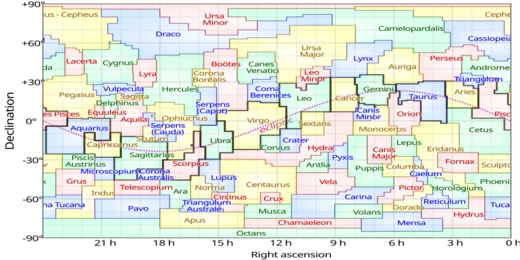
Leo is a zodiac constellation situated in the northern sky, with Cancer to its west and Virgo to its east. Its Latin name means "lion," and in ancient Greek mythology, it symbolized the Nemean Lion slain by Heracles during his twelve labors. Cataloged by Ptolemy in the 2nd century as one of 48 constellations, it is now among the 88 modern constellations and stands out as one of the easiest to identify, thanks to its many luminous stars and a shape that suggests a crouching lion.
The constellation boasts nine bright stars visible without a telescope, four of which shine at first or second magnitude, making Leo particularly prominent. Six of these stars form an asterism called the Sickle, which looks like a backward question mark to modern eyes; these are Epsilon, Mu, Zeta, Gamma, Eta, and Alpha Leonis. The remaining three stars create an isosceles triangle: Beta Leonis (Denebola) marks the lion’s tail, while Delta and Theta Leonis outline the rest of its body.
Leo also hosts several notable stars. R Leonis is a red giant and a Mira variable, ranging from a minimum magnitude of 10 to a normal maximum of 6, with occasional brightening to magnitude 4.4. Located 330 light-years away, it has a 310-day period and a diameter 450 times that of the Sun. Wolf 359 (CN Leonis), a red dwarf of magnitude 13.5, lies just 7.8 light-years from Earth and is a flare star that periodically brightens by up to one magnitude. Gliese 436, a faint star about 33 light-years away, has a transiting Neptune-mass exoplanet. CW Leo (IRC +10216) is the brightest star in the night sky at infrared N-band wavelengths. SDSS J102915+172927 (Caffau’s star) is a population II star in the galactic halo, roughly 13 billion years old and among the oldest known, with the lowest metallicity of any star. In 1602, Tycho Brahe removed a group of stars once considered the lion’s tail tuft to form the separate constellation Coma Berenices, though ancient Greeks and Romans had already recognized that grouping.
Leo is rich in deep-sky objects, especially galaxies. The most famous include Messier 65, Messier 66, Messier 95, Messier 96, Messier 105, and NGC 3628, with M65 and M66 forming part of the Leo Triplet. The Leo Ring, a cloud of hydrogen and helium gas, orbits two galaxies in the constellation.
Quick Facts
- Abbreviation
- Leo
- Genitive
- Leonis
- Pronounce
- ˈ · l · iː · oʊ, genitive l · iː · ˈ · oʊ · n · ᵻ · s
- Symbolism
- the Lion
- Ra
- 11
- Dec
- +15
- Family
- Zodiac
- Quadrant
- NQ2
- Areatotal
- 947
- Arearank
- 12th
- Numbermainstars
- 9, 15
- Numberbfstars
- 92
Facts from the source article.
Lore & Background
Leo was one of the earliest recognized constellations, with archaeological evidence that the Mesopotamians had a similar constellation as early as 4000 BCE. The Persians called it Ser or Shir; the Turks, Artan; the Syrians, Aryo; the Jews, Arye; the Indians, Simha—all meaning 'lion'. Some mythologists believe that in Sumeria, Leo represented the monster Humbaba, killed by Gilgamesh. In Babylonian astronomy, the constellation was called UR.GU.LA, the 'Great Lion', and the bright star Regulus was known as 'the star that stands at the Lion's breast' and the King Star.
In Greek mythology, Leo was identified as the Nemean Lion killed by Heracles during the first of his twelve labours. The Lion would take women as hostages to its lair, luring warriors to their misfortune. Impervious to any weaponry, the Lion was defeated by Heracles with his bare hands: he caught it in midair, grasped its forelegs and hind legs, and bent it backwards, breaking its back. Zeus commemorated this labor by placing the Lion in the sky. The Roman poet Ovid called it Herculeus Leo and Violentus Leo; Bacchi Sidus (star of Bacchus) was another title. Manilius called it Jovis et Junonis Sidus (Star of Jupiter and Juno).
Modern astronomers, including Tycho Brahe in 1602, excised a group of stars that once made up the 'tuft' of the lion's tail and used them to form the new constellation Coma Berenices, though there was precedent for that designation among the ancient Greeks and Romans.
Reader's Guide
Leo's significance stems from its ancient recognition and its role as one of the zodiac constellations. Its bright stars and distinctive shape—the Sickle asterism resembling a backwards question mark, and a triangle formed by Denebola, Delta Leonis, and Theta Leonis—make it easily identifiable. The constellation contains many bright galaxies, including the Leo Triplet (M65, M66, NGC 3628) and other Messier objects, as well as the Leo Ring, a cloud of hydrogen and helium gas. Notable stars include the variable red giant R Leonis, the nearby red dwarf Wolf 359 (a flare star), the carbon star CW Leo (brightest in the infrared N-band), and the ancient, metal-poor star SDSS J102915+172927 (Caffau's star). The Leonid meteor shower, peaking in mid-November, originates from Comet Tempel-Tuttle and produces significant outbursts every 35 years. Leo is also home to some of the largest structures in the observable universe, including the Huge-LQG, the second largest known structure. In astrology, the Sun is considered to be in the sign Leo from July 23 to August 22 (tropical) or August 16 to September 17 (sidereal).
Did You Know?
- Leo contains the star Wolf 359, one of the nearest stars to Earth at 7.8 light-years away.
- The carbon star CW Leo is the brightest star in the night sky at the infrared N-band (10 μm wavelength).
- The star SDSS J102915+172927 (Caffau's star) is about 13 billion years old, making it one of the oldest stars in the Galaxy.
- The Leonid meteor shower's parent body is Comet Tempel-Tuttle, which causes significant outbursts every 35 years.
Mythology & Cross-Cultural Legacy
Leo stands as one of humanity's oldest recognized patterns in the night sky. Archaeological evidence suggests that Mesopotamian observers were already charting a lion-shaped grouping of stars as far back as 4000 BCE, making it a cornerstone of early astronomical tradition. The constellation's identity as a lion proved remarkably universal: Persians called it Ser or Shir, Turks knew it as Artan, Syrians as Aryo, Jews as Arye, and Indians as Simha—each name translating simply to "lion." In Babylonian astronomy, it carried the grand title UR.GU.LA, the "Great Lion," and its brightest star, Regulus, was revered as the star standing at the lion's breast, earning the additional title of King Star. The Greeks later wove their own epic into the pattern, identifying Leo with the Nemean Lion, a creature of impervious hide that terrorized the countryside by luring warriors into its cave with kidnapped women. Only Heracles, stripped of his weapons by the beast's invulnerable skin, could defeat it—slipping into the lair and crushing the lion with his bare hands as the first of his twelve legendary labors.
The Sickle & Stellar Highlights
Leo's sky is anchored by nine naked-eye stars, four of which shine at first or second magnitude, giving the constellation its unmistakable prominence. Six of these stars trace an asterism called the Sickle—Epsilon, Mu, Zeta, Gamma, Eta, and Alpha Leonis—which to modern eyes resembles a backwards question mark. The remaining three, including Denebola at the lion's tail, Delta, and Theta Leonis, sketch out the animal's body in a loose isosceles triangle. Beyond these familiar beacons, Leo hides remarkable stellar variety. R Leonis, a red giant Mira variable 330 light-years away, swells to 450 solar diameters and pulses on a 310-day cycle, dimming to magnitude 10 before brightening to 4.4. Wolf 359, a faint red dwarf just 7.8 light-years distant, flickers as a flare star. And in the galactic halo, Caffau's star glows with the lowest metallicity of any known star, carrying an estimated age of 13 billion years.
Galactic Treasures & Cosmic Giants
Leo is a treasure trove for deep-sky observers, hosting some of the most celebrated galaxies in the catalog. The Leo Triplet—Messier 65, Messier 66, and NGC 3628—sits 37 million light-years away, with M66's spiral arms visibly warped by gravitational tugs from its companions, potentially shedding outer stars that may one day coalesce into a dwarf galaxy. A hydrogen-and-helium cloud known as the Leo Ring orbits this group. Nearby, the barred spiral M95 and its companion M96 lie 20 million light-years out, while elliptical M105 hovers a degree away. NGC 2903, discovered by William Herschel in 1784, mirrors the Milky Way in size and shape at 25 million light-years, its dusty bar driving shock waves that ignite star formation across a 2,000-light-year region. Perhaps most astonishing, Leo's sky frames some of the largest known structures in the observable universe, including the Huge-LQG—the second largest structure ever identified—alongside the Clowes–Campusano LQG and other vast quasar groups.
Meteor Showers & the Leonid Connection
Each November, the constellation Leo becomes the radiant point for one of the year's most anticipated meteor events. The Leonids peak around November 14–15, with their parent body, Comet Tempel-Tuttle, sending showers of debris into Earth's orbit. Under typical conditions, observers can expect roughly ten meteors per hour, but every 35 years, when Earth passes through a denser trail of cometary material, the shower erupts into a spectacular outburst that has captivated skywatchers for centuries. The radiant sits close to Gamma Leonis, the heart of the Sickle asterism, making the constellation's bright stars a natural reference point for tracking the streaks. Leo also hosts a quieter, minor shower called the January Leonids, which peaks between January 1 and 7. Though far less dramatic than its November counterpart, this secondary display adds another seasonal chapter to the constellation's role in the annual meteor calendar, reminding us that Leo's influence extends well beyond its static stars and galaxies into the dynamic realm of interplanetary dust.
More in Constellations, Part 2 1-24
Spotted an error? Know more?
Reader corrections go straight into our review queue. Suggest an edit · How this site is sourced