Ophiuchus
A large equatorial constellation representing a serpent-bearer.

Ophiuchus (pronounced o-fee-YOO-kəs) is a sizable constellation that sits across the celestial equator. Its name derives from the Ancient Greek word ὀφιοῦχος (ophioûkhos), which translates to "serpent-bearer," and it is typically pictured as a man holding a snake. That serpent is represented by the separate constellation Serpens. This constellation was among the 48 that the 2nd-century astronomer Ptolemy cataloged, and it is still counted among the 88 modern constellations. An older name for it was Serpentarius.
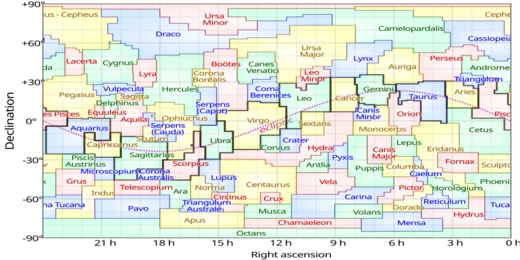
The constellation lies between Aquila, Serpens, Scorpius, Sagittarius, and Hercules, northwest of the Milky Way’s center. Its southern portion sits between Scorpius to the west and Sagittarius to the east. In the Northern Hemisphere, Ophiuchus is most easily seen during summer. It sits opposite Orion. Depicted as a man clutching a serpent, his body splits the snake constellation Serpens into two parts: Serpens Caput and Serpens Cauda. Ophiuchus crosses the equator, with most of its area in the Southern Hemisphere. Its brightest star, Rasalhague, is near the northern edge at about +12° 30′ declination. The constellation stretches southward to −30° declination. Parts of the ecliptic within Ophiuchus lie south of −20° declination.
From November to January—summer in the Southern Hemisphere, winter in the Northern—Ophiuchus is in the daytime sky and therefore invisible at most latitudes. However, in the polar region north of the Arctic Circle during Northern Hemisphere winter, the Sun stays below the horizon even at midday. There, stars (including parts of Ophiuchus, especially Rasalhague) become visible at twilight for a few hours around local noon, low in the south. During Northern Hemisphere spring and summer, when Ophiuchus normally appears in the night sky, it is actually hidden because the midnight sun blocks the stars at those times and places in the Arctic. Near the equator, Ophiuchus is overhead around midnight in June and in the evening sky in October.
The constellation’s brightest stars include α Ophiuchi, called Rasalhague ("head of the serpent charmer"), with a magnitude of 2.07, and η Ophiuchi, known as Sabik ("the preceding one"), at magnitude 2.43. Alpha Ophiuchi consists of an A-type (bluish-white) giant star and a K-type main sequence star; the primary rotates rapidly with a tilted axis. Eta Ophiuchi is a binary system.
Quick Facts
- Abbreviation
- Oph
- Genitive
- Ophiuchi
- Pronounce
- ˌ · ɒ · f · i · ˈ · juː · k · ə · s / genitive: ˌ · ɒ · f · i · ˈ · juː · k · aɪ
- Symbolism
- the serpent-bearer
- Ra
- 17
- Dec
- −8
- Family
- Hercules
- Quadrant
- SQ3
- Areatotal
- 948
- Arearank
- 11th
- Numbermainstars
- 10
- Numberbfstars
- 65
Facts from the source article.
Lore & Background
Ophiuchus lies between Aquila, Serpens, Scorpius, Sagittarius, and Hercules, northwest of the center of the Milky Way. The southern part lies between Scorpius to the west and Sagittarius to the east. In the Northern Hemisphere, it is best visible in summer. It is opposite of Orion. Ophiuchus is depicted as a man grasping a serpent; the interposition of his body divides the snake constellation Serpens into two parts, Serpens Caput and Serpens Cauda. Ophiuchus straddles the equator with the majority of its area lying in the Southern Hemisphere. Rasalhague, its brightest star, lies near the northern edge of Ophiuchus at about +12° 30′ declination. The constellation extends southward to −30° declination. Segments of the ecliptic within Ophiuchus are south of −20° declination.
There is no evidence of the constellation preceding the classical era, and in Babylonian astronomy, a 'Sitting Gods' constellation seems to have been located in the general area of Ophiuchus. However, Gavin White proposes that Ophiuchus may in fact be remotely descended from this Babylonian constellation, representing Nirah, a serpent-god who was sometimes depicted with his upper half human but with serpents for legs. The earliest mention of the constellation is in Aratus.
Reader's Guide
Ophiuchus is notable for containing several bright stars and deep-sky objects. Its brightest star, Rasalhague, is a rapid rotator with an inclined axis. The constellation hosts Barnard's Star, one of the nearest stars to the Solar System, which has been a target for interstellar travel plans such as Project Daedalus. RS Ophiuchi is a recurrent nova that erupts around every 15 years, most recently in 2021, and is thought to be at the brink of becoming a Type Ia supernova. The supernova of 1604, known as Kepler's Supernova, was first observed near θ Ophiuchi; Galileo used its brief appearance to counter the Aristotelian dogma that the heavens are changeless. In 2005, the Ophiuchus Superbubble was discovered, a superbubble so large it extends beyond the plane of the galaxy. The constellation also contains the unusual galaxy merger remnant NGC 6240, which has two supermassive black holes 3,000 light-years apart and an unusually high rate of star formation. In 2022, the nearest stellar black hole, Gaia BH1, was identified in Ophiuchus. The space probe Voyager 1 is traveling in the direction of Ophiuchus.
Mythological Roots & Celestial Identity
Ophiuchus derives its name from the Ancient Greek word ophioûkhos, which translates to "serpent-bearer." The constellation is traditionally depicted as a man clutching a serpent in his grasp, and that serpent is actually the separate constellation Serpens. Because Ophiuchus's body is interposed across the snake, it effectively splits Serpens into two distinct segments: Serpens Caput (the head) and Serpens Cauda (the tail). An older alternative name for this region of sky was Serpentarius. The constellation earned its place among the 48 constellations catalogued by the 2nd-century astronomer Ptolemy, and it has endured through to the present day as one of the 88 officially recognized modern constellations. In English, its pronunciation is commonly rendered as "o-fee-YOO-kəs." This mythological framework of a charmer subduing a serpent gives the constellation a narrative quality that sets it apart from more abstract stellar groupings, and it remains a vivid reminder of how ancient sky-watchers wove story into the patterns of light above.
Position, Visibility & the Equatorial Straddle
Ophiuchus occupies a unique position by straddling the celestial equator, with the bulk of its area falling in the Southern Hemisphere. It stretches from roughly +12° 30′ declination at its northern edge, near Rasalhague, down to −30° declination in the south. It sits between Aquila, Serpens, Scorpius, Sagittarius, and Hercules, northwest of the Milky Way's center. In the Northern Hemisphere it is best observed during summer months and sits directly opposite Orion. This opposition creates an interesting visibility paradox: from November through January, Ophiuchus is lost in daytime glare for most observers. Yet in the Arctic during winter, when the Sun never rises, parts of Ophiuchus—especially Rasalhague—can be glimpsed low in the southern sky around local noon. Conversely, during the Arctic's summer, the midnight sun washes out the very stars that would otherwise be visible. Near the equator, the constellation appears nearly overhead around midnight in June and in the evening sky by October.
Stellar Highlights & Dramatic Cosmic Events
The constellation hosts several notable stars, including Rasalhague (α Ophiuchi, magnitude 2.07), a bluish-white A-type giant paired with a K-type companion, and Sabik (η Ophiuchi, magnitude 2.43), a binary system. Barnard's Star, one of only three stellar systems closer to us than the Alpha Centauri group, resides here and had four planets confirmed in 2025 after years of disputed claims. RS Ophiuchi belongs to the rare class of recurrent novae, brightening by hundreds of times roughly every fifteen years, with its most recent eruption observed in 2021; it is thought to be on the verge of a Type Ia supernova. Perhaps the most famous event tied to Ophiuchus is the 1604 supernova, first sighted near θ Ophiuchi and studied so thoroughly by Johannes Kepler that it bears his name. Galileo seized on its appearance to challenge the Aristotelian belief in an unchanging heavens. More recently, in 2009, astronomers identified GJ 1214, a star just 42 light-years away whose dimming pattern revealed a low-density exoplanet possibly wrapped in hydrogen or steam.
Deep-Sky Treasures & Breakthrough Discoveries
Ophiuchus is a rich hunting ground for deep-sky objects, containing globular clusters M9, M10, M12, M14, M19, M62, and M107, along with open clusters IC 4665 and NGC 6633, and the nebula IC 4603-4604. M10, at just 20,000 light-years, is one of the closer globulars, while M62 and M107 stand out for their abundance of variable stars and multiple stellar generations with differing elemental abundances. The constellation also harbors NGC 6240, a butterfly-shaped galaxy merger remnant 400 million light-years distant that contains two supermassive black holes separated by 3,000 light-years. Beyond individual objects, Ophiuchus has been the site of landmark discoveries: in 2005, Green Bank Telescope data revealed the Ophiuchus Superbubble, a structure so vast it extends beyond the galactic plane, and in 2007, the Swedish Odin satellite detected molecular oxygen clouds in space for the first time, with observations made in this very constellation.
More in Constellations, Part 2 1-24
Spotted an error? Know more?
Reader corrections go straight into our review queue. Suggest an edit · How this site is sourced