Eridanus (constellation)
A sprawling river constellation in the southern sky.

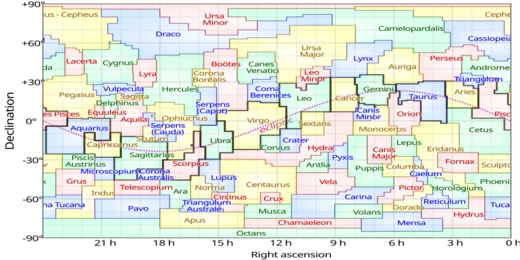
Eridanus is a constellation in the southern celestial hemisphere, depicted as a river. It was one of the 48 constellations cataloged by the astronomer Ptolemy in the 2nd century AD and is still counted among the 88 modern constellations, ranking as the sixth largest. The name was later applied in Latin to the Po River in Italy and to a small river in Athens.
At its southern tip lies Achernar (Alpha Eridani), a blue-white main-sequence star of magnitude 0.5, 144 light-years from Earth. Its traditional name means "the river's end." Achernar is unusually flat—one of the flattest stars known—with an equatorial radius about 50% larger than its polar radius due to extremely rapid rotation. Other notable stars include Beta Eridani (Cursa), a blue-white star of magnitude 2.8, 89 light-years away; its name means "the footstool," referencing its position south of Orion's foot. Theta Eridani (Acamar) is a binary star 161 light-years away, with blue-white components of magnitudes 3.2 and 4.3, separable in small amateur telescopes. 32 Eridani, 290 light-years distant, is a binary with a yellow primary (magnitude 4.8) and a blue-green secondary (magnitude 6.1), also visible in small telescopes. 39 Eridani, 206 light-years away, is a binary divisible in small telescopes, consisting of an orange giant (magnitude 4.9) and a fainter companion (magnitude 8). The triple star system 40 Eridani, 16 light-years from Earth, includes an orange main-sequence star (magnitude 4.4), a white dwarf (magnitude 9.5)—the most easily visible white dwarf—and a red dwarf (magnitude 11) that orbits the white dwarf every 250 years. p Eridani is a binary with two orange components, 27 light-years away, of magnitudes 5.8 and 5.9, orbiting each other every 500 years. Epsilon Eridani (Ran), an orange main-sequence star of magnitude 3.7, 10.5 light-years away, hosts one extrasolar planet roughly the mass of Jupiter, with an orbital period of 7 years.
The Eridanus Supervoid, discovered in 2007, is a vast region nearly devoid of galaxies, about one billion light-years in diameter. It is the second largest known void, after the Giant Void in Canes Venatici. It was identified by linking a "cold spot" in the cosmic microwave background to a lack of radio galaxies in data from the Very Large Array Sky Survey. Some speculate the void might result from quantum entanglement between our universe and another.
Quick Facts
- Abbreviation
- Eri
- Genitive
- Eridani
- Pronounce
- ᵻ · ˈ · r · ɪ · d · ən · ə · s Erídanus, / genitive ᵻ · ˈ · r · ɪ · d · ən · aɪ
- Symbolism
- the river Eridanus
- Ra
- 3.25
- Dec
- −29
- Family
- Heavenly Waters
- Quadrant
- SQ1
- Areatotal
- 1138
- Arearank
- 6th
- Numbermainstars
- 24
- Numberbfstars
- 87
Facts from the source article.
Lore & Background
According to one theory, the Greek constellation takes its name from the Babylonian constellation known as the Star of Eridu (MUL.NUN.KI). Eridu was an ancient city in the extreme south of Babylonia, situated in marshy regions and held sacred to the god Enki-Ea, who ruled the cosmic domain of the Abyss—a mythical conception of the fresh-water reservoir below the Earth's surface. Eridanus is connected to the myth of Phaethon, who took over the reins of his father Helios' sky chariot (the Sun) but lacked the strength to control it, veering wildly and scorching both Earth and heaven. Zeus intervened by striking Phaethon dead with a thunderbolt and casting him to Earth. The constellation was supposed to be the path Phaethon drove along; in later times, it was considered a path of souls. Since Eridanos was also a Greek name for the Po (Latin Padus), in which the burning body of Phaethon is said by Ovid to have extinguished, the mythic geography of the celestial and earthly Eridanus is complex. Another association with Eridanus is a series of rivers all around the world, first conflated with the Nile River in Egypt and also identified with the Po River in Italy. The stars of the modern constellation Fornax were formerly a part of Eridanus.
Reader's Guide
Eridanus is depicted in ancient sky charts as a flowing river, starting from Orion and flowing in a meandering fashion past Cetus and Fornax and into the southern hemispheric stars. Johann Bayer's Uranometria depicts the river constellation as a flowing river. In Indian astronomy, the stars that correspond to Eridanus are also depicted as a river starting close to the head of Orion just below Auriga; it is called Srotaswini in Sanskrit, meaning the course of a river or stream, specifically depicted as the Ganges on the head of Dakshinamoorthy or Nataraja, a Hindu incarnation of Shiva. The stars that correspond to Eridanus cannot be fully seen from China; in Chinese astronomy, the northern part is located within the White Tiger of the West, and the unseen southern part was classified among the Southern Asterisms by Xu Guangqi based on knowledge of western star charts. The constellation has also served as a namesake for the USS Eridanus (AK-92), a United States Navy Crater-class cargo ship, and Éridan, a French cargo liner. Notable deep-sky objects include NGC 1535, a small blue-gray planetary nebula; a portion of the Orion Molecular Cloud Complex; IC 2118, a faint reflection nebula; and several galaxies including NGC 1300, a grand design barred spiral galaxy. The Eridanus Supervoid, discovered as of 2007, is a large supervoid with a diameter of about one billion light years, the second largest known void, with some speculation that it may be due to quantum entanglement between our universe and another.
Did You Know?
- Achernar, the brightest star in Eridanus, is one of the flattest stars known, with a radius about 50% larger at the equator than at the poles due to extremely rapid spin.
- The 40 Eridani system, 16 light-years from Earth, contains the most easily visible white dwarf in the sky.
- Epsilon Eridani (Ran) hosts one extrasolar planet similar to Jupiter, with an approximate mass of one Jupiter mass and an orbital period of 7 years.
- The Eridanus Supervoid, discovered as of 2007, has a diameter of about one billion light years and is the second largest known void.
Stellar Wonders and Peculiarities
At the southern tip of Eridanus blazes Achernar, a blue-white main-sequence star sitting 144 light-years from Earth. Its traditional name translates to 'the river's end,' a fitting title for a star that marks the constellation's farthest reach. What makes Achernar truly extraordinary is its shape: it is one of the most flattened stars known to science. Because it spins at an extreme rate, its equatorial radius swells roughly 50 percent beyond its polar radius, giving it an almost disc-like silhouette. Moving along the river, observers encounter a rich collection of multiple-star systems. Acamar (Theta Eridani) presents a blue-white binary pair 161 light-years away, easily split in modest telescopes. The triple system of 40 Eridani, just 16 light-years distant, pairs an orange main-sequence star with the most easily visible white dwarf in the sky and a red dwarf completing a 250-year orbit. Epsilon Eridani, an orange star only 10.5 light-years out, hosts a Jupiter-mass planet on a seven-year path, making it one of the nearest known exoplanet systems.
The Eridanus Supervoid
Beyond the glittering stars lies a vast cosmic emptiness that dwarfs anything visible to the naked eye. The Eridanus Supervoid, identified as of 2007, stretches roughly one billion light-years across, making it the second-largest known void in the observable universe, trailing only the Giant Void associated with Canes Venatici. Its discovery came through an elegant cross-referencing of two datasets: astronomers linked a 'cold spot' in the cosmic microwave background radiation to a conspicuous absence of radio galaxies in the National Radio Astronomy Observatory's Very Large Array Sky Survey. The sheer scale of this galactic desert has prompted even more speculative ideas. Some researchers have floated the possibility that the void's existence could be explained by quantum entanglement between our universe and another, a hypothesis that remains firmly in the realm of conjecture. Regardless of its ultimate origin, the Eridanus Supervoid stands as a striking reminder that the cosmos is defined as much by what is missing as by what is present.
Mythology and the River's Name
The name Eridanus carries layers of cultural and mythological meaning that stretch back millennia. One theory traces the Greek constellation to the Babylonian 'Star of Eridu' (MUL.NUN.KI), referencing the ancient southern city of Eridu, a marshy settlement sacred to Enki-Ea, the deity governing the Abyss—the mythical fresh-water reservoir beneath the Earth. In Greek tradition, the constellation is bound to the tragic tale of Phaethon, who seized his father Helios's solar chariot and careened wildly across the sky, scorching both heaven and Earth. Zeus struck him down with a thunderbolt, and his burning body was cast to the ground. The meandering path of Eridanus was said to trace the route Phaethon drove, and in later interpretations it became a passage for souls. The name also merged with earthly geography: Eridanos was the Greek term for the Po River in Italy, into which Ovid placed Phaethon's extinguished remains, and was even conflated with the Nile in Egypt. The modern constellation Fornax was once part of Eridanus, reflecting how the river's boundaries shifted over centuries.
Deep-Sky Treasures and Meteor Showers
Eridanus shelters a remarkable assortment of deep-sky objects that reward patient observers. NGC 1300, a face-on grand-design barred spiral galaxy 61 million light-years distant, harbors a peculiar inner structure: a tightly wound spiral measuring 3,300 light-years in diameter nested within the broader spiral arms. Nearby, NGC 1535 offers a small blue-gray planetary nebula at the 9th magnitude, its disk resolvable in larger amateur instruments. The far northeastern corner of the constellation overlaps with a portion of the Orion Molecular Cloud Complex, while IC 2118 presents a faint reflection nebula—possibly an ancient supernova remnant or gas lit by Rigel in neighboring Orion. The constellation also hosts the barred-spiral galaxies NGC 1232, NGC 1234, and NGC 1291. In terms of meteor activity, the Nu Eridanids radiate from this region between late August and mid-September, their parent body an unidentified Oort cloud object, while the Omicron Eridanids peak in early November, adding two seasonal displays to the southern sky.
More in Constellations, Part 2 1-24
Spotted an error? Know more?
Reader corrections go straight into our review queue. Suggest an edit · How this site is sourced