Serpens
The only modern constellation split into two non-contiguous parts.

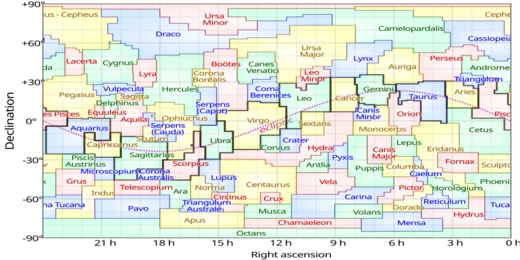
Serpens, from the Ancient Greek *Óphis* meaning "the Serpent," is a constellation found in the northern celestial hemisphere. It was one of the 48 constellations cataloged by the 2nd-century astronomer Ptolemy and is still counted among the 88 modern constellations recognized by the International Astronomical Union. What makes Serpens unique is that it is split into two separate, non-touching parts: Serpens Caput (the Serpent’s Head) to the west and Serpens Cauda (the Serpent’s Tail) to the east. Lying between these two halves is the constellation Ophiuchus, the Serpent-Bearer. In artistic depictions, the serpent’s body is shown passing behind Ophiuchus, running from Mu Serpentis in the head to Nu Serpentis in the tail. The brightest star in Serpens is Alpha Serpentis, also known as Unukalhai, a red giant located in Serpens Caput with an apparent magnitude of 2.63. Also in Serpens Caput are the globular cluster Messier 5, which is visible to the naked eye, and the naked-eye variable stars R Serpentis and Tau4 Serpentis. Notable objects beyond our galaxy include Seyfert’s Sextet, one of the densest known galaxy clusters; Arp 220, the prototype of ultraluminous infrared galaxies; and Hoag’s Object, the most famous example of the rare ring galaxy class. The Milky Way’s galactic plane runs through Serpens Cauda, making this region rich in deep-sky objects. Among them are the Eagle Nebula (IC 4703) and its associated star cluster Messier 16. This nebula spans 70 by 50 light-years and contains the Pillars of Creation, three dust clouds made famous by a Hubble Space Telescope image. Other striking features include the Red Square Nebula, one of the few square-shaped objects known in astronomy, and Westerhout 40, a massive, nearby star-forming region composed of a molecular cloud and an H II region. In Greek mythology, Serpens represents a snake held by the healer Asclepius, who is represented in the sky by Ophiuchus. Asclepius once killed a snake, but another snake revived it by placing a healing herb on it before its death. Because snakes shed their skin each year, they were seen as symbols of rebirth in ancient Greek culture, and legend says Asclepius used the same technique to revive dead humans. This story likely explains why Serpens appears with Ophiuchus, though the true reason remains uncertain.
Quick Facts
- Abbreviation
- Ser
- Genitive
- Serpentis
- Pronounce
- ˈ · s · ɜːr · p · ᵻ · n · z, / genitive s · ər · ˈ · p · ɛ · n · t · ᵻ · s
- Symbolism
- the Snake
- Ra
- Serpens Caput: 15 · 10.4–16 · 22.5 / Serpens Cauda: 17 · 16.9–18 · 58.3
- Dec
- Serpens Caput: 25.66–-03.72 / Serpens Cauda: 06.42–-16.14
- Family
- Hercules
- Areatotal
- Serpens Caput: 428 sq. deg. / Serpens Cauda: 208 sq. deg. / Total: 637
- Arearank
- 23rd
- Numbermainstars
- 11
- Numberbfstars
- 57
- Numberbrightstars
- 1
Facts from the source article.
Lore & Background
In Greek mythology, Serpens represents a snake held by the healer Asclepius. Represented in the sky by the constellation Ophiuchus, Asclepius once killed a snake, but the animal was subsequently resurrected after a second snake placed a revival herb on it before its death. As snakes shed their skin every year, they were known as the symbol of rebirth in ancient Greek society, and legend says Asclepius would revive dead humans using the same technique he witnessed. Although this is likely the logic for Serpens' presence with Ophiuchus, the true reason is still not fully known. Sometimes, Serpens was depicted as coiling around Ophiuchus, but the majority of atlases showed Serpens passing either behind Ophiuchus' body or between his legs. In some ancient atlases, the constellations Serpens and Ophiuchus were depicted as two separate constellations, although more often they were shown as a single constellation. One notable figure to depict Serpens separately was Johann Bayer; thus, Serpens' stars are cataloged with separate Bayer designations from those of Ophiuchus. When Eugène Delporte established modern constellation boundaries in the 1920s, he elected to depict the two separately. However, this posed the problem of how to disentangle the two constellations, with Delporte deciding to split Serpens into two areas—the head and the tail—separated by the continuous Ophiuchus. These two areas became known as Serpens Caput and Serpens Cauda, caput being the Latin word for head and cauda the Latin word for tail. In Chinese astronomy, most of the stars of Serpens represented part of a wall surrounding a marketplace, known as Tianshi, which was in Ophiuchus and part of Hercules. Serpens also contains a few Chinese constellations. Two stars in the tail represented part of Shilou, the tower with the market office. Another star in the tail represented Liesi, jewel shops. One star in the head (Mu Serpentis) marked Tianru, the crown prince's wet nurse, or sometimes rain. There were two 'serpent' constellations in Babylonian astronomy, known as Mušḫuššu and Bašmu. It appears that Mušḫuššu was depicted as a hybrid of a dragon, a lion and a bird, and loosely corresponded to Hydra. Bašmu was a horned serpent (cf. Ningishzida) and roughly corresponds to the Ὄφις constellation of Eudoxus of Cnidus on which the Ὄφις (Serpens) of Ptolemy is based.
Reader's Guide
Serpens is notable as the only modern constellation split into two disconnected regions: Serpens Caput (the head) and Serpens Cauda (the tail). It is also unusual in that it depends on another constellation for context—specifically, it is being held by the Serpent Bearer Ophiuchus. Covering 636.9 square degrees, it ranks 23rd of the 88 constellations in size. Its brightest star is Alpha Serpentis (Unukalhai), a red giant of magnitude 2.63. Serpens Caput contains the naked-eye globular cluster Messier 5 and the naked-eye variables R Serpentis and Tau4 Serpentis. Notable extragalactic objects include Seyfert's Sextet, one of the densest galaxy clusters known; Arp 220, the prototypical ultraluminous infrared galaxy; and Hoag's Object, the most famous of the very rare class of galaxies known as ring galaxies. Part of the Milky Way's galactic plane passes through Serpens Cauda, which is rich in galactic deep-sky objects such as the Eagle Nebula (IC 4703) and its associated star cluster Messier 16, which contains the Pillars of Creation. Other striking objects include the Red Square Nebula and Westerhout 40, a massive nearby star-forming region. The constellation's history includes Greek mythology linking it to Asclepius, and its modern boundaries were set by Eugène Delporte in the 1920s, who split Serpens into two areas separated by Ophiuchus.
Did You Know?
- Serpens is the only modern constellation split into two non-contiguous parts: Serpens Caput and Serpens Cauda.
- The brightest star in Serpens is Alpha Serpentis, also called Unukalhai, a red giant with an apparent magnitude of 2.63.
- Serpens Cauda contains the Eagle Nebula and the Pillars of Creation, made famous by the Hubble Space Telescope.
The Only Constellation in Two Pieces
Serpens holds a distinction no other constellation in the modern sky can claim: it exists as two physically separate patches of stars, with an entire third constellation wedged between them. The western fragment, Serpens Caput, and the eastern fragment, Serpens Cauda, are divided by Ophiuchus, the Serpent-Bearer, whose figure the ancients imagined gripping the creature's body. In traditional star charts, the serpent's form is drawn as passing behind Ophiuchus, with the connection point falling between Mu Serpentis in the head and Nu Serpentis in the tail. This structural quirk means Serpens cannot be understood in isolation; it relies on Ophiuchus for its very identity. Despite the split, the constellation spans 636.9 square degrees, placing it 23rd among the 88 recognized constellations. Its principal asterism comprises eleven stars, and a total of 108 stars within its borders shine brighter than the traditional naked-eye limit of magnitude 6.5. During the Northern Hemisphere's summer, Serpens arcs across both the northern and southern skies, a reminder that even a divided constellation commands a wide swath of the celestial dome.
The Serpent in Myth and Memory
In Greek tradition, Serpens maps the snake gripped by Asclepius, the divine healer whose figure fills the neighboring constellation Ophiuchus. The myth recounts Asclepius slaying a serpent, only for a second snake to place a restorative herb upon the dying creature, reviving it. Since snakes shed their skin each year, the ancient Greeks read them as emblems of renewal, and legend says Asclepius mimicked that process to bring the dead back to life. Yet the precise symbolic logic behind the serpent's celestial pairing with the healer remains debated. In star charts, the creature is sometimes drawn coiling around Ophiuchus, though most atlases show it passing behind his body or threading between his legs. The serpent's story traveled far beyond the Mediterranean. In Chinese astronomy, most of Serpens' stars formed part of Tianshi, a wall surrounding a marketplace, while scattered stars marked a market office tower, jewel shops, and the crown prince's wet nurse. Babylonian sky-watchers identified two serpent figures: Mušḫuššu, a dragon-lion-bird hybrid loosely corresponding to Hydra, and Bašmu, a horned serpent associated with the deity Ningishzida, which aligns with the Óphis constellation first catalogued by Eudoxus of Cnidus and later carried into Ptolemy's list.
A Treasury of Deep-Sky Wonders
Few constellations pack as much astronomical variety into their borders as Serpens. In the head, the red giant Alpha Serpentis—known by its traditional name Unukalhai—glows at magnitude 2.63 from roughly 23 parsecs away. Nearby, Lambda Serpentis, a Sun-like star just 12 parsecs distant, hosts a confirmed exoplanet. The head also shelters the naked-eye globular cluster Messier 5 and the variable stars R Serpentis and Tau4 Serpentis. Beyond our galaxy, Serpens Caput contains some of the most extreme objects known: Seyfert's Sextet, one of the densest galaxy groupings identified; Arp 220, the prototypical ultraluminous infrared galaxy; and Hoag's Object, the most celebrated example of the exceedingly rare ring-galaxy class. The tail, threaded by the Milky Way's galactic plane, offers a different kind of richness. The Eagle Nebula, spanning 70 by 50 light-years, cradles the Pillars of Creation—three towering dust columns immortalized by the Hubble Space Telescope—alongside the young star cluster Messier 16. The Red Square Nebula, one of the very few astronomical objects with a genuinely square outline, and Westerhout 40, a massive nearby star-forming region of molecular cloud and H II region, complete a catalog that spans from naked-eye gems to the most exotic galaxies.
From Ptolemy's Catalog to Modern Boundaries
Serpens has survived two millennia of shifting astronomical practice. The 2nd-century astronomer Ptolemy included it among his 48 constellations, and the International Astronomical Union retains it as one of the 88 official figures of the modern sky, assigning it the abbreviation "Ser" in 1922. For centuries, the relationship between Serpens and Ophiuchus was ambiguous: some atlases treated them as a single combined figure, while others, most notably the German astronomer Johann Bayer, drew them as separate entities, giving Serpens its own independent set of Bayer star designations. The definitive modern split came when Belgian astronomer Eugène Delporte drew precise boundaries in the 1920s and 1930s. Faced with separating the intertwined serpent and bearer, Delporte chose to bisect Serpens into two distinct regions—Caput, outlined by a 10-sided polygon, and Cauda, enclosed by a 22-sided polygon—with Ophiuchus occupying the continuous strip between them. In equatorial coordinates, the head stretches from right ascension 15h 10.4m to 16h 22.5m and declination 25.66° to −03.72°, while the tail spans right ascension 17h 16.9m to 18h 58.3m and declination 06.42° to −16.14°. The head is bordered by Libra, Virgo, Boötes, Corona Borealis, Ophiuchus, and Hercules; the tail by Sagittarius, Scutum, Aquila, and Ophiuchus.
More in Constellations, Part 2 1-24
Spotted an error? Know more?
Reader corrections go straight into our review queue. Suggest an edit · How this site is sourced