Monoceros
A faint equatorial constellation named for the unicorn.

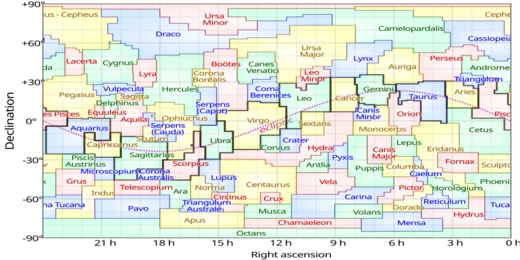
Monoceros (Greek for "unicorn") is a dim constellation lying on the celestial equator. It was first defined by the 17th-century mapmaker Petrus Plancius. Orion sits to its west, Gemini to its north, Canis Major to its south, and Hydra to its east; Canis Minor, Lepus, and Puppis also border it.
Only a handful of stars in Monoceros reach fourth magnitude, so the constellation is hard to spot without optical aid. Alpha Monocerotis shines at magnitude 3.93, and Gamma Monocerotis at 3.98. Beta Monocerotis is a triple star system whose three components form a fixed triangle, with magnitudes of 4.7, 5.2, and 6.1; William Herschel discovered it in 1781 and called it one of the most beautiful sights in the heavens. Epsilon Monocerotis is a fixed binary with magnitudes 4.5 and 6.5. S Monocerotis (also designated 15 Monocerotis) is a bluish-white variable star at the heart of NGC 2264, varying slightly between magnitudes 4.2 and 4.6, and it has an 8th-magnitude companion. V838 Monocerotis, a red supergiant variable, erupted on January 6, 2002; by February its brightness had surged 10,000-fold in a single day. After the outburst, the Hubble Space Telescope captured a light echo illuminating the surrounding dust. Monoceros also holds Plaskett’s Star, a massive binary whose combined mass, based on 2008 calculations, approaches 100 solar masses. Scholz’s Star, a binary system with a red dwarf primary and a brown dwarf secondary, passed within 120,000 astronomical units of the Sun about 70,000 years ago, grazing the Oort cloud. One of the nearest known black holes lies here: A0620-00, a binary system roughly 3,300 light-years away, whose black hole is estimated at 6.6 solar masses.
Two super-Earth exoplanets orbit in one planetary system in Monoceros. CoRoT-7b was detected by the CoRoT satellite, and CoRoT-7c by the HARPS ground-based instrument. Until Kepler-10b was announced in January 2011, CoRoT-7b was the smallest exoplanet with a measured diameter—1.58 times Earth’s, giving it about 3.95 times Earth’s volume. Both planets were discovered in 2009.
Because the galactic plane runs through Monoceros, interstellar dust hides background galaxies. The constellation is rich in clusters and nebulae. Messier 50 is an open cluster.
Quick Facts
- Abbreviation
- Mon
- Genitive
- Monocerotis
- Pronounce
- m · ə · ˈ · n · ɒ · s · ᵻ · r · ə · s, / genitive m · ə · ˌ · n · ɒ · s · ᵻ · ˈ · r · oʊ · t · ᵻ · s
- Symbolism
- the Unicorn
- Ra
- 7.15
- Dec
- −5.74
- Family
- Orion
- Quadrant
- NQ2
- Areatotal
- 482
- Arearank
- 35th
- Numbermainstars
- 4
- Numberbfstars
- 32
Facts from the source article.
Lore & Background
In Western astronomy, Monoceros is a relatively modern constellation, not one of Ptolemy's 48 in the Almagest. Its first certain appearance was on a globe created by the cartographer Petrus Plancius in 1612 or 1613, and it was later charted by German astronomer Jakob Bartsch as Unicornu on his star chart of 1624. German astronomers Heinrich Wilhelm Olbers and Ludwig Ideler indicate (according to Richard Hinckley Allen's allegations) that the constellation may be older, quoting an astrological work from 1564 that mentioned 'the second horse between the Twins and the Crab has many stars, but not very bright'; these references may ultimately be due to the 13th century Scotsman Michael Scot, but refer to a horse and not a unicorn, and its position does not quite match. Joseph Scaliger (died 1609) is reported to have found Monoceros on an ancient Persian sphere. Astronomer Camille Flammarion (died 1925) believed that a former constellation, Neper (the 'Auger'), occupied the part of that sky now deemed Monoceros and Microscopium, but this is disputed. Chinese asterisms Sze Fūh, the Four Great Canals; Kwan Kew; and Wae Choo, the Outer Kitchen, all lay within the boundaries of Monoceros.
Reader's Guide
Monoceros is notable for containing a variety of astronomical objects of interest. Among its stars, Beta Monocerotis is a triple star system discovered by William Herschel in 1781, which he called 'one of the most beautiful sights in the heavens'. The constellation also hosts V838 Monocerotis, a variable red supergiant that had an outburst starting on January 6, 2002, increasing in brightness by a factor of 10,000 in one day; afterward, the Hubble Space Telescope observed a light echo illuminating the surrounding dust. Plaskett's Star, a massive binary system with a combined mass estimated at almost 100 solar masses, lies in Monoceros, as does the binary system Scholz's Star, which performed a close flypast of the Solar System approximately 70,000 years ago. One of the nearest known black holes to the Solar System, A0620-00, is in this constellation, at a distance of roughly 3,300 light-years. Monoceros contains two Super-Earth exoplanets in the CoRoT-7 system, discovered in 2009; CoRoT-7b was the smallest exoplanet to have its diameter measured until the announcement of Kepler-10b. Deep-sky objects include Messier 50, the Rosette Nebula, the Christmas Tree Cluster, the Cone Nebula, NGC 2254, Hubble's Variable Nebula, and IC 447. Part of the galactic plane goes through Monoceros, so background galaxies are concealed by interstellar dust.
Origins and Historical Attribution
Monoceros is a relatively modern addition to Western astronomy, entirely absent from Ptolemy's 48 constellations recorded in the Almagest. Its first confirmed appearance on the celestial map came on a globe crafted by the Dutch cartographer Petrus Plancius around 1612 or 1613, after which the German astronomer Jakob Bartsch charted it under the Latin name Unicornu on his 1624 star chart. Nevertheless, hints of an older lineage persist. Heinrich Wilhelm Olbers and Ludwig Ideler cited a 1564 astrological text describing a dim, star-rich horse situated between the Twins and the Crab, a reference possibly traceable to the 13th-century Scotsman Michael Scot, though it names a horse rather than a unicorn and its position is slightly askew. Joseph Scaliger reportedly spotted Monoceros on an ancient Persian sphere, and Camille Flammarion proposed that a now-lost constellation called Neper, the Auger, once occupied this stretch of sky alongside Microscopium, a claim that remains contested. In Chinese astronomy, the region was home to asterisms including Sze Fūh, the Four Great Canals, Kwan Kew, and Wae Choo, the Outer Kitchen.
Stellar Wonders and Dramatic Events
Monoceros shelters some of the most spectacular stellar phenomena visible in the night sky. Beta Monocerotis, a triple system whose three components form a fixed triangle with magnitudes of 4.7, 5.2, and 6.1, was spotted by William Herschel in 1781, who hailed it as one of the most beautiful sights in the heavens. Far more dramatic is V838 Monocerotis, a red supergiant that erupted on January 6, 2002, and by February had surged in brightness by a factor of ten thousand in a single day. Once the outburst subsided, the Hubble Space Telescope captured a light echo that illuminated the dust shrouding the star. The constellation also hosts Plaskett's Star, a binary whose combined mass approaches 100 solar masses according to 2008 calculations, and Scholz's Star, a red dwarf paired with a brown dwarf that swept within 120,000 astronomical units of the Sun roughly 70,000 years ago. Perhaps most striking is the binary A0620-00, some 3,300 light-years distant, which contains one of the nearest known black holes to the Solar System, estimated at 6.6 solar masses.
Deep-Sky Objects and Nebulae
A segment of the galactic plane threads through Monoceros, and the resulting interstellar dust conceals many background galaxies, yet the constellation more than compensates with a rich treasury of clusters and nebulae. The Rosette Nebula, a diffuse cloud spanning over 100 light-years at a distance of 4,900 light-years, harbors an associated star cluster and numerous Bok globules tucked into its dark lanes. Lewis Swift and Edward Emerson Barnard each discovered it independently during the 1880s while hunting for comets. The Christmas Tree Cluster, NGC 2264, glows at magnitude 3.9 some 2,400 light-years away, its shape earning a festive name; variable star S Monocerotis marks the trunk while V429 Monocerotis sits at the topper. The nearby Cone Nebula, though very dim and elusive through a telescope, reveals a dark conic structure in photographs and hosts several Herbig-Haro objects tied to protostars. Hubble's Variable Nebula, NGC 2261, was found by Herschel in 1783 and is lit by the young variable R Monocerotis, a pairing that makes it simultaneously an emission and a reflection nebula.
Exoplanets and the Faint Sky
Monoceros earned a notable place in exoplanet history through the CoRoT-7 system, which contains two Super-Earth worlds. CoRoT-7b was detected by the CoRoT space satellite, while its sibling CoRoT-7c was identified using the High Accuracy Radial Velocity Planet Searcher from ground-based observatories; both were announced in 2009. CoRoT-7b, measuring 1.58 times Earth's diameter and roughly 3.95 times its volume, held the distinction of being the smallest exoplanet with a confirmed diameter until Kepler-10b was revealed in January 2011. The constellation itself is faint, containing only a handful of fourth-magnitude stars, with Alpha Monocerotis at visual magnitude 3.93 and Gamma Monocerotis at 3.98, making it a challenge for the unaided eye. Yet within this dim patch of sky, bordered by Orion to the west, Gemini to the north, Canis Major to the south, and Hydra to the east, astronomers have uncovered black holes, supergiant eruptions, and rocky worlds that rival our own in scale.
More in Constellations, Part 2 1-24
Spotted an error? Know more?
Reader corrections go straight into our review queue. Suggest an edit · How this site is sourced