Cetus (constellation)
A water constellation home to the first known variable star.

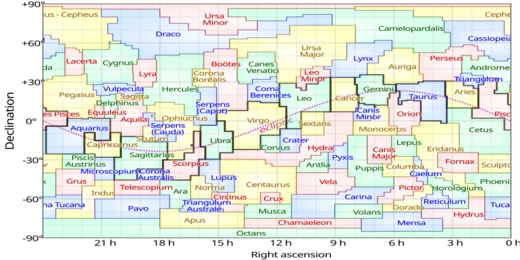
Cetus ( SEE-təss) is a constellation, sometimes called 'the whale' in English. It is notable for containing the first variable star to be discovered, Mira, and for lying in a region of the sky with other water-related constellations: Aquarius, Pisces and Eridanus. The ecliptic passes less than 0.25° from one of its corners, so the Moon and planets briefly enter Cetus in 50% of their successive orbits.
Quick Facts
- Abbreviation
- Cet
- Genitive
- Ceti
- Pronounce
- ˈ · s · iː · t · ə · s SEE · təss, genitive ˈ · s · iː · t · aɪ SEE · tye
- Symbolism
- the Whale, Shark, or Sea Monster
- Ra
- 00 · 26 · 22.2486–03 · 23 · 47.1487
- Dec
- 10.5143948–-24.8725095
- Family
- Perseus
- Areatotal
- 1231
- Arearank
- 4th
- Numbermainstars
- 14
- Numberbfstars
- 88
- Numberbrightstars
- 2
Facts from the source article.
Lore & Background
In Greek mythology, the Cetus was a large sea monster which both Perseus and Heracles needed to slay. Cetus may have originally been associated with a whale in Mesopotamian cultures. It is often now called the Whale, though it is most strongly associated with the sea-monster slain by Perseus as he saved Andromeda. The constellation is in the middle of 'The Sea' recognised by mythologists, a set of water-associated constellations including Eridanus, Pisces, Piscis Austrinus and Aquarius. Despite this, there are no specific references to the stars of Cetus in Babylonian sources. Cetus has been depicted in many ways throughout its history. In the 17th century, Johann Bayer depicted it as a 'dragon fish', while both Willem Blaeu and Andreas Cellarius depicted Cetus as a whale-like creature in the same century. It has also been variously depicted with animal heads attached to a piscine body. In non-Western astronomy, the Tukano and Kobeua people of the Amazon used the stars of Cetus to create a jaguar representing the god of hurricanes. In Hawaii, the constellation was called Na Kuhi, and Mira may have been called Kane.
Reader's Guide
Cetus is significant for containing Mira, the first variable star discovered, which over 332 days varies from magnitude 3 to 10, giving it the name 'wonderful' due to its seeming appearance and disappearance. The constellation also hosts several notable stars: α Ceti (Menkar), a red-hued giant; β Ceti (Diphda), the brightest star; γ Ceti (Kaffaljidhma), a close double; and Tau Ceti, a near Sun-like star at 11.9 light-years. UV Ceti is a binary system of two red dwarfs, one a flare star prone to sudden outbursts.
Deep-sky objects in Cetus include many distant galaxies because the constellation lies far from the galactic plane. The brightest is Messier 77, a face-on spiral Seyfert galaxy. The Pisces–Cetus Supercluster Complex is one of the largest known structures in the observable Universe, containing the Virgo Supercluster. Other objects include the planetary nebula NGC 246 (the 'Cetus Ring' or 'Pac-Man Nebula'), the irregular dwarf galaxy IC 1613, and the Wolf–Lundmark–Melotte barred irregular galaxy. The galactic cluster JKCS 041 is the most distant cluster of galaxies yet discovered. The constellation also contains the massive cD galaxy Holmberg 15A and the ultra-diffuse galaxy NGC 1052-DF2.
Did You Know?
- The ecliptic passes less than 0.25° from one corner of Cetus, so the southern part of the Sun appears in Cetus for about 14 hours each year on March 27 to 28.
- Mira (Omicron Ceti) was the first variable star discovered, by David Fabricius in 1596.
- UV Ceti is an unusual binary variable star.
Mythological Roots & Cultural Depictions
Cetus carries a dual identity in the night sky: a sea monster from Greek legend and, in older traditions, perhaps a whale revered by Mesopotamian cultures. In the most familiar telling, the creature was the beast Poseidon unleashed upon the coast, threatening the princess Andromeda until Perseus slew it. Heracles also faced this monster in his own mythic cycle. The constellation sits at the heart of what mythologists call "The Sea," a cluster of water-themed constellations including Eridanus, Pisces, Piscis Austrinus, and Aquarius. Yet despite its prominence in Greek storytelling, no specific Babylonian references to Cetus's stars have been found. Artistic renderings have varied wildly: Johann Bayer painted a "dragon fish" in the 1600s, while Willem Blaeu and Andreas Cellarius chose a more whale-like form. Other artists attached animal heads to a fish body. In Chinese astronomy, Cetus's stars are split between the Black Tortoise of the North and the White Tiger of the West, while the Tukano and Kobeua peoples of the Amazon also wove the stars into their own cosmologies.
Stellar Treasures of the Whale
Cetus hosts a remarkable roster of stars. Mira, designated Omicron Ceti by Bayer, holds the distinction of being the first variable star ever identified, discovered by David Fabricius in 1596. Over its 332-day cycle it swells from 400 to 500 solar diameters, brightening to naked-eye magnitude 3 before fading to magnitude 10; its apparent vanishing earned it a name meaning "wonderful." At 420 light-years it remains the prototype of the Mira variable class. Alpha Ceti, or Menkar meaning "the nose," is a red giant of magnitude 2.5 at 220 light-years, paired with a blue-white companion, 93 Ceti. Beta Ceti, officially Diphda, is the constellation's brightest star at magnitude 2.0, an orange giant 96 light-years away whose traditional name Deneb Kaitos translates to "the whale's tail." Gamma Ceti, Kaffaljidhma, is a tight double with a blue primary. Tau Ceti, a Sun-like yellow main-sequence star at just 11.9 light-years, draws exoplanet researchers' attention. UV Ceti, a pair of red dwarfs 8.7 light-years out, includes a flare star whose random outbursts can spike brightness to magnitude 7.
Deep-Sky Wonders & Cosmic Architecture
Because Cetus sits far from the Milky Way's dense galactic plane, its sky is relatively free of obscuring dust, making it a prime hunting ground for distant galaxies. Messier 77, a face-on spiral about 50 million light-years away, is the brightest deep-sky object here; its nucleus glows at magnitude 10, and as a Seyfert galaxy it shines brightly in radio wavelengths. The Pisces–Cetus Supercluster Complex, a vast galaxy filament, ranks among the largest known structures in the observable universe and even encompasses the Virgo Supercluster and our Local Group. Within Cetus's borders lie the massive cD galaxy Holmberg 15A, the ultra-diffuse galaxy NGC 1052-DF2, the irregular dwarf IC 1613, and the barred irregular galaxy WLM, discovered by Max Wolf in 1909. The planetary nebula NGC 246, nicknamed the "Cetus Ring" or "Pac-Man Nebula" by amateur observers, sits 1,600 light-years out. Most recently, the cluster JKCS 041 was confirmed as the most distant galaxy cluster yet found, while the object MoM-BH*-1, classified as a "little red dot," was proposed in 2026 to be a black hole star.
Ecliptic Proximity & Orbital Interactions
Although Cetus is not one of the twelve classical zodiac constellations, the ecliptic grazes within 0.25 degrees of one of its corners, creating a fascinating orbital relationship. This close proximity means the Moon and planets will drift into Cetus during roughly half of their successive orbits, occasionally occulting its stars as they pass in front. The Sun's southern limb also clips into the constellation for approximately 14 hours around March 27 to 28 each year. Asteroids with slightly greater orbital inclinations than the Moon or planets can cast longer occultation shadows across the north-western portion of Cetus. From the perspective of Mars, the apparent plane of the Sun and the average planetary plane both pass through the constellation, making it a point of celestial intersection in Martian skies. Bayer originally assigned designations from Alpha through Psi to the constellation's prominent stars, with later additions of Phi, Kappa, and Xi; however, Psi Ceti was eventually removed after astronomers determined it was a duplicate of Xi Arietis.
More in Constellations, Part 2 1-24
Spotted an error? Know more?
Reader corrections go straight into our review queue. Suggest an edit · How this site is sourced