Taurus (constellation)
An ancient zodiac constellation featuring the Pleiades and the Crab Nebula.

Taurus, meaning "Bull" in Latin, is a zodiac constellation found in the northern celestial hemisphere. It stands out as a large, prominent feature of the winter sky in the Northern Hemisphere and ranks among the oldest known constellations, with origins reaching back to the Early Bronze Age. Back then, it marked where the Sun sat during the spring equinox. Because of its link to the agricultural calendar, bull figures inspired by Taurus appeared in the myths of ancient Sumer, Akkad, Assyria, Babylon, Egypt, Greece, and Rome. Its traditional astrological symbol, ♉︎, looks like a bull’s head. Several features in Taurus catch astronomers’ attention. Two of the nearest open clusters to Earth—the Pleiades and the Hyades—lie within it, both visible without a telescope. The brightest star, Aldebaran, is a red giant shining at first magnitude. In the northeastern part of the constellation sits Messier 1, also called the Crab Nebula, a supernova remnant that contains the Crab Pulsar. The Taurus-Auriga complex, one of the closest regions where stars are actively forming, crosses into the northern section. The variable star T Tauri serves as the prototype for a class of pre-main-sequence stars.
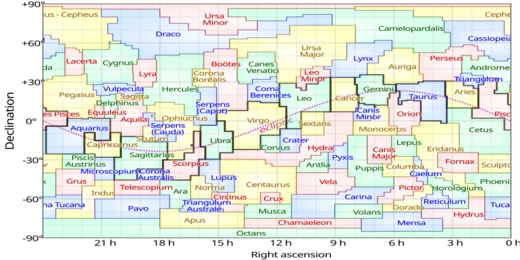
Taurus is large and prominent in the Northern Hemisphere’s winter sky, positioned between Aries to the west and Gemini to the east. To the north lie Perseus and Auriga; to the southeast, Orion; to the south, Eridanus; and to the southwest, Cetus. Around late November to early December, Taurus reaches opposition—its farthest point from the Sun—and stays visible all night. By late March, it sets at sunset and vanishes behind the Sun’s glare from May through July. As part of the zodiac, the ecliptic cuts through Taurus. This circle across the celestial sphere traces the Sun’s apparent path as Earth orbits each year. Because the Moon and planets orbit near the ecliptic, they often appear in Taurus at some point during the year. The Milky Way’s galactic plane crosses the northeast corner of the constellation, and the galactic anticenter lies near the border between Taurus and Auriga. Taurus is the only constellation crossed by all three of the galactic equator, celestial equator, and ecliptic. A ring-like galactic structure called Gould’s Belt also passes through it.
Quick Facts
- Abbreviation
- Tau
- Genitive
- Tauri
- Pronounce
- ˈ · t · ɔː · r · ə · s TOR · əs; · genitive ˈ · t · ɔr · aɪ TOR · eye
- Symbolism
- the Bull
- Ra
- 4.9
- Dec
- 19
- Family
- Zodiac
- Quadrant
- NQ1
- Areatotal
- 797
- Arearank
- 17th
- Numberbfstars
- 132
- Numberbrightstars
- 4
Facts from the source article.
Lore & Background
Taurus is one of the oldest constellations, dating back to the Early Bronze Age at least, when it marked the location of the Sun during the spring equinox. Its importance to the agricultural calendar influenced various bull figures in the mythologies of Ancient Sumer, Akkad, Assyria, Babylon, Egypt, Greece, and Rome. Its traditional astrological symbol resembles a bull's head. Taurus is a large and prominent constellation in the Northern Hemisphere's winter sky, between Aries to the west and Gemini to the east; to the north lies Perseus and Auriga, to the southeast Orion, to the south Eridanus, and to the southwest Cetus. In late November-early December, Taurus reaches opposition and is visible the entire night. By late March, it is setting at sunset and completely disappears behind the Sun's glare from May to July. The constellation is intersected by the ecliptic, and the galactic plane of the Milky Way intersects its northeast corner. Taurus is the only constellation crossed by all three of the galactic equator, celestial equator, and ecliptic.
Reader's Guide
Taurus is significant for its many features of interest to astronomers. It hosts two of the nearest open clusters to Earth, the Pleiades and the Hyades, both visible to the naked eye. At first magnitude, the red giant Aldebaran is the brightest star in the constellation, forming the bull's bloodshot eye in a V-shaped asterism created by the Hyades. In the northeast part of Taurus is Messier 1, the Crab Nebula, a supernova remnant containing the Crab Pulsar, created by a Type II supernova seen from Earth on July 4, 1054. One of the closest regions of active star formation, the Taurus-Auriga complex, crosses into the northern part of the constellation. The variable star T Tauri is the prototype of a class of pre-main-sequence stars. The constellation also contains the Crystal Ball Nebula (NGC 1514), a planetary nebula of historical interest. The recommended three-letter abbreviation for the constellation, as adopted by the International Astronomical Union in 1922, is 'Tau', and its official boundaries were set by Belgian astronomer Eugène Delporte in 1930.
Did You Know?
- The Crab Nebula (M1) was created by a Type II supernova explosion seen from Earth on July 4, 1054.
- Aldebaran's name derives from the Arabic al-dabarān, meaning 'the follower', probably because it follows the Pleiades across the sky.
Ancient Roots and Mythological Resonance
Taurus stands as one of the oldest recognized constellations, with origins reaching back to the Early Bronze Age. During that era it marked the Sun's position at the spring equinox, making it a vital reference point for agricultural calendars. That practical significance rippled outward into the mythologies of numerous ancient civilizations—Sumer, Akkad, Assyria, Babylon, Egypt, Greece, and Rome each developed their own bull figures inspired by this stretch of sky. The constellation's traditional astrological symbol, a stylized bull's head, preserves that ancient association to this day. As a member of the zodiac, Taurus is intersected by the ecliptic, the apparent annual path of the Sun across the celestial sphere. Because the orbital planes of the Moon and the planets lie close to this same circle, those wandering bodies can typically be found within Taurus's borders at some point during each year, reinforcing its role as a celestial landmark for observers across millennia.
The Bull's Face and the Seven Sisters
The heart of Taurus is defined by two of the nearest open star clusters to Earth: the Hyades and the Pleiades, both visible without optical aid. The Hyades form a V- or K-shaped asterism that outlines the bull's face, with Aldebaran—an orange K5 III giant at first magnitude—serving as the bull's bloodshot eye, described as glaring menacingly at Orion to the southeast. Aldebaran, whose Arabic name al-dabarān means "the follower" for its nightly trail behind the Pleiades, carries roughly 116 percent of the Sun's mass and hosts a candidate exoplanet. The Hyades span about five degrees of sky and include the naked-eye double star Theta Tauri, known by the proper name Chamukuy. To the northwest, the Pleiades (M45) shine as the "Seven Sisters," their seven brightest members at magnitude six or better. Astronomers estimate the cluster contains 500 to 1,000 stars, all roughly 100 million years old, ranging from large bright stars to brown and white dwarfs. Classified as irregularly shaped and loosely concentrated, the Pleiades are expected to dissipate within about 250 million years.
Supernova Remnants and Newborn Stars
Beyond its bright stars, Taurus harbors some of the most scientifically significant deep-sky objects in the night sky. In the constellation's northeast region lies Messier 1, the Crab Nebula, a supernova remnant that contains the Crab Pulsar. Equally remarkable is the Taurus-Auriga complex, one of the closest regions of active star formation to Earth, stretching across the northern part of Taurus and into neighboring Auriga. Within this complex sits T Tauri, a variable star that serves as the prototype for an entire class of pre-main-sequence stars. The constellation also hosts several eclipsing binary systems: Zeta Tauri, known by the proper name Tianguan, completes its orbit every 133 days, while Lambda Tauri, a B3 star orbited by a less massive A4 companion, dims by 1.1 magnitudes every 3.953 days as the dimmer star partially eclipses the brighter one. Their separation of just 0.1 astronomical units means tidal forces visibly deform both stellar shapes.
Celestial Geometry and Seasonal Visibility
Taurus occupies a large, prominent position in the Northern Hemisphere's winter sky, bordered by Aries to the west, Gemini to the east, Perseus and Auriga to the north, Orion to the southeast, Eridanus to the south, and Cetus to the southwest. It reaches opposition—its furthest point from the Sun and best all-night visibility—in late November through early December. By late March it is setting at sunset, and from May to July it vanishes entirely behind the Sun's glare. Taurus holds a unique geometric distinction: it is the only constellation crossed by all three major celestial circles—the galactic equator, the celestial equator, and the ecliptic. The galactic plane of the Milky Way intersects its northeast corner, while the galactic anticenter sits near the Taurus-Auriga border. A ring-like structure called Gould's Belt also passes through the constellation. The IAU adopted "Tau" as its three-letter abbreviation in 1922, and Belgian astronomer Eugène Delporte defined its official boundaries in 1930 as a 26-segment polygon spanning right ascension from 03h 23.4m to 05h 53.3m and declination from +31.10° to −1.35°.
More in Constellations, Part 2 1-24
Spotted an error? Know more?
Reader corrections go straight into our review queue. Suggest an edit · How this site is sourced