Pisces (constellation)
A zodiac constellation of two fishes connected by cords.

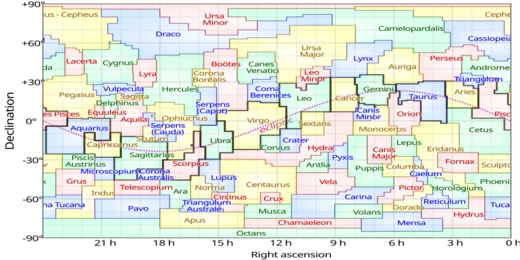
Pisces is a constellation of the zodiac, its name Latin for 'fishes'. Its vast bulk and main asterism, viewed in most European cultures per Greco-Roman antiquity as a distant pair of fishes connected by one cord each that join at an apex, lie in the Northern celestial hemisphere. It is notable because the ecliptic and the celestial equator intersect within this constellation at the first point of Aries, and the Sun passes directly overhead of the equator at approximately this point at the March equinox. The March equinox is currently situated in Pisces, directly south of ω Psc, and due to precession it is gradually drifting westward toward Aquarius.
Quick Facts
- Abbreviation
- Psc
- Genitive
- Piscium
- Pronounce
- ˈ · p · aɪ · s · iː · z; genitive ˈ · p · ɪ · ʃ · i · əm
- Symbolism
- the Fishes
- Ra
- 1
- Dec
- +15
- Family
- Zodiac
- Quadrant
- NQ1
- Areatotal
- 889
- Arearank
- 14th
- Numbermainstars
- 18
- Numberbfstars
- 86
Facts from the source article.
Lore & Background
Pisces originates from some composition of the Babylonian constellations Šinunutu4 'the great swallow' in current western Pisces, and Anunitum the 'Lady of the Heaven' at the place of the northern fish. In first-millennium BC texts known as the Astronomical Diaries, part of the constellation was also called DU.NU.NU (Rikis-nu.mi, 'the fish cord or ribbon'). In Greco-Roman mythology, Pisces is associated with the legend that Aphrodite and her son Eros either shape-shifted into forms of fishes to escape the monster Typhon, or were rescued by two fishes. According to Hyginus, Aphrodite and Eros fled by leaping into the Euphrates River and transforming into fishes. The Roman variant has Venus and Cupid carried away on the backs of two fishes. Another origin tale preserved by Hyginus tells of an egg that rolled into the Euphrates; fishes nudged it to shore, doves sat on it until Aphrodite hatched out, and the fishes were placed in the skies as a constellation. In 1690, Johannes Hevelius regarded Pisces as composed of four subdivisions: Piscis Boreus, Linum Boreum, Linum Austrinum, and Piscis Austrinus (the latter now a separate constellation). In 1754, John Hill proposed to sever a southern zone as Testudo (the Turtle), but this is now obsolete.
Reader's Guide
Pisces is a large but dim constellation, the second dimmest of the zodiac, with only two stars brighter than magnitude 4. Its stars include Alrescha (Alpha Piscium), a variable binary star; Fumalsamakah (Beta Piscium); and several others such as Delta Piscium, which is subject to lunar occultations. Van Maanen's Star, the closest-known solitary white dwarf to Earth, lies about 2° south of Delta Piscium and is too faint to be seen with the naked eye. The constellation contains notable deep-sky objects: M74, a loosely wound spiral galaxy with extensive star formation; NGC 488, an isolated face-on prototypical spiral galaxy; NGC 520, a pair of colliding galaxies; CL0024+24, a massive galaxy cluster that lenses a background galaxy; and 3C 31, an active galaxy with jets extending millions of light-years. Due to the dimness of its stars, Pisces is essentially invisible in or near any major city because of light pollution. In non-Western astronomy, its stars were incorporated into several Chinese constellations, including Wai-ping ('Outer Enclosure') and part of the House of the Sandal. In German folklore, the Fishes appear in the tale of Antenteh, who met two magical fish; his wife's escalating wishes ultimately angered the fish, who took back all they had granted.
Did You Know?
- Van Maanen's Star, located about 2° south of Delta Piscium, is the closest-known solitary white dwarf to the Sun.
- M74, a spiral galaxy in Pisces, hosted a type II-P supernova discovered in June 2003 by Robert Evans.
- Pisces is the second dimmest of the zodiac constellations, with only two stars brighter than magnitude 4.
Celestial Position & Astronomical Significance
Pisces occupies a uniquely significant position in the night sky. It sits in the Northern celestial hemisphere, flanked by Aquarius to the southwest and the smaller Aries to the east. What makes this region truly remarkable is that both the ecliptic and the celestial equator cross within its boundaries. The first point of Aries—where the Sun crosses the equator at the March equinox—currently resides here, just south of omega Psc. Because of axial precession, this point is slowly drifting westward toward Aquarius. The zero point of right ascension and declination also falls within Pisces's borders. The constellation's traditional symbol is the paired fish glyph, and its Latin name simply means 'fishes.' In most European traditions drawing on Greco-Roman sources, the main asterism is seen as two distant fishes linked by a single cord that meets at an apex. Despite its large area, Pisces ranks as the second dimmest zodiac constellation, with only two stars brighter than magnitude 4.
Stellar Population & Notable Stars
Despite spanning a vast patch of sky, Pisces is remarkably star-poor among the zodiac, containing just two stars above magnitude 4. Among its notable members, Alpha Piscium (Alrescha, 'the cord') is a variable A2 binary 309.8 light-years away, while Beta Piscium (Fumalsamakah, 'mouth of the fish') is a B6Ve star at 492 light-years. Zeta Piscium (Revati, 'rich') stands out as a quintuple star system 148 light-years distant. Eta Piscium (Alpherg, 'emptying') is a Gamma Cassiopeiae variable with a weak magnetic field. Perhaps the most extraordinary object here is Van Maanen's Star, the closest known solitary white dwarf to Earth. It sits about 2° south of Delta Piscium, moves across the sky at nearly 3 arcseconds per year, and packs 67% of the Sun's mass into just 1% of its radius. Its outer atmosphere sits at roughly 6,110 K, suggesting an age near 3 billion years. It was once misidentified as an F-type star before white dwarf properties were understood.
Deep-Sky Wonders
Pisces harbors a remarkable collection of deep-sky objects. M74, a loosely wound Sc spiral galaxy 30 million light-years away, was discovered by Pierre Méchain in 1780 and hosts numerous young star clusters with associated nebulae indicating active star formation. In June 2003, Robert Evans identified a type II-P supernova in its outer regions; the progenitor was later determined to be a red supergiant of 8 solar masses. NGC 488 is an isolated face-on spiral that has also hosted two observed supernovae. NGC 520 presents a pair of colliding galaxies 105 million light-years distant. The cluster CL0024+17, 3.6 billion light-years away, gravitationally lenses a background galaxy at 5.7 billion light-years, stretching it into arc-shaped images. Finally, 3C 31, an active radio galaxy 237 million light-years away, emits jets from its central supermassive black hole that stretch several million light-years in opposing directions, making them among the largest structures in the observable universe.
Mythological & Historical Origins
Pisces traces its roots to Babylonian astronomy, where the western portion corresponded to Šinunutu4, 'the great swallow,' and the northern fish region to Anunitum, the 'Lady of the Heaven.' First-millennium BC Astronomical Diaries also referenced a 'fish cord or ribbon' within the constellation. In Greco-Roman tradition, the constellation became tied to Aphrodite and Eros. Hyginus, citing Diognetus Erythraeus, described the pair fleeing the monster Typhon by leaping into the Euphrates and transforming into fish. Ovid's Roman variant instead has Venus and Cupid carried to safety on the backs of two fishes. A separate Hyginus tale tells of an egg rolling into the river, nudged ashore by fishes, from which Aphrodite hatched; the fish were then honored in the sky. In 1690, Johannes Hevelius divided Pisces into four subdivisions in his Firmamentum Sobiescianum, including Piscis Boreus, the North Fish.
More in Constellations, Part 2 1-24
Spotted an error? Know more?
Reader corrections go straight into our review queue. Suggest an edit · How this site is sourced