Sextans
A faint equatorial constellation named for Hevelius's lost sextant.

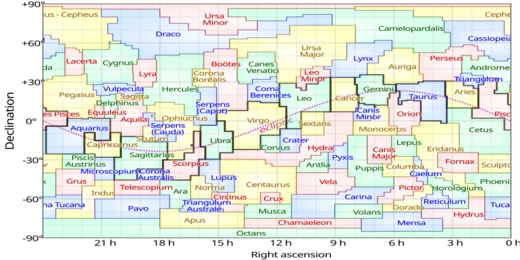
Sextans is a dim, minor constellation that sits on the celestial equator. Polish astronomer Johannes Hevelius created it in 1687, naming it after the astronomical sextant he relied on for his own work. The constellation is medium in size, bordered by Leo to the north, Hydra to the southwest, and Crater to the southeast. Its official three-letter abbreviation, set by the International Astronomical Union in 1922, is "Sex." Belgian astronomer Eugène Delporte defined its boundaries in 1930 as a square, with right ascension between 09h 41m and 10h 51m and declination from +6.43° to −11.7°. Because Sextans lies close to the ecliptic, the Moon and planets often cross it, especially its northeastern corner.
Hevelius originally called it Sextans Uraniae. He chose the name to honor the astronomical sextant he lost when his observatory burned down on 26 September 1679, a disaster he described in the preface to his *Annus climactericus* (1685). Despite the fire, he rebuilt enough equipment to observe the great comet of December 1680. The constellation’s position near the celestial equator makes it visible from most of the world.
John Flamsteed labeled 41 stars for Sextans. Francis Baily planned to assign Bayer designations but left them unlettered because none of the stars were brighter than magnitude 4.5. Benjamin Apthorp Gould later lettered the five brightest stars—Alpha through Epsilon—in his *Uranometria Argentina*. In total, 38 stars in Sextans are at or brighter than apparent magnitude 6.5.
Alpha Sextantis, the constellation’s brightest star, is the only one above fifth magnitude, at 4.49. It is an aging A-type star of spectral class A0 III, located 280±20 light-years away. At 385 million years old, it is exhausting hydrogen at its core and leaving the main sequence. Gamma Sextantis, the second brightest at magnitude 5.05, is a binary system of two A-type main-sequence stars (classes A1 V and A4 V). They orbit each other every 77.55 years in an eccentric path, 280±10 light-years away, with a separation of 0.4 arcseconds—difficult to see without a 30 cm telescope. Beta Sextantis, slightly fainter at magnitude 5.07 and 364±10 light-years distant, is a B-type main-sequence star (class B6 V) used as a standard in the MK spectral classification system. It is suspected to be an Alpha2 Canum Venaticorum variable with a 15.4-day period.
Quick Facts
- Abbreviation
- Sex
- Genitive
- Sextantis, Sextansis
- Pronounce
- ˈ · s · ɛ · k · s · t · ən · z, / genitive s · ɛ · k · s · ˈ · t · æ · n · t · ᵻ · s
- Symbolism
- the Sextant
- Ra
- 09 · 41 · 04.8653–10 · 51 · 30.2447IAU, The Constellations, Sextans
- Dec
- 6.4327669–-11.6621428IAU, The Constellations, Sextans
- Family
- Hercules
- Quadrant
- SQ2
- Areatotal
- 314
- Arearank
- 47th
- Numbermainstars
- 3
- Numberbfstars
- 28
Facts from the source article.
Lore & Background
Sextans was introduced by Polish astronomer Johannes Hevelius in 1687, originally under the name Sextans Uraniae. The constellation was named in memory of the astronomical sextant he lost when his observatory was destroyed by fire on 26 September 1679, a catastrophe he later described in the preface to his Annus climactericus (1685). Despite the devastation, Hevelius rebuilt enough of his equipment to observe the great comet of December 1680. The constellation sits near the celestial equator, making it visible from most parts of the world.
Sextans is a medium-sized constellation bordering Leo to the north, touching on Hydra to the southwest, and Crater to the southeast. The recommended three-letter abbreviation for the constellation, as adopted by the International Astronomical Union in 1922, is 'Sex'. The official constellation boundaries, as set by Belgian astronomer Eugène Delporte in 1930, are defined by a square. In the equatorial coordinate system, the right ascension coordinates of these borders lie between 09h 41m and 10h 51m, while the declination coordinates are between +6.43° and −11.7°. Since it is close to the ecliptic plane, the Moon and planets regularly cross the constellation, especially its northeastern corner.
John Flamsteed labeled 41 stars for the constellation. Francis Baily intended to give Bayer designations to some of the stars but because none of them were above magnitude 4.5, he left them unlettered. Rather, it was Benjamin Apthorp Gould who lettered some of the stars. He labeled the five brightest stars using Greek letters Alpha (α) to Epsilon (ε) in his Uranometria Argentina. All together, there are 38 stars that are brighter than or equal to apparent magnitude 6.5.
Reader's Guide
Sextans holds significance as a constellation introduced in the late 17th century by Johannes Hevelius, commemorating his lost astronomical sextant. Its stars are generally faint, with Alpha Sextantis being the only star above fifth magnitude. The constellation contains several notable multiple star systems, including 35 Sextantis, a triple star system consisting of two evolved K-type giants. Variable stars within Sextans include 25, 23 Sextantis, and LHS 292. The only noteworthy deep-sky object is NGC 3115, an edge-on lenticular galaxy. The constellation lies near the ecliptic, causing the Moon and some planets to occasionally pass through it for brief periods. Sextans is also the location of the field studied by the COSMOS project, undertaken by the Hubble Space Telescope. Within this field, Sextans B is a fairly bright dwarf irregular galaxy at magnitude 6.6, 4.3 million light-years from Earth, part of the Local Group. CL J1001+0220 is, as of 2016, the most distant-known galaxy cluster at redshift z=2.506, 11.1 billion light-years from Earth. In June 2015, astronomers reported evidence for population III stars in the Cosmos Redshift 7 galaxy (at z = 6.60) found in Sextans, which may have started the production of chemical elements heavier than hydrogen needed for later formation of planets and life.
Did You Know?
- Sextans was introduced in 1687 by Polish astronomer Johannes Hevelius, originally under the name Sextans Uraniae.
- The constellation was named after the astronomical sextant Hevelius lost when his observatory was destroyed by fire on 26 September 1679.
- Alpha Sextantis is the brightest star in the constellation with an apparent magnitude of 4.49, and is the only star above fifth magnitude.
A Memorial Forged in Fire
Sextans carries a story of loss and stubborn determination. In 1687, Polish astronomer Johannes Hevelius introduced this small constellation to the sky, originally calling it Sextans Uraniae. The name was not a random choice—it honored the astronomical sextant, a measuring instrument Hevelius relied on heavily in his observations, which he lost forever when his observatory burned to the ground on 26 September 1679. He later recounted that devastating night in the preface of his work Annus climactericus, published in 1685. Yet the fire did not end his career. Hevelius rebuilt enough of his equipment to catch a glimpse of the great comet that swept through the heavens in December 1680, a remarkable feat of recovery. By naming a constellation after his lost instrument, he turned personal tragedy into a permanent fixture of the night sky, ensuring that every stargazer who finds Sextans is reminded of a man who refused to let a single blaze extinguish his curiosity.
A Faint but Fascinating Star Field
Sextans is home to 38 stars that shine at or above apparent magnitude 6.5, yet none of them blaze brightly. John Flamsteed cataloged 41 stars within its borders, but Francis Baily, who intended to assign traditional Bayer designations, balked because no star exceeded magnitude 4.5. The task eventually fell to Benjamin Apthorp Gould, who in his Uranometria Argentina gave Greek letters to the five brightest, from Alpha through Epsilon. Alpha Sextantis, at magnitude 4.49, is the constellation's sole star above the fifth magnitude. It is an ageing A-type giant, roughly 385 million years old, currently burning through its core hydrogen and drifting off the main sequence, situated about 280 light-years away. Gamma Sextantis, the second brightest at magnitude 5.05, is a binary pair of A-type main-sequence stars locked in a 77.55-year eccentric dance. Beta Sextantis, a B-type star, has served as a reference standard in the MK spectral classification system and is suspected to be a variable with a 15.4-day pulsation cycle.
Windows to the Distant Universe
Though Sextans is a modest patch of sky, it has become a gateway to some of the most extraordinary objects in astronomy. The Hubble Space Telescope directed its COSMOS project survey at a field within this constellation, yielding discoveries that stretch the boundaries of what we can observe. Among the finds is CL J1001+0220, which as of 2016 held the record as the most distant known galaxy cluster, sitting at a redshift of 2.506 and roughly 11.1 billion light-years away. In June 2015, researchers reported evidence of Population III stars in the Cosmos Redshift 7 galaxy at redshift 6.60, a finding of enormous significance because such primordial stars likely forged the first heavy elements beyond hydrogen, seeding the universe with the raw material for planets and life. Closer to home, Sextans B is a dwarf irregular galaxy at magnitude 6.6, part of our Local Group at 4.3 million light-years. The constellation also hosts NGC 3115, an edge-on lenticular galaxy, and the remarkable triple system 35 Sextantis, where two K-type giants each twice the Sun's mass orbit one another over roughly 23,000 years.
Position, Boundaries, and the Wandering Sky
Sextans occupies a medium-sized square region straddling the celestial equator, with right ascension spanning from 09 hours 41 minutes to 10 hours 51 minutes and declination ranging from +6.43 degrees to −11.7 degrees. Its official boundaries were fixed in 1930 by Belgian astronomer Eugène Delporte, and the International Astronomical Union adopted the three-letter abbreviation Sex in 1922. The constellation neighbors Leo to the north, Hydra to the southwest, and Crater to the southeast. Because it sits so close to the ecliptic plane, the Moon and the planets make regular transits through its territory, with the northeastern corner being the most frequently visited. This proximity to the ecliptic also means that deep-sky objects within Sextans, such as NGC 3115, can be briefly obscured by the Moon or a passing planet. The equatorial placement grants Sextans the advantage of visibility from most inhabited regions of Earth, making this otherwise faint constellation accessible to observers on both hemispheres throughout the year.
More in Constellations, Part 2 1-24
Spotted an error? Know more?
Reader corrections go straight into our review queue. Suggest an edit · How this site is sourced