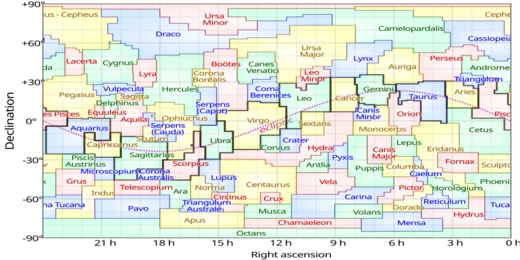
Mensa (constellation)
The faintest constellation, named for Table Mountain near Cape Town.

Mensa is a faint constellation located in the Southern Celestial Hemisphere, close to the south celestial pole. It was one of fourteen constellations created in the 1700s by the French astronomer Nicolas-Louis de Lacaille. The name comes from the Latin word for "table," but it originally honored Table Mountain and was called "Mons Mensae." Today, it is one of the eighty-eight official constellations recognized by the International Astronomical Union (IAU). Its shape is a keystone-like wedge covering 153.5 square degrees of sky. Apart from Octans, the south polar constellation, Mensa is the most southerly constellation and can only be seen from locations south of the 5th parallel in the Northern Hemisphere. It is the dimmest constellation acknowledged by the IAU, with no bright stars—its brightest, Alpha Mensae, is just barely visible from suburban areas. The constellation contains part of the Large Magellanic Cloud, several star clusters, a quasar, and at least three star systems known to host exoplanets.
**History**
Lacaille originally named this constellation "Montagne de la Table" or "Mons Mensae," creating it from faint southern stars to honor Table Mountain in South Africa, which overlooks Cape Town near where he set up his observatory. He remembered that the Magellanic Clouds were sometimes called Cape clouds, and that Table Mountain was often shrouded in clouds during strong southeasterly storms. So he placed a "table" in the sky beneath those clouds. Lacaille spent two years at the Cape of Good Hope, observing and cataloging 10,000 southern stars. He devised fourteen new constellations in uncharted southern regions not visible from Europe. Mensa was the only one of these that did not commemorate an instrument from the Age of Enlightenment. In 1844, Sir John Herschel suggested shortening the name to a single word, noting that Lacaille himself had abbreviated some of his other constellations.
Although Mensa's stars have no ancient mythology, the mountain it is named after does. Called "Tafelberg" in Dutch and German, it has two neighboring peaks: Devil's Peak and Lion's Head. Table Mountain appears in the mythology of the Cape of Good Hope, which is famous for its storms. Explorer Bartolomeu Dias saw the mountain as a mythical anvil for storms.
Quick Facts
- Abbreviation
- Men
- Genitive
- Mensae
- Pronounce
- ˈ · m · ɛ · n · s · ə / genitive: ˈ · m · ɛ · n · s · iː
- Symbolism
- the Table Mountain
- Ra
- 03 · 12 · 55.9008–07 · 36 · 51.5289
- Dec
- −71–−85.5
- Family
- La Caille
- Quadrant
- SQ1
- Areatotal
- 153
- Arearank
- 75th
- Numbermainstars
- 4
- Numberbfstars
- 16
Facts from the source article.
Lore & Background
Originally named 'Montagne de la Table' or 'Mons Mensae', Mensa was created by Nicolas-Louis de Lacaille out of dim Southern Hemisphere stars in honor of Table Mountain, a South African mountain overlooking Cape Town, near the location of Lacaille's observatory. He recalled that the Magellanic Clouds were sometimes known as Cape clouds, and that Table Mountain was often covered in clouds when a southeasterly stormy wind blew. Hence he made a 'table' in the sky under the clouds. Lacaille had observed and catalogued 10,000 southern stars during a two-year stay at the Cape of Good Hope. He devised 14 new constellations in uncharted regions of the Southern Celestial Hemisphere not visible from Europe. Mensa was the only constellation that did not honor an instrument symbolic of the Age of Enlightenment. Sir John Herschel proposed shrinking the name to one word in 1844, noting that Lacaille himself had abbreviated some of his constellations thus. Although the stars of Mensa do not feature in any ancient mythology, the mountain it is named after has a rich mythology. Called 'Tafelberg' in Dutch and German, it has two neighboring mountains called 'Devil's Peak' and 'Lion's Head'. Table Mountain features in the mythology of the Cape of Good Hope, notorious for its storms. Explorer Bartolomeu Dias saw the mountain as a mythical anvil for storms. Mensa is bordered by Dorado to the north, Hydrus to the northwest and west, Octans to the south, Chamaeleon to the east and Volans to the northeast. Covering 153.5 square degrees and 0.372% of the night sky, it ranks 75th of the 88 constellations in size. The three-letter abbreviation for the constellation, as adopted by the IAU in 1922, is 'Men'. The official constellation boundaries, as set by Belgian astronomer Eugène Delporte in 1930, are defined by a polygon of eight segments. In the equatorial coordinate system, the right ascension coordinates of these borders lie between 03h 12m 55.9008s and 07h 36m 51.5289s, while the declination coordinates are between −69.75° and −85.26°. The whole constellation is visible to observers south of latitude 5°N.
Reader's Guide
Mensa's significance lies in its unique history and extreme southerly position. Created by Nicolas-Louis de Lacaille in the 18th century, it is the only one of his 14 new constellations not named after an instrument of the Age of Enlightenment, instead honoring Table Mountain. Lacaille's choice linked the Magellanic Clouds (Cape clouds) with the cloud-covered mountain, creating a 'table' in the sky. As the faintest constellation recognized by the IAU, with no star above magnitude 5.0, Mensa challenges observers and underscores the dimness of the far southern sky. Its legacy includes hosting part of the Large Magellanic Cloud, several star clusters, a quasar, and at least three star systems with exoplanets, including the first exoplanet detected by TESS submitted for publication (around Pi Mensae). The constellation's boundaries were formalized by Eugène Delporte in 1930, and its three-letter abbreviation 'Men' was adopted by the IAU in 1922. Mensa remains a testament to Lacaille's systematic cataloguing of southern stars and the cultural mythology of Table Mountain, a landmark notorious for storms.
Did You Know?
- Mensa is the faintest constellation in the night sky recognized by the IAU, with its brightest star Alpha Mensae barely visible in suburban skies.
- It was the only one of Lacaille's 14 new constellations that did not honor an instrument symbolic of the Age of Enlightenment.
- The constellation covers 153.5 square degrees, ranking 75th of the 88 constellations in size.
- At least three star systems in Mensa have been found to have exoplanets, including Pi Mensae which hosts the first exoplanet detected by TESS submitted for publication.
More in Constellations, Part 2 1-24
Spotted an error? Know more?
Reader corrections go straight into our review queue. Suggest an edit · How this site is sourced