Libra (constellation)
Libra is a faint zodiac constellation representing weighing scales.

Libra is a zodiac constellation in the Southern celestial hemisphere. Its Latin name means "weighing scales," and its old symbol is ♎︎. The constellation is relatively dim, lacking any first-magnitude stars, and sits between Virgo to the west and Scorpius to the east. Its brightest star is Beta Librae, also called Zubeneschamali. Three star systems within Libra are known to host planets.
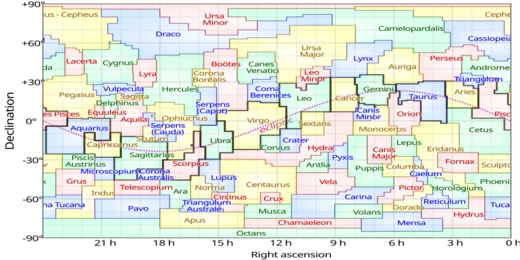
The constellation covers 538.1 square degrees, or 1.304% of the night sky, making it the 29th largest of the 88 constellations. Its official three-letter abbreviation, adopted by the International Astronomical Union in 1922, is "Lib." The boundaries, set by Eugène Delporte in 1930, form a 12-sided polygon. In equatorial coordinates, these borders span right ascension from 14h 22m 08.08s to 16h 02m 17.23s and declination from −0.47° to −30.00°. Observers south of latitude 60°N can see the entire constellation.
Libra contains 83 stars brighter than or equal to apparent magnitude 6.5. Its brightest stars form a quadrangle visible to the naked eye. Traditionally, Alpha and Beta Librae represent the scales' beam, while Gamma and Sigma are the pans. Alpha Librae, or Zubenelgenubi, is a multiple star system resolvable with binoculars into a blue-white primary (magnitude 2.7) and a white secondary (magnitude 5.2, spectral type F3V) about 74.9 light-years away. Its name means "the southern claw." Beta Librae (Zubeneschamali), the "northern claw," is a green-tinged star of magnitude 2.6, located about 160 or 185 ± 2 light-years from Earth. Gamma Librae, called Zubenelakrab ("the scorpion's claw"), is an orange giant of magnitude 3.9, 152 light-years away.
Iota Librae is a complex multiple star 377 light-years away, with both optical and true binary components. Its primary is a blue-white star of magnitude 4.5, an inseparable binary with a 23-year period. A secondary of magnitude 9.4, visible in small telescopes, is itself a binary with magnitudes 10 and 11. An optical companion, 25 Librae, is a magnitude 6.1 star 219 light-years away, visible in binoculars. Mu Librae is a binary divisible in medium amateur telescopes, 235 light-years away, with a primary of magnitude 5.7 and secondary of magnitude 6.8. Delta Librae is an Algol-type eclipsing variable star 304 light-years away, varying between magnitude 4.9 and 5.9 over 2 days and 8 hours.
Quick Facts
- Abbreviation
- Lib
- Genitive
- Librae
- Pronounce
- ˈ · l · iː · b · r · ə, genitive ˈ · l · iː · b · r · iː
- Symbolism
- the balance
- Ra
- 15
- Dec
- −15
- Family
- Zodiac
- Quadrant
- SQ3
- Areatotal
- 538
- Arearank
- 29th
- Numbermainstars
- 4, 6
- Numberbfstars
- 56
Facts from the source article.
Lore & Background
Libra was known in Babylonian astronomy as MUL Zibanu (the 'scales' or 'balance'), or alternatively as the Claws of the Scorpion. The scales were held sacred to the sun god Shamash, who was also the patron of truth and justice. Since these times, Libra has been associated with law, fairness and civility. It was also seen as the Scorpion's Claws in ancient Greece, a name used repeatedly by Aratus, which made it widespread in Hellenistic times. In Arabic, zubānā means 'scorpion's claws', and likely similarly in other Semitic languages; this resemblance of words may be why the Scorpion's claws became the Scales. Indeed, Zubenelgenubi and Zubeneschamali, the names of the constellation's two main stars, in Arabic mean 'southern claw' and 'northern claw' respectively. It has also been suggested that the scales are an allusion to the fact that when the sun entered this part of the ecliptic at the autumnal equinox, the days and nights are equal. Libra's status as the location of the equinox earned the equinox the name 'First Point of Libra', though this location ceased to coincide with the constellation in 730 BC because of the precession of the equinoxes. In ancient Egypt, the three brightest stars of Libra (α, β, and σ Librae) formed a constellation that was viewed as a boat. Libra is not mentioned by Eudoxus or Aratus as a constellation. Libra is mentioned by Manetho (3rd century B.C.) and Geminus (1st century B.C.), and included by Ptolemy in his 48 asterisms. Ptolemy catalogued 17 stars, Tycho Brahe 10, and Johannes Hevelius 20. It only became a constellation in ancient Rome, when it began to represent the scales held by Astraea, the goddess of justice, associated with Virgo in Greek mythology.
Reader's Guide
Libra is notable for its historical association with justice and balance, stemming from Babylonian and Greek traditions. Its brightest stars, Alpha and Beta Librae, are named from Arabic terms meaning 'southern claw' and 'northern claw', reflecting its earlier identity as the Scorpion's Claws. The constellation contains the Gliese 581 planetary system, which gained attention in the late 2000s and early 2010s as the subject of some of the earliest claims of potentially habitable exoplanets, though it is now known that Gliese 581c is too hot to be potentially habitable, and the planet candidates Gliese 581d and g likely do not exist. At the time of its discovery in 2009, Gliese 581e was the smallest mass exoplanet known orbiting a normal star. Libra also hosts one bright globular cluster, NGC 5897, and a galaxy, IC 1059. The constellation's boundaries were set by Eugène Delporte in 1930, and its three-letter abbreviation 'Lib' was adopted by the International Astronomical Union in 1922. In astrology, as of 2002, the Sun appears in the constellation Libra from October 31 to November 22. A United States navy ship, Libra (AKA-12), was named after the constellation.
Did You Know?
- Libra's brightest star, Zubeneschamali, is a green-tinged star of magnitude 2.6.
- The constellation contains the Gliese 581 planetary system, which at one time included the smallest mass exoplanet known orbiting a normal star.
- Sigma Librae was formerly known as Gamma Scorpii despite being well inside the boundaries of Libra, and was not redesignated until 1851 by Benjamin A. Gould.
More in Constellations, Part 2 1-24
Spotted an error? Know more?
Reader corrections go straight into our review queue. Suggest an edit · How this site is sourced