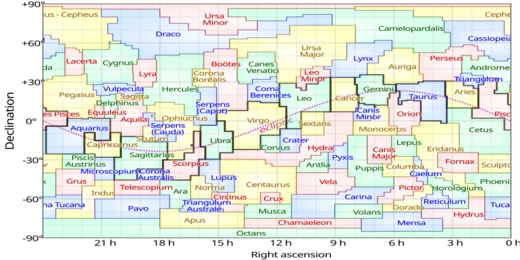
Lepus (constellation)
A hare constellation south of Orion, listed by Ptolemy.

Lepus, Latin for "hare," is a constellation located just south of the celestial equator. It sits directly below Orion the Hunter and is often depicted as a hare fleeing from Orion or his hunting dogs. While the hare is not tied to any specific Greek myth, the constellation was among the 48 cataloged by the 2nd-century astronomer Ptolemy and is still one of the 88 modern constellations.
In mythology, Lepus is usually shown as a hare being hunted by Orion, with his dogs Canis Major and Canis Minor in pursuit. The constellation is also linked to the Moon rabbit. Four of its stars—Alpha, Beta, Gamma, and Delta Leporis—form a quadrilateral. In Arabic, these stars are called *Arsh al-Jawzā'* ("the Throne of Jawzā'"), *Kursiyy al-Jawzā' al-Mu'akhkhar* ("the Hindmost Chair of Jawzā'"), and *al-Nihāl* ("the Camels Quenching Their Thirst").
The constellation contains several bright stars, both single and double. Alpha Leporis, the brightest, is a white supergiant of magnitude 2.6, about 1,300 light-years away. Its traditional name, Arneb, means "hare" in Arabic. Beta Leporis, called Nihal, is a yellow giant of magnitude 2.8, 159 light-years distant. Gamma Leporis is a double star visible with binoculars: a yellow primary of magnitude 3.6 (29 light-years away) and an orange secondary of magnitude 6.2. Delta Leporis is a yellow giant of magnitude 3.8, 112 light-years from Earth. Epsilon Leporis is an orange giant of magnitude 3.2, 227 light-years away. Kappa Leporis, 560 light-years distant, is a double star resolvable with a medium amateur telescope; its primary is blue-white (magnitude 4.4) and its secondary is magnitude 7.4.
Several variable stars reside in Lepus. R Leporis, a Mira variable known as "Hind's Crimson Star" for its deep red color and named after John Russell Hind, ranges from magnitude 9.8 to 7.3 over 420 days, though it can dim to magnitude 12 or brighten to 5.5. Its color deepens as it brightens, and it lies about 1,500 light-years away. T Leporis is another Mira variable, studied in detail by ESO's Very Large Telescope Interferometer. RX Leporis is a semi-regular red giant with a two-month period, varying between magnitudes 5.0 and 7.4.
The only Messier object in Lepus is M79, a globular cluster of magnitude 8.0, about 42,000 light-years away. It is one of the few globular clusters visible in the Northern Celestial Hemisphere during winter.
Quick Facts
- Abbreviation
- Lep
- Genitive
- Leporis
- Pronounce
- ˈ · l · iː · p · ə · s, or colloquially ˈ · l · ɛ · p · ə · s; genitive ˈ · l · ɛ · p · ər · ᵻ · s
- Symbolism
- the Hare
- Ra
- 04 · 55 · 02.2311–06 · 12 · 51.7500IAU, The Constellations, Lepus
- Dec
- -10.8138046–-27.2787991IAU, The Constellations, Lepus
- Family
- Orion
- Quadrant
- NQ2
- Areatotal
- 290
- Arearank
- 51st
- Numbermainstars
- 8
- Numberbfstars
- 20
Facts from the source article.
Lore & Background
Lepus is most often represented as a hare being hunted by Orion, whose hunting dogs (Canis Major and Canis Minor) pursue it. The constellation is also associated with the Moon rabbit. Four stars of this constellation (α, β, γ, δ Lep) form a quadrilateral and are known as ‘Arsh al-Jawzā', "the Throne of Jawzā'" or Kursiyy al-Jawzā' al-Mu'akhkhar, "the Hindmost Chair of Jawzā'" and al-Nihāl, "the Camels Quenching Their Thirst" in Arabic.
Although the hare does not represent any particular figure in Greek mythology, Lepus was one of the 48 constellations listed by the 2nd-century astronomer Ptolemy, and it remains one of the 88 modern constellations.
Reader's Guide
Lepus contains a fair number of bright stars, both single and double. Alpha Leporis, the brightest star, is a white supergiant of magnitude 2.6, 1300 light-years from Earth; its traditional name Arneb means "hare" in Arabic. Beta Leporis, traditionally known as Nihal (Arabic for "quenching their thirst"), is a yellow giant of magnitude 2.8, 159 light-years from Earth. Gamma Leporis is a double star divisible in binoculars, with a yellow primary of magnitude 3.6 and an orange secondary of magnitude 6.2, 29 light-years from Earth. Delta Leporis is a yellow giant of magnitude 3.8, 112 light-years from Earth. Epsilon Leporis is an orange giant of magnitude 3.2, 227 light-years from Earth. Kappa Leporis is a double star divisible in medium aperture amateur telescopes, 560 light-years from Earth, with a blue-white primary of magnitude 4.4 and a secondary of magnitude 7.4.
Several variable stars are in Lepus. R Leporis, called "Hind's Crimson Star" for its striking red color and named for John Russell Hind, is a Mira variable that varies in magnitude from a minimum of 9.8 to a maximum of 7.3, with a period of 420 days; it can be as dim as magnitude 12 and as bright as magnitude 5.5, and its color intensifies as it brightens. T Leporis is also a Mira variable observed in detail by ESO's Very Large Telescope Interferometer. RX Leporis is a semi-regular red giant with a period of 2 months, ranging from magnitude 7.4 to 5.0.
There is one Messier object in Lepus, M79, a globular cluster of magnitude 8.0, 42,000 light-years from Earth. One of the few globular clusters visible in the Northern Celestial Hemisphere's winter, it is a Shapley class V cluster, meaning it has an intermediate concentration towards its center, and is often described as having a "starfish" shape. M79 was discovered in 1780 by Pierre Méchain.
Did You Know?
- The brightest star, Alpha Leporis, is named Arneb, which means 'hare' in Arabic.
- R Leporis is called 'Hind's Crimson Star' for its striking red color and was named for John Russell Hind.
- M79, a globular cluster in Lepus, was discovered in 1780 by Pierre Méchain.
More in Constellations, Part 2 1-24
Spotted an error? Know more?
Reader corrections go straight into our review queue. Suggest an edit · How this site is sourced