Indus (constellation)
Southern constellation introduced by Keyser and de Houtman in 1598.

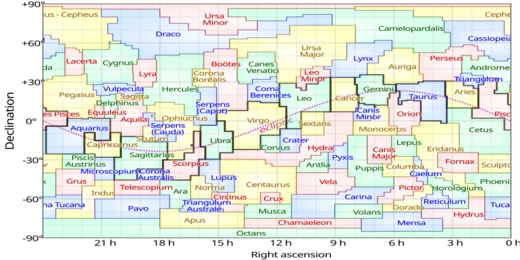
Indus is a southern constellation first charted by European astronomers in the 1590s, appearing on a globe made by Petrus Plancius by early 1598. It later featured in Johann Bayer's 1603 star atlas *Uranometria*. Its name translates to "the Indian," thought to represent a native of Madagascar or the East Indies. The constellation sits far south of the Tropic of Capricorn, though its triangular shape is visible from the equator for most of the year. It stretches north to south and has an irregular border.
None of Indus's stars rank among the hundred brightest in the sky. Its most luminous are two of third magnitude and three of fourth magnitude. In 1756, Nicolas-Louis de Lacaille assigned Bayer designations from Alpha to Rho to 18 stars, skipping Xi and labeling two as Kappa and Lambda. The Lambda stars (Lambda1 and Lambda2) were later placed in Pavo, and those designations are obsolete. In 1879, Benjamin Gould moved Nu Indi to Microscopium, renaming it Nu Microscopii; today's Nu Indi refers to HD 211988.
Alpha Indi, the brightest star, is an orange giant of magnitude 3.1, about 101 light-years away. Beta Indi, also an orange giant, shines at magnitude 3.7 from 600 light-years distant. Delta Indi is a white star of magnitude 4.4, 185 light-years from Earth. These three form a nearly perfect right triangle, with Beta at the right angle in the southeast. Epsilon Indi, an orange dwarf of magnitude 4.7, is one of the closest stars to the Sun at roughly 11.8 light-years. It hosts a pair of binary brown dwarfs and has long been a target for SETI studies. It has the third-highest proper motion of any star visible to the naked eye (after Groombridge 1830 and 61 Cygni) and the ninth-highest overall, and will drift into Tucana around the year 2640. It lies directly between Alpha and Beta.
Indus contains one bright binary star: Theta Indi, divisible in small amateur telescopes, 97 light-years away. Its primary is a white star of magnitude 4.5, its secondary a white star of magnitude 7.0. It sits near the hypotenuse of the triangle formed by Alpha, Beta, and Delta.
The only notable variable star in Indus is T Indi, a semi-regular, deeply colored red giant with an 11-month period, about 1,900 light-years away. Its brightness ranges from magnitude 5 at maximum to 7 at minimum.
Notable galaxies include NGC 7038, NGC 7049, and NGC 7090.
Quick Facts
- Abbreviation
- Ind
- Genitive
- Indi
- Pronounce
- ˈ · ɪ · n · d · ʊ · s, / genitive ˈ · ɪ · n · d · aɪ
- Ra
- 20 · 28 · 40.6308–23 · 27 · 59.4799IAU, The Constellations, Indus
- Dec
- -44.9588585–-74.4544678IAU, The Constellations, Indus
- Family
- Bayer
- Quadrant
- SQ4
- Areatotal
- 294
- Arearank
- 49th
- Numbermainstars
- 3
- Numberbfstars
- 16
- Numberbrightstars
- 0
Facts from the source article.
Lore & Background
The constellation was first illustrated by Petrus Plancius, who made a fairly large celestial globe from the observations of Pieter Dirkszoon Keyser and Frederick de Houtman. The first depiction of this constellation in a celestial atlas followed in Johann Bayer's Uranometria of 1603. Plancius portrayed the figure as a nude male with three arrows in one hand and one in the other, as a native, lacking quiver and bow. It is among the twelve constellations introduced by Keyser and de Houtman, which first appeared on Plancius's celestial globe in 1598.
Indus lacks stars among the sky's brightest 100 stars in apparent magnitude. Its brightest stars are two of third magnitude and three of fourth magnitude. Lacaille gave 18 stars Bayer designations Alpha through Rho in 1756, but omitted Xi, and labelled two stars as Kappa and Lambda. Lambda Indi (Lambda1 and Lambda2) were included in Pavo and the designations are no longer used. In 1879, Benjamin Gould renamed Nu Indi as Nu Microscopii as it turns out that it was situated into Microscopium and renamed as such, though today's Nu Indi now refers to HD 211988.
Alpha Indi, its brightest, is an orange giant of magnitude 3.1, 101 light-years away. Beta Indi is an orange giant of magnitude 3.7, 600 light-years distant. Delta Indi is a white star of magnitude 4.4, 185 light-years from Earth. The three form a near-perfect right-angled triangle, such that Beta marks the right angle and is in the south-east. Epsilon Indi is one of the closest stars to Earth, approximately 11.8 light years away. It is an orange dwarf of magnitude 4.7, meaning that the yellow dwarf Sun is slightly hotter and larger. The system has been discovered to contain a pair of binary brown dwarfs, and has long been a prime candidate in SETI studies. This star has the third-highest proper motion of all visible to the unaided eye, as ranks behind Groombridge 1830 and 61 Cygni, and the ninth-highest overall. This will move the star into Tucana around 2640. It figures directly between Alpha and Beta.
Reader's Guide
Indus is notable for containing Epsilon Indi, one of the closest stars to Earth at approximately 11.8 light years away, and a prime candidate in SETI studies. Its system contains a pair of binary brown dwarfs. The constellation also hosts the superluminous supernova ASASSN-15lh (SN 2015L), detected in 2015 by the All Sky Automated Survey for SuperNovae (ASAS-SN). Based on the study conducted by Subo Dong and team from the Kavli Institute for Astronomy and Astrophysics (KIAA) at Peking University, it was approximately doubly luminous to any supernova detected, and at peak was almost 50 times more intrinsically luminous than the Milky Way. Its distance is approximately 3.82 gigalight-years, denoting an age approximately half that of the universe. Indus is home to one bright binary star, Theta Indi, divisible in small amateur telescopes, 97 light-years from Earth. Its primary is a white star of magnitude 4.5 and its secondary is a white star of magnitude 7.0. It figures close to the hypotenuse of the right-angled triangle of Alpha, Beta and Delta, the three brightest stars of Indus. The only bright variable star in Indus is T Indi, a semi-regular, deeply coloured red giant with a period of 11 months, 1900 light-years away. Its minimum magnitude is 7 and its maximum: 5. Galaxies in Indus include NGC 7038, NGC 7049, and NGC 7090. IC 5152 is a dwarf irregular galaxy lying at a distance of about 1.7 million parsec (5.5 million light years), at the edge of the Local Group, although it is not a certain member.
Did You Know?
- Indus was first mapped on a celestial globe by Petrus Plancius by early 1598, based on observations by Pieter Dirkszoon Keyser and Frederick de Houtman.
- The three brightest stars of Indus—Alpha, Beta, and Delta—form a near-perfect right-angled triangle, with Beta marking the right angle.
More in Constellations, Part 2 1-24
Spotted an error? Know more?
Reader corrections go straight into our review queue. Suggest an edit · How this site is sourced