Hydrus
A southern constellation representing a male water snake.

Hydrus is a faint constellation located far south in the sky. It is one of twelve constellations that Petrus Plancius devised, based on observations made by the Dutch explorers Pieter Dirkszoon Keyser and Frederick de Houtman. The name translates to "male water snake," setting it apart from the larger, female-named Hydra. For observers in most of the Northern Hemisphere, Hydrus never rises above the horizon.
The constellation first appeared on a 35-centimeter celestial globe produced in Amsterdam by Plancius and Jodocus Hondius around the turn of 1597 into 1598. Johann Bayer’s *Uranometria*, published in 1603, was the first celestial atlas to depict it. That same year, de Houtman included Hydrus in his own star catalog, using the Dutch name *De Waterslang*—referring to a type of snake encountered during the expedition, not a mythical creature. On his 1756 planisphere of the southern sky, the French astronomer Nicolas Louis de Lacaille labeled it *l’Hydre Mâle*, distinguishing it from the feminine Hydra. Jean Fortin kept the French name for his 1776 *Atlas Céleste*, while Lacaille later Latinized it to *Hydrus* for his 1763 revised *Coelum Australe Stelliferum*.
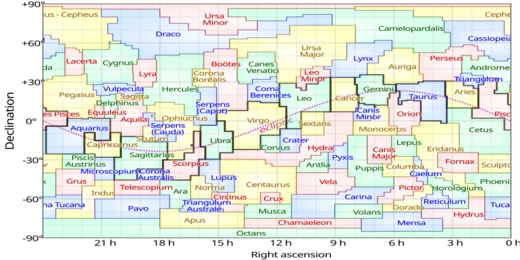
Hydrus has an irregular shape. It borders Mensa to the southeast, Eridanus to the east, Horologium and Reticulum to the northeast, Phoenix to the north, Tucana to the northwest and west, and Octans to the south. Lacaille shortened Hydrus’ tail to make room for Octans, a constellation he himself had created. Covering 243 square degrees—0.589% of the night sky—it ranks 61st in size among the 88 official constellations. The International Astronomical Union adopted the three-letter abbreviation "Hyi" in 1922. Belgian astronomer Eugène Delporte set the official boundaries in 1930, defined by a polygon of 12 segments. In equatorial coordinates, these borders span right ascension from 00h 06.1m to 04h 35.1m and declination from −57.85° to −82.06°. Because it lies so far south, Hydrus stays below the horizon for observers north of the 30th parallel in the Northern Hemisphere, while it is circumpolar south of the 50th parallel in the Southern Hemisphere. Herman Melville mentions both Hydrus and Argo Navis in *Moby Dick*, writing "beneath effulgent Antarctic Skies," a detail that reflects his knowledge of southern constellations from whaling voyages.
Quick Facts
- Abbreviation
- Hyi
- Genitive
- Hydri
- Pronounce
- ˈ · h · aɪ · d · r · ə · s, genitive ˈ · h · aɪ · d · r · aɪ
- Symbolism
- the water snake
- Ra
- 00 · 06.1–04 · 35.1
- Dec
- −57.85°–−82.06°
- Family
- Bayer
- Quadrant
- SQ1
- Areatotal
- 243
- Arearank
- 61st
- Numbermainstars
- 3
- Numberbfstars
- 19
Facts from the source article.
Lore & Background
Hydrus was one of the twelve constellations established by the astronomer Petrus Plancius from the observations of the southern sky by the Dutch explorers Pieter Dirkszoon Keyser and Frederick de Houtman, who had sailed on the first Dutch trading expedition, known as the Eerste Schipvaart, to the East Indies. It first appeared on a 35-cm (14 in) diameter celestial globe published in late 1597 (or early 1598) in Amsterdam by Plancius with Jodocus Hondius. The first depiction of this constellation in a celestial atlas was in the German cartographer Johann Bayer's Uranometria of 1603. De Houtman included it in his southern star catalogue the same year under the Dutch name De Waterslang, "The Water Snake," it representing a type of snake encountered on the expedition rather than a mythical creature. The French explorer and astronomer Nicolas Louis de Lacaille called it l’Hydre Mâle on the 1756 version of his planisphere of the southern skies, distinguishing it from the feminine Hydra. The French name was retained by Jean Fortin in 1776 for his Atlas Céleste, while Lacaille Latinised the name to Hydrus for his revised Coelum Australe Stelliferum in 1763.
Irregular in shape, Hydrus is bordered by Mensa to the southeast, Eridanus to the east, Horologium and Reticulum to the northeast, Phoenix to the north, Tucana to the northwest and west, and Octans to the south; Lacaille had shortened Hydrus' tail to make space for this last constellation he had drawn up. Covering 243 square degrees and 0.589% of the night sky, it ranks 61st of the 88 constellations in size. The three-letter abbreviation for the constellation, as adopted by the International Astronomical Union in 1922, is "Hyi." The official constellation boundaries, as set by Belgian astronomer Eugène Delporte in 1930, are defined by a polygon of 12 segments. As one of the deep southern constellations, it remains below the horizon at latitudes north of the 30th parallel in the Northern Hemisphere, and is circumpolar at latitudes south of the 50th parallel in the Southern Hemisphere. Herman Melville mentions it and Argo Navis in Moby Dick "beneath effulgent Antarctic Skies," highlighting his knowledge of the southern constellations from whaling voyages. A line drawn between the long axis of the Southern Cross to Beta Hydri and then extended 4.5 times will mark a point due south. Hydrus culminates at midnight around 26 October.
Reader's Guide
Hydrus is notable for containing Beta Hydri, the brightest star in the constellation at magnitude 2.8, which is also the closest reasonably bright star to the south celestial pole. Beta Hydri is a yellow subgiant star about 24 light-years from Earth, thought to be between 6.4 and 7.1 billion years old, and bears some resemblance to what the Sun may look like in the far distant future. The constellation also hosts Gamma Hydri, a variable red giant 60 times the diameter of the Sun, and VW Hydri, one of the brightest dwarf novae in the heavens. Four star systems in Hydrus have been found to have exoplanets to date, including HD 10180, which could bear up to nine planetary companions—as of 2012 more than any other system, including the Solar System. The constellation's history traces back to Dutch explorers and early celestial cartography, and its depiction in Johann Bayer's Uranometria of 1603 marked its first appearance in a celestial atlas. Lacaille later charted its brighter stars and gave them Bayer designations in 1756. Hydrus remains a key navigational marker for southern hemisphere observers, as a line from the Southern Cross through Beta Hydri points due south.
Did You Know?
- Hydrus was one of twelve constellations created by Petrus Plancius from observations by Pieter Dirkszoon Keyser and Frederick de Houtman.
- The brightest star, Beta Hydri, is the closest reasonably bright star to the south celestial pole.
- HD 10180 in Hydrus could bear up to nine planetary companions, more than any other system as of 2012.
- Herman Melville mentions Hydrus in Moby Dick 'beneath effulgent Antarctic Skies.'
More in Constellations, Part 2 1-24
Spotted an error? Know more?
Reader corrections go straight into our review queue. Suggest an edit · How this site is sourced