Horologium (constellation)
A faint southern constellation representing a pendulum clock.

Horologium, whose name comes from the Latin for pendulum clock (itself from the Greek for an instrument that tells the hour), is a faint constellation in the southern sky. It consists of six stars and was first charted in 1756 by the French astronomer Nicolas-Louis de Lacaille, who pictured it as a clock with a pendulum and a second hand. The International Astronomical Union (IAU) redefined it in 1922 as the region of the celestial sphere containing Lacaille’s stars, making it one of the 88 official constellations. The entire constellation is visible only to observers south of 23° north latitude.
Lacaille devised Horologium and thirteen other new constellations after cataloguing nearly 10,000 southern stars during a two-year stay at the Cape of Good Hope. All but one of his new constellations honored scientific instruments, reflecting the spirit of the Age of Enlightenment. He first described it in 1756 as *l’Horloge à pendule & à secondes* (clock with pendulum and seconds hand). The name was Latinised to Horologium in a catalogue and chart published posthumously in 1763.
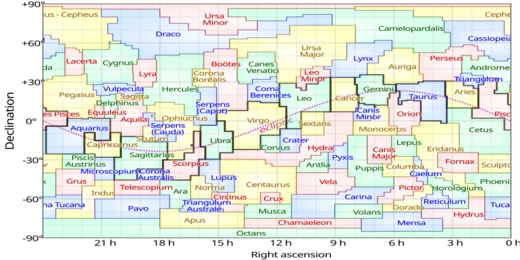
Covering 248.9 square degrees—0.603% of the sky—Horologium ranks 58th in area among modern constellations. It borders five constellations: Eridanus, Caelum, Reticulum, Dorado, and Hydrus. Its official three-letter abbreviation, adopted by the IAU in 1922, is “Hor.” The constellation’s boundaries form a twenty-two-sided polygon, with right ascension coordinates between 02h 12.8m and 04h 20.3m, and declination between −39.64° and −67.04°.
Horologium’s brightest star, Alpha Horologii, has an apparent magnitude of 3.85—the only star in the constellation brighter than magnitude 4. It is an aging orange giant about 11 times the Sun’s diameter, located 115 light-years from Earth. Lacaille originally designated 11 stars with Bayer letters, from Alpha to Lambda Horologii. In the mid-19th century, English astronomer Francis Baily removed Epsilon and Theta Horologii as too faint, could not locate Lacaille’s Beta Horologii (and reassigned the designation to another star), and found Kappa Horologii unverifiable (likely the star HD 18292). In 1879, American astronomer Benjamin Apthorp Gould added Mu and Nu Horologii, deeming them bright enough.
Quick Facts
- Abbreviation
- Hor
- Genitive
- Horologii
- Symbolism
- The Pendulum Clock
- Ra
- 02 · 12 · 48.5665–04 · 20 · 18.3390IAU, The Constellations, Horologium
- Dec
- -39.6368256–-67.0358200IAU, The Constellations, Horologium
- Family
- La Caille
- Quadrant
- SQ1
- Areatotal
- 249
- Arearank
- 58th
- Numbermainstars
- 6
- Numberbfstars
- 10
- Numberbrightstars
- 0
Facts from the source article.
Lore & Background
The French astronomer Nicolas-Louis de Lacaille first described the constellation as l'Horloge à pendule & à secondes (Clock with pendulum and seconds hand) in 1756, after he had observed and catalogued almost 10,000 southern stars during a two-year stay at the Cape of Good Hope. He devised fourteen new constellations in previously uncharted regions of the southern celestial hemisphere, which were not visible from Europe. All but one honoured scientific instruments, and so symbolised the Age of Enlightenment. The constellation name was Latinised to Horologium in a catalogue and updated chart published posthumously in 1763. The Latin term is ultimately derived from the Ancient Greek ὡρολόγιον, for an instrument for telling the hour.
Covering a total of 248.9 square degrees or 0.603% of the sky, Horologium ranks 58th in area out of the 88 modern constellations. Its position in the southern celestial hemisphere means the whole constellation is visible to observers south of 23°N. Horologium is bordered by five constellations: Eridanus, Caelum, Reticulum, Dorado, and Hydrus. The three letter abbreviation for the constellation, as adopted by the International Astronomical Union in 1922, is 'Hor'. The official constellation boundaries are defined by a twenty-two-sided polygon. In the equatorial coordinate system, the right ascension coordinates of these borders lie between 02h 12.8m and 04h 20.3m, while the declination coordinates are between −39.64° and −67.04°.
Horologium has one star brighter than apparent magnitude 4, and 41 stars brighter than or equal to magnitude 6.5. Lacaille charted and designated 11 stars in the constellation, giving them the Bayer designations Alpha through Lambda Horologii in 1756. In the mid-19th century, English astronomer Francis Baily removed the designations of two—Epsilon and Theta Horologii—as he held they were too faint to warrant naming. He was unable to find a star that corresponded to the coordinates of Lacaille's Beta Horologii. Determining that the coordinates were wrong, he assigned the designation to another star. Kappa Horologii, too, was unable to be verified—although it most likely was the star HD 18292—and the name fell out of use. In 1879, American astronomer Benjamin Apthorp Gould assigned designations to what became Mu and Nu Horologii as he felt they were bright enough to warrant them.
Reader's Guide
Horologium is notable as one of the fourteen constellations devised by Nicolas-Louis de Lacaille to fill uncharted southern skies, all but one of which honored scientific instruments and symbolized the Age of Enlightenment. Its brightest star, Alpha Horologii, is an aging orange giant that has swollen to around 11 times the diameter of the Sun. The long-period variable star R Horologii has one of the largest variations in brightness among all stars in the night sky visible to the unaided eye, ranging from magnitude 4.7 to 14.3. Four star systems in the constellation are known to have exoplanets; at least one—Gliese 1061—contains an exoplanet in its habitable zone. The constellation also hosts several deep-sky objects, including the globular cluster NGC 1261 and the merging galaxies NGC 1512 and NGC 1510. The Horologium-Reticulum Supercluster is a galaxy supercluster second in mass only to the Shapley Supercluster in the local universe. The constellation's boundaries were officially defined by the IAU in 1922, and its three-letter abbreviation is 'Hor'.
Did You Know?
- R Horologii is a Mira variable with one of the widest ranges in brightness known among stars visible to the unaided eye, from magnitude 4.7 to 14.3.
- Gliese 1061, located 12 light-years from Earth, is the 20th-closest single star or stellar system to the Sun and has a planet in its habitable zone.
More in Constellations, Part 2 1-24
Spotted an error? Know more?
Reader corrections go straight into our review queue. Suggest an edit · How this site is sourced