Grus (constellation)
A southern constellation representing a crane, one of the Southern Birds.

Grus is a constellation in the southern sky, its name Latin for the crane, a type of bird. It is one of twelve constellations conceived by Petrus Plancius from the observations of Pieter Dirkszoon Keyser and Frederick de Houtman, and first appeared on a 35-centimetre-diameter celestial globe published in 1598 in Amsterdam by Plancius and Jodocus Hondius. Grus is notable as part of the group of four constellations known as the 'Southern Birds', along with Pavo, Phoenix and Tucana.
Quick Facts
- Abbreviation
- Gru
- Genitive
- Gruis
- Pronounce
- ˈ · ɡ · r · ʌ · s, or colloquially ˈ · ɡ · r · uː · s; genitive ˈ · ɡ · r · uː · ᵻ · s
- Symbolism
- the crane
- Ra
- 21 · 27.4–23 · 27.1
- Dec
- −36.31°–−56.39°
- Family
- Bayer
- Quadrant
- SQ4
- Areatotal
- 366
- Arearank
- 45th
- Numbermainstars
- 8
- Numberbfstars
- 28
Facts from the source article.
Lore & Background
The stars that form Grus were originally considered part of the neighbouring constellation Piscis Austrinus, with Gamma Gruis seen as part of the fish's tail. The stars were first defined as a separate constellation by Petrus Plancius, who created twelve new constellations based on the observations of the southern sky by the Dutch explorers Pieter Dirkszoon Keyser and Frederick de Houtman, who had sailed on the first Dutch trading expedition, known as the Eerste Schipvaart, to the East Indies. Grus first appeared on a 35-centimetre-diameter celestial globe published in 1598 in Amsterdam by Plancius with Jodocus Hondius, and its first depiction in a celestial atlas was in Johann Bayer's Uranometria of 1603. De Houtman included it in his southern star catalogue the same year under the Dutch name Den Reygher, 'The Heron', but Bayer followed Plancius and Hondius in using Grus. An alternative name, Phoenicopterus (Latin 'flamingo'), was used briefly during the early 17th century, seen in the 1605 work Cosmographiae Generalis by Paul Merula and a c. 1625 globe by Pieter van den Keere. Astronomer Ian Ridpath has reported the symbolism likely came from Plancius originally.
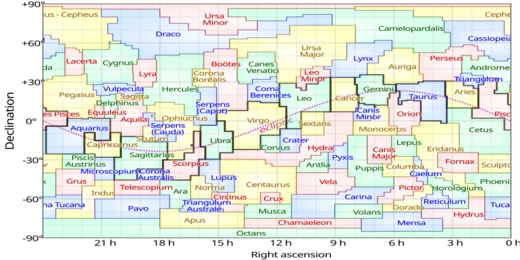
Grus is bordered by Piscis Austrinus to the north, Sculptor to the northeast, Phoenix to the east, Tucana to the south, Indus to the southwest, and Microscopium to the west. Bayer straightened the tail of Piscis Austrinus to make way for Grus in his Uranometria. Covering 366 square degrees, it ranks 45th of the 88 modern constellations in size. The official constellation boundaries were set by Belgian astronomer Eugène Delporte in 1930. Grus is located too far south to be seen by observers in the British Isles and the northern United States, though it can easily be seen from Florida or San Diego; the whole constellation is visible to observers south of latitude 33°N.
In Chinese astronomy, Gamma and Lambda Gruis may have been included in the tub-shaped asterism Bàijiù, along with stars from Piscis Austrinus. In Central Australia, the Arrernte and Luritja people living on a mission in Hermannsburg viewed the sky as divided between them, east of the Milky Way representing Arrernte camps and west denoting Luritja camps. Alpha and Beta Gruis, along with Fomalhaut, Alpha Pavonis and the stars of Musca, were all claimed by the Arrernte.
Reader's Guide
Grus holds significance as one of the twelve constellations created by Petrus Plancius from the observations of Keyser and de Houtman during the first Dutch trading expedition to the East Indies. Its first appearance on a 1598 celestial globe and subsequent inclusion in Bayer's Uranometria of 1603 established it in Western astronomy. The constellation's stars were originally part of Piscis Austrinus, and French explorer Nicolas-Louis de Lacaille gave Bayer designations to its stars in 1756, some of which had been previously considered part of Piscis Austrinus. Grus is part of the 'Southern Birds' group with Pavo, Phoenix and Tucana. Its brightest star, Alpha Gruis (Alnair), is a 1.7-magnitude blue-white star. Beta Gruis is a red giant variable star. Six star systems in Grus have been found to have planets, including the red dwarf Gliese 832, one of the closest stars to Earth to have a planetary system, and WASP-95, which has a planet that orbits every two days. Deep-sky objects include the planetary nebula IC 5148 (the Spare Tyre Nebula) and the Grus Quartet, a group of four interacting galaxies. The constellation's boundaries were formalized by Eugène Delporte in 1930, and its three-letter abbreviation 'Gru' was adopted by the International Astronomical Union in 1922.
Did You Know?
- The constellation's brightest star, Alpha Gruis, is also known as Alnair and appears as a 1.7-magnitude blue-white star.
- Grus is one of four constellations collectively known as the 'Southern Birds', along with Pavo, Phoenix and Tucana.
More in Constellations, Part 2 1-24
Spotted an error? Know more?
Reader corrections go straight into our review queue. Suggest an edit · How this site is sourced