Crater (constellation)
A small cup-shaped constellation on the back of Hydra.

Crater is a faint constellation in the southern sky, covering a small area. Its name comes from the Latinized form of the Greek word *krater*, meaning a cup used for diluting wine. One of the 48 constellations cataloged by the astronomer Ptolemy in the second century, it represents a cup linked to the god Apollo and placed on the back of Hydra, the water snake. No star in Crater shines brighter than third magnitude.
In Babylonian star lists dating back to at least 1100 BC, the stars of Crater may have been grouped with those of Corvus the crow into a single constellation called the Babylonian Raven. British researcher John H. Rogers noted that the neighboring constellation Hydra represented Ningishzida, the underworld god in the Babylonian text MUL.APIN. He suggested that Corvus, Crater, and Hydra together symbolized death and marked the entrance to the underworld. Both Corvus and Crater also appeared in Mithraic imagery, a religion thought to have originated in the Middle East before spreading to ancient Greece and Rome.
Greek mythology ties Crater to a story about a crow serving Apollo. The crow was sent to fetch water but delayed when it found figs and waited for them to ripen. It finally brought back water in a cup, along with a water snake, blaming the snake for drinking the water. Apollo saw through the lie and angrily threw the crow, cup, and snake into the sky. The constellations were arranged so the crow could not drink from the cup, serving as a warning against defying the gods. A different origin comes from the writer Phylarchus, who told of Eleusa near Troy, a city struck by plague. Its ruler Demophon was told by an oracle to sacrifice a maiden each year. He planned to choose by lottery but excluded his own daughters. A nobleman named Mastusius objected, forcing Demophon to sacrifice his own daughter. Later, Mastusius killed Demophon’s daughters and tricked the king into drinking a cup mixed with their blood and wine. When Demophon discovered the truth, he ordered Mastusius and the cup thrown into the sea. Crater represents that cup.
In Chinese astronomy, the stars of Crater fall within the Vermillion Bird of the South. Together with some stars from Hydra, they form Yi, the Red Bird’s wings. Yi also names the 27th lunar mansion. Alternatively, Yi depicts a heroic archer, with his bow made from other stars in Hydra.
Quick Facts
- Abbreviation
- Crt
- Genitive
- Crateris
- Pronounce
- ˈ · k · r · eɪ · t · ər, / genitive k · r · ə · ˈ · t · iː · r · ᵻ · s
- Symbolism
- the cup
- Ra
- 10 · 51 · 06.1297–11 · 56 · 23.6655
- Dec
- -6.6621790–-25.1957951
- Areatotal
- 282
- Arearank
- 53rd
- Numbermainstars
- 4
- Numberbfstars
- 12
- Numberbrightstars
- 0
- Brighteststarname
- δ Crt
Facts from the source article.
Lore & Background
In the Babylonian star catalogues dating from at least 1100 BC, the stars of Crater were possibly incorporated with those of the crow Corvus in the Babylonian Raven. British scientist John H. Rogers observed that the adjoining constellation Hydra signified Ningishzida, the god of the underworld in the Babylonian compendium MUL.APIN. He proposed that Corvus and Crater (along with Hydra) were death symbols and marked the gate to the underworld. Corvus and Crater also featured in the iconography of Mithraism, which is thought to have been of middle-eastern origin before spreading into Ancient Greece and Rome.
Crater is identified with a story from Greek mythology in which a crow or raven serves Apollo, and is sent to fetch water, but it delays its journey as it finds some figs and waits for them to ripen before eating them. Finally, it retrieves the water in a cup and takes back a water snake, blaming it for drinking the water. According to the myth, Apollo saw through the fraud, and angrily cast the crow, cup, and snake into the sky. The three constellations were arranged in such a way that the crow was prevented from drinking from the cup, and hence seen as a warning against sinning against the gods. Phylarchus wrote of a different origin for Crater. He told how the city of Eleusa near Troy was beset by plague. Its ruler Demophon consulted an oracle which decreed that a maiden should be sacrificed each year. Demophon declared that he would choose a maiden by lottery, but he did not include his own daughters. One nobleman, Mastusius, objected, forcing Demophon to sacrifice his daughter. Later, Mastusius killed Demophon's daughters and tricked the ruler in drinking a cup containing a mixture of their blood and wine. Upon finding out the deed, the king ordered Mastusius and the cup to be thrown into the sea. Crater signifies the cup.
In Chinese astronomy, the stars of Crater are located within the constellation of the Vermillion Bird of the South. They depict, along with some stars from Hydra, Yi, the Red Bird's wings. Yi also denotes the 27th lunar mansion. Alternatively, Yi depicts a heroic bowman; his bow composed of other stars in Hydra. In the Society Islands, Crater was recognized as a constellation called Moana-'ohu-noa-'ei-ha'a-moe-hara.
Reader's Guide
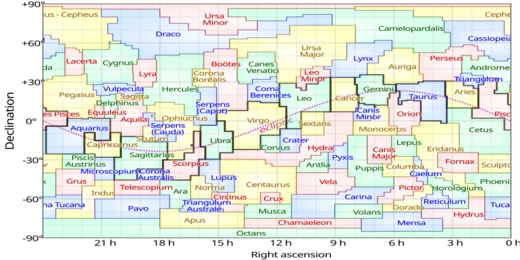
Crater is a small constellation covering 282.4 square degrees, ranking 53rd of the 88 constellations in area. It is bordered by Leo and Virgo to the north, Corvus to the east, Hydra to the south and west, and Sextans to the northwest. Its three-letter abbreviation, adopted by the International Astronomical Union in 1922, is 'Crt'. The official constellation boundaries, set by Belgian astronomer Eugène Delporte in 1930, are defined by a polygon of six segments. In the equatorial coordinate system, the right ascension coordinates of these borders lie between 10h 51m 14s and 11h 56m 24s, while the declination coordinates are between −6.66° and −25.20°. Its position in the southern celestial hemisphere means that the whole constellation is visible to observers south of 65°N. The German cartographer Johann Bayer used the Greek letters alpha through lambda to label the most prominent stars in the constellation. Bode added more, though only Psi Crateris remains in use. John Flamsteed gave 31 stars in Crater and the segment of Hydra immediately below Crater Flamsteed designations, naming the resulting constellation Hydra et Crater. Most of these stars lie in Hydra. The three brightest stars—Delta, Alpha, and Gamma Crateris—form a triangle located near the brighter star Nu Hydrae in Hydra. Within the constellation's borders, there are 33 stars brighter than or equal to apparent magnitude 6.5. Seven star systems have been found to host planets. A few notable galaxies, including Crater 2 and NGC 3981, and a famous quasar lie within the borders of the constellation.
Did You Know?
- Crater is one of the 48 constellations listed by the second-century astronomer Ptolemy.
- Its two brightest stars, Delta and Alpha Crateris, are ageing orange giant stars that are cooler and larger than the Sun.
- Beta Crateris is a binary star system composed of a white giant star and a white dwarf.
More in Constellations, Part 2 1-24
Spotted an error? Know more?
Reader corrections go straight into our review queue. Suggest an edit · How this site is sourced