Corona Australis
A southern crown constellation with a nearby star-forming cloud.

Corona Australis is a constellation found in the Southern Celestial Hemisphere. Its Latin name translates to "southern crown," making it the southern equivalent of Corona Borealis, the northern crown. The 2nd-century astronomer Ptolemy listed it among his 48 constellations, and it is still counted among the 88 modern ones. The Ancient Greeks saw it as a wreath rather than a crown, linking it to Sagittarius or Centaurus. Other cultures have compared its pattern to a turtle, an ostrich nest, a tent, or a rock hyrax's hut.
Though dimmer than its northern counterpart, the constellation stands out due to the oval or horseshoe shape formed by its brighter stars. Its two brightest stars, Alpha and Beta Coronae Australis, both shine at an apparent magnitude of about 4.1. Epsilon Coronae Australis is the brightest example of a W Ursae Majoris variable star in the southern sky. Situated along the Milky Way, Corona Australis hosts one of the closest star-forming regions to our Solar System: the Corona Australis Molecular Cloud, a dusty dark nebula roughly 430 light-years away. This cloud contains stars in their earliest stages of life. The variable stars R and TY Coronae Australis illuminate parts of the nebula, causing its brightness to change.
The International Astronomical Union (IAU) officially entered the constellation's name as "Corona Australis" in 1922 when it established the 88 modern constellations. In 1932, the IAU's commission on notation recorded the name as "Corona Austrina" when approving a list of four-letter abbreviations for constellations. Those abbreviations were repealed in 1955, and the IAU now uses "Corona Australis" exclusively.
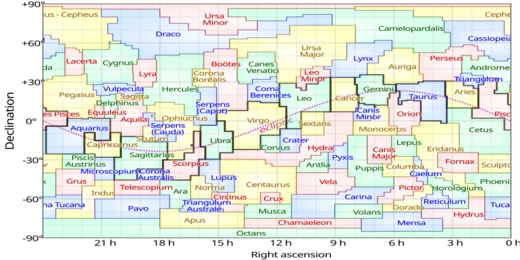
Corona Australis is a small constellation, bordered by Sagittarius to the north, Scorpius to the west, Telescopium to the south, and Ara to the southwest. Its three-letter abbreviation, adopted by the IAU in 1922, is "CrA." Belgian astronomer Eugène Delporte set the official constellation boundaries in 1930, defining them with a polygon of four segments. In the equatorial coordinate system, these borders span right ascension from 17h 58.3m to 19h 19.0m and declination from −36.77° to −45.52°. Covering 128 square degrees, it ranks 80th in area among the constellations. It culminates at midnight around June 30.
Quick Facts
- Abbreviation
- CrA
- Genitive
- Coronae Australis
- Symbolism
- The Southern Crown
- Ra
- 17 · 58 · 30.1113–19 · 19 · 04.7136IAU, The Constellations, Corona Australis
- Dec
- -36.7785645–-45.5163460IAU, The Constellations, Corona Australis
- Family
- Hercules
- Areatotal
- 128
- Arearank
- 80th
- Numbermainstars
- 6
- Numberbfstars
- 14
- Numberbrightstars
- 0
- Brighteststarname
- β CrA (Alqubba)
Facts from the source article.
Lore & Background
The Ancient Greeks saw Corona Australis as a wreath rather than a crown and associated it with Sagittarius or Centaurus. Other cultures have likened the pattern to a turtle, ostrich nest, a tent, or even a hut belonging to a rock hyrax. The name of the constellation was entered as 'Corona Australis' when the International Astronomical Union (IAU) established the 88 modern constellations in 1922. In 1932, the name was instead recorded as 'Corona Austrina' when the IAU's commission on notation approved a list of four-letter abbreviations for the constellations. The four-letter abbreviations were repealed in 1955. The IAU presently uses 'Corona Australis' exclusively.
Reader's Guide
Corona Australis is a small constellation bordered by Sagittarius to the north, Scorpius to the west, Telescopium to the south, and Ara to the southwest. Its official constellation boundaries, set by Belgian astronomer Eugène Delporte in 1930, are defined by a polygon of four segments. Covering 128 square degrees, it ranks 80th in area. The only star in the constellation to have received a name is Alfecca Meridiana or Alpha CrA. The name combines the Arabic name of the constellation with the Latin for 'southern'. Alpha and Beta are so similar as to be indistinguishable in brightness to the naked eye. The Corona Australis Molecular Cloud, lying about 430 light years away, contains stars at the earliest stages of their lifespan. The variable stars R and TY Coronae Australis light up parts of the nebula, which varies in brightness accordingly. The first nebulae of the cloud were recorded in 1865 by Johann Friedrich Julius Schmidt.
Did You Know?
- Corona Australis is one of the 48 constellations listed by the 2nd-century astronomer Ptolemy.
- The constellation contains one of the closest star-forming regions to the Solar System, the Corona Australis Molecular Cloud, about 430 light years away.
- Alpha and Beta Coronae Australis are the two brightest stars, both with an apparent magnitude of around 4.1.
More in Constellations, Part 2 1-24
Spotted an error? Know more?
Reader corrections go straight into our review queue. Suggest an edit · How this site is sourced