Circinus
A faint southern constellation representing a drafting compass.

Circinus is a faint, compact constellation in the southern sky, introduced in 1756 by French astronomer Nicolas-Louis de Lacaille. Its name comes from the Latin word for a compass—the drafting tool used to draw circles—and it should not be mistaken for Pyxis, which represents a mariner's compass that points north. The constellation’s brightest star is Alpha Circini, with an apparent magnitude of 3.19. It is slightly variable and holds the title of the brightest rapidly oscillating Ap star visible in the night sky. Other notable stars include AX Circini, a Cepheid variable that can be seen without a telescope, and BX Circini, a faint star believed to have formed from the merger of two white dwarfs. Two Sun-like stars here host planets: HD 134060 has two small planets, and HD 129445 has a Jupiter-like planet. In 185 AD, the supernova SN 185 appeared in Circinus and was recorded by Chinese observers, while two novae were observed in the 20th century.
The Milky Way runs through Circinus, bringing with it the open cluster NGC 5823 and the planetary nebula NGC 5315. The constellation also contains a striking spiral galaxy, the Circinus Galaxy, discovered in 1977; it is the closest Seyfert galaxy to our own Milky Way. A meteor shower called the Alpha Circinids (ACI), also discovered in 1977, radiates from this area of the sky.
**History** In 1756, Lacaille introduced the constellation under the French name *le Compas*, representing a pair of dividing compasses, on a chart of the southern sky. On that chart, he depicted the constellations Norma, Circinus, and Triangulum Australe as a set square and ruler, a compass, and a surveyor’s level—a set of draughtsman’s tools. Circinus received its current Latin name in 1763, when Lacaille published an updated sky map using Latin names for the constellations he had created.
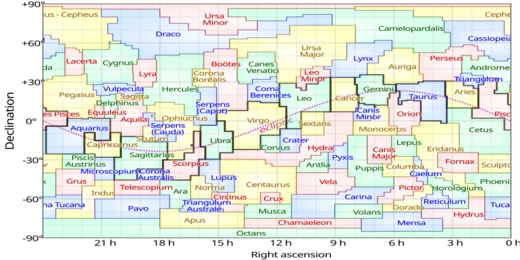
**Characteristics** Circinus is bordered by Centaurus, Musca, Apus, Triangulum Australe, Norma, and Lupus, and lies near the bright stars Alpha and Beta Centauri. Because its declination ranges from −50° to −70°, the entire constellation is visible only south of latitude 30° N. The official boundaries, set by Belgian astronomer Eugène Delporte in 1930, form a polygon of 14 segments. In the equatorial coordinate system, its right ascension borders lie between 13h 38.4m and 15h 30.2m, and its declination borders between −55.43° and −70.62°.
Quick Facts
- Abbreviation
- Cir
- Genitive
- Circini
- Pronounce
- ˈ · s · ɜːr · s · ᵻ · n · ə · s Círcinus, / genitive ˈ · s · ɜːr · s · ᵻ · n · aɪ
- Symbolism
- Compass
- Ra
- 13 · 38.4–15 · 30.2
- Dec
- −55.43°–−70.62°
- Areatotal
- 93
- Arearank
- 85th
- Numbermainstars
- 3
- Numberbfstars
- 9
- Numberbrightstars
- 0
- Brighteststarname
- α Cir (Xami)
Facts from the source article.
Lore & Background
In 1756, French astronomer Nicolas-Louis de Lacaille introduced the constellation of Circinus with the French name le Compas, representing a pair of dividing compasses, on a chart of the southern sky. On that chart, Lacaille portrayed the constellations of Norma, Circinus, and Triangulum Australe, respectively, as a set square and ruler, a compass, and a surveyor's level in a set of draughtsman's instruments. Circinus was given its current name in 1763, when Lacaille published an updated sky map with Latin names for the constellations he introduced.
Bordered by Centaurus, Musca, Apus, Triangulum Australe, Norma and Lupus, Circinus lies adjacent to the Alpha and Beta Centauri stars. As it is at declination −50° to −70°, the whole constellation is only visible south of latitude 30° N. The official constellation boundaries, as set by Belgian astronomer Eugène Delporte in 1930, are defined by a polygon of 14 segments. Circinus culminates each year at 9 p.m. on 30 July.
Lacaille charted and gave 8 stars Bayer designations Alpha through Theta in 1756. Circinus is a faint constellation, with only one star brighter than fourth magnitude. The Milky Way runs through the constellation, featuring prominent objects such as the open cluster NGC 5823 and the planetary nebula NGC 5315. Circinus hosts a notable spiral galaxy, the Circinus Galaxy, discovered in 1977; it is the closest Seyfert galaxy to the Milky Way. The Alpha Circinids (ACI), a meteor shower also discovered in 1977, radiate from this constellation.
Reader's Guide
Circinus, though small and faint, holds several points of significance as described in the source article. Its brightest star, Alpha Circini, is the brightest rapidly oscillating Ap star in the night sky, a type known for oddly localized magnetic fields and slight variability. The constellation contains two sun-like stars with planetary systems: HD 134060 has two small planets, and HD 129445 has a Jupiter-like planet. Supernova SN 185 appeared in Circinus in 185 AD and was recorded by Chinese observers, and two novae have been observed more recently in the 20th century. The Circinus Galaxy, discovered in 1977, is the closest Seyfert galaxy to the Milky Way, adding to the constellation's deep-sky importance. The Milky Way runs through Circinus, providing rich star fields and objects such as the open cluster NGC 5823 and the planetary nebula NGC 5315. The Alpha Circinids meteor shower, also discovered in 1977, radiates from this constellation. The constellation's history traces to Lacaille's 1756 chart, where it was part of a set of draughtsman's instruments alongside Norma and Triangulum Australe.
More in Constellations, Part 2 1-24
Spotted an error? Know more?
Reader corrections go straight into our review queue. Suggest an edit · How this site is sourced