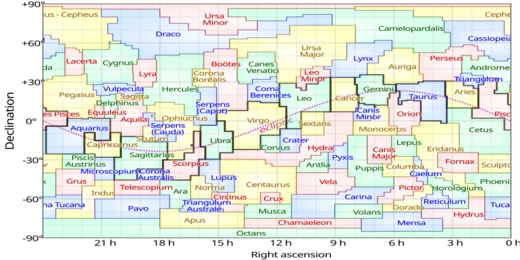
Carina (constellation)
Southern constellation representing the keel of the ship Argo.

Carina is a constellation found in the southern sky. Its name comes from the Latin word for a ship's keel, and it originally formed the bottom part of a much larger constellation called Argo Navis, which represented the mythical ship of Jason and the Argonauts. That huge constellation was eventually split into three separate pieces, with Carina being the keel, Puppis the poop deck, and Vela the sails.
The constellation of Argo Navis was first recognized in ancient Greece. Because it was so massive and contained so many stars that needed individual labels, the French astronomer Nicolas-Louis de Lacaille divided it into three sections in 1763. Carina became the hull or keel section. By the 19th century, these three sections were treated as separate constellations, and they were officially included in the list of 88 modern constellations recognized by the International Astronomical Union in 1930. Lacaille kept one set of Greek letters for the entire original Argo, but gave each of the three new constellations its own set of Latin letters. This is why Carina holds the stars Alpha, Beta, and Epsilon, while Vela has Gamma and Delta, Puppis has Zeta, and so on.
Carina contains Canopus, a white-hued bright giant that is the second-brightest star in the entire night sky, with a magnitude of –0.72. Formally called Alpha Carinae, it lies 313 light-years from Earth. Its traditional name comes from the mythological Canopus, a navigator for King Menelaus of Sparta. Several other stars in Carina shine above magnitude 3. Beta Carinae, also called Miaplacidus, is a blue-white star of magnitude 1.7, located 111 light-years away. Epsilon Carinae, known as Avior, is an orange-hued giant with a similar brightness at magnitude 1.9, but it is much farther at 630 light-years. Theta Carinae is a blue-white star of magnitude 2.7, 440 light-years away, and is the brightest member of the star cluster IC 2602. Iota Carinae is a white supergiant of magnitude 2.2, sitting 690 light-years from Earth.
The most notable variable star in Carina is Eta Carinae. It has a mass roughly 100 times that of the Sun and shines with 4 million times the Sun's brightness. Its unusual behavior was first noticed in 1677, when it suddenly brightened to magnitude 4, catching the attention of Edmond Halley. Eta Carinae lies inside NGC 3372, commonly called the Carina Nebula.
Quick Facts
- Abbreviation
- Car
- Genitive
- Carinae
- Pronounce
- k · ə · ˈ · r · aɪ · n · ə · ,_ · k · ə · ˈ · r · iː · n · ə kə · RY · nə · ,_- · REE · -, genitive k · ə · ˈ · r · aɪ · n · iː kə · RY · nee
- Symbolism
- the keel
- Ra
- 06 · 02 · 59.7365–11 · 20 · 37.4211
- Dec
- −50.7545471–−75.6840134
- Family
- Heavenly Waters
- Areatotal
- 494
- Arearank
- 34th
- Numbermainstars
- 9
- Numberbfstars
- 52
- Numberbrightstars
- 6
Facts from the source article.
Lore & Background
Carina was once a part of Argo Navis, the great ship of the mythical Jason and the Argonauts who searched for the Golden Fleece. The constellation of Argo was introduced in ancient Greece. Due to the massive size of Argo Navis and the sheer number of stars that required separate designation, Nicolas-Louis de Lacaille divided Argo into three sections in 1763, including Carina (the hull or keel). In the 19th century, these three became established as separate constellations, and were formally included in the list of 88 modern IAU constellations in 1930. Lacaille kept a single set of Greek letters for the whole of Argo, and separate sets of Latin letter designations for each of the three sections; therefore Carina has the α, β and ε, Vela has γ and δ, Puppis has ζ, and so on.
Carina contains Canopus, a white-hued bright giant that is the second-brightest star in the night sky at magnitude −0.72. Its traditional name comes from the mythological Canopus, who was a navigator for Menelaus, king of Sparta. Other notable stars include Eta Carinae, the most prominent variable star in Carina, which had a major outburst in 1843 that made it the equal of Sirius. Eta Carinae is inside NGC 3372, commonly called the Carina Nebula, and is surrounded by the Homunculus Nebula composed of gas ejected in 1843.
From China, the stars of Carina can barely be seen; Canopus was located in the Vermilion Bird of the South. Polynesian peoples had many names for Canopus but no name for the constellation in particular. The Māori name for Canopus is Ariki.
Reader's Guide
Carina's significance lies in its rich stellar and deep-sky objects. It contains Canopus, the second-brightest star in the night sky, and Eta Carinae, a massive variable star considered a prime supernova candidate. The Carina Nebula (NGC 3372) is an extended emission nebula approximately 8,000 light-years away and 300 light-years wide, discovered by Nicolas-Louis de Lacaille in 1751. It includes the Keyhole Nebula, described by John Herschel in 1847 and likened to a keyhole by Emma Converse in 1873. The Homunculus Nebula, a planetary nebula visible to the naked eye, was ejected by Eta Carinae during its 1843 outburst. Carina also hosts several open clusters visible to the unaided eye, including IC 2602 (the Southern Pleiades) and NGC 3532, as well as the globular cluster NGC 2808. The constellation contains the radiant of the Eta Carinids meteor shower, which peaks around January 21 each year. Two asterisms are prominent: the Diamond Cross and the False Cross, the latter often mistaken for the Southern Cross and causing errors in astronavigation. The Bullet Cluster (1E 0657-56), a galaxy cluster 4 billion light-years away, is named for the shock wave seen in its intracluster medium.
Did You Know?
- Carina was originally part of the larger constellation Argo Navis, which was divided into three sections by Nicolas-Louis de Lacaille in 1763.
- Eta Carinae had a massive outburst in 1843 that made it as bright as Sirius, reaching magnitude −1.5.
- The Carina Nebula (NGC 3372) is about 300 light-years wide and contains the Keyhole Nebula, described by John Herschel in 1847.
More in Constellations, Part 2 1-24
Spotted an error? Know more?
Reader corrections go straight into our review queue. Suggest an edit · How this site is sourced