Capricornus
The smallest zodiac constellation, depicted as a sea goat.

Capricornus is a zodiac constellation, its Latin name meaning "horned goat" or "goat horn," and it is usually depicted as a sea goat—a mythical hybrid with the front half of a goat and the tail of a fish. It ranks among the 88 modern constellations and was one of the 48 cataloged by the 2nd-century astronomer Claudius Ptolemy. Within the zodiac, it is the smallest constellation, though not the smallest of all 88 recognized by the International Astronomical Union.
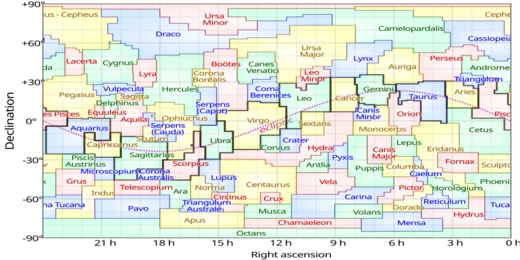
The constellation lies in a region of the sky known as the Sea or the Water, which includes other water-themed constellations like Aquarius, Pisces, and Eridanus. Its modern boundaries touch Aquila, Sagittarius, Microscopium, Piscis Austrinus, and Aquarius.
Capricornus is relatively faint, with only one star brighter than magnitude 3. Its alpha star shines at just magnitude 3.6. The brightest star is Delta Capricorni, called Deneb Algedi, with a magnitude of 2.9 and located 39 light-years away. Its name comes from Arabic words for "tail" (deneb) and "young goat" (al-gedi), meaning "the tail of the goat." Deneb Algedi is a Beta Lyrae variable—an eclipsing binary that varies by about 0.2 magnitudes every 24.5 hours.
Other bright stars range from magnitude 3.1 to 5.1. Alpha Capricorni is a multiple star system. The primary, Alpha-2 Capricorni, is a yellow-hued giant of magnitude 3.6, 109 light-years away. The secondary, Alpha-1 Capricorni, is a yellow-hued supergiant of magnitude 4.3, 690 light-years away. These two stars are visible separately to the naked eye, and each is itself a multiple system: Alpha-1 has a magnitude 9.2 companion, while Alpha-2 has a magnitude 11.0 companion, which is itself a binary with two components of magnitude 11. The traditional names Algedi or Giedi come from the Arabic word for "the kid," referencing the constellation's mythology.
Beta Capricorni, also called Dabih, is a double star. Its primary is a yellow-hued giant of magnitude 3.1, 340 light-years away, and its secondary is a blue-white star of magnitude 6.1. The pair can be split with binoculars. The name Dabih comes from an Arabic phrase meaning "the lucky stars of the slaughterer," tied to ritual sacrifices performed by ancient Arabs at the heliacal rising of Capricornus. Gamma Capricorni, sometimes called Nashira ("bringing good tidings"), is a white-hued giant of magnitude 3.7, 139 light-years away.
Quick Facts
- Abbreviation
- Cap
- Genitive
- Capricorni
- Pronounce
- ˌ · k · æ · p · r · ᵻ · ˈ · k · ɔːr · n · ə · s, genitive ˌ · k · æ · p · r · ᵻ · ˈ · k · ɔːr · n · aɪ
- Symbolism
- the Sea-Goat
- Ra
- 20 · 06 · 46.4871–21 · 59 · 04.8693
- Dec
- -8.4043999–-27.6914144
- Family
- Zodiac
- Areatotal
- 414
- Arearank
- 40th
- Numbermainstars
- 9, 13, 23
- Numberbfstars
- 49
- Numberbrightstars
- 1
Facts from the source article.
Lore & Background
Capricornus is located in an area of sky called the Sea or the Water, consisting of many water-related constellations such as Aquarius, Pisces and Eridanus. The constellation was first attested in depictions on a cylinder-seal from around the 21st century BCE, and it was explicitly recorded in the Babylonian star catalogues before 1000 BCE. In the Early Bronze Age the winter solstice occurred in the constellation, but due to the precession of the equinoxes, the December solstice now takes place in the constellation Sagittarius. The Sun is now in the constellation Capricorn from late January through mid-February.
Despite its faintness, the constellation Capricornus has one of the oldest mythological associations, having been consistently represented as a hybrid of a goat and a fish since the Middle Bronze Age, when the Babylonians used MULSUḪUR.MAŠ 'The Goat-Fish' as a symbol of their god Ea. In Greek mythology, the constellation is sometimes identified as Amalthea, the goat that suckled the infant Zeus after his mother, Rhea, saved him from being devoured by his father, Cronos. Amalthea's broken horn was transformed into the cornucopia or 'horn of plenty'. Capricornus is also sometimes identified as Pan, the god with a goat's horns and legs, who saved himself from the monster Typhon by giving himself a fish's tail and diving into a river.
Reader's Guide
Capricornus is a faint constellation, with only one star above magnitude 3; its alpha star has a magnitude of only 3.6. The brightest star is δ Capricorni, also called Deneb Algedi, with a magnitude of 2.9, located 39 light-years from Earth. Deneb Algedi is a Beta Lyrae variable star (a type of eclipsing binary), ranging by about 0.2 magnitudes with a period of 24.5 hours. Other bright stars include α Capricorni, a multiple star with a yellow-hued giant primary and a yellow-hued supergiant secondary; β Capricorni, a double star also known as Dabih; and γ Capricorni, sometimes called Nashira. The constellation contains several deep-sky objects, including the globular cluster Messier 30 (NGC 7099) of magnitude 7.5, located 30,000 light-years away, and the galaxy group HCG 87, a group of at least three galaxies 400 million light-years from Earth that are interacting and may merge millions of years in the future to form a giant elliptical galaxy. The planet Neptune was discovered by German astronomer Johann Galle near Deneb Algedi on 23 September 1846, although by modern constellation boundaries Neptune lay within Aquarius at the time. Capricornus's brighter stars are found on a triangle whose vertices are α2 Capricorni (Giedi), δ Capricorni (Deneb Algiedi), and ω Capricorni. H. A. Rey has suggested an alternative visualization that graphically shows a goat.
Did You Know?
- Capricornus is the smallest constellation in the zodiac.
- Its brightest star, Deneb Algedi, is a Beta Lyrae variable star that ranges by about 0.2 magnitudes every 24.5 hours.
- The planet Neptune was discovered near Deneb Algedi on 23 September 1846 by Johann Galle.
- In Babylonian astronomy, Capricornus was represented as the Goat-Fish, a symbol of the god Ea.
More in Constellations, Part 2 1-24
Spotted an error? Know more?
Reader corrections go straight into our review queue. Suggest an edit · How this site is sourced