Caelum
A faint southern constellation named for the engraver's chisel.

Caelum is a faint southern constellation that was created in the 1750s by Nicolas Louis de Lacaille and is now one of the 88 modern constellations. Its Latin name translates to "chisel," and it was originally called Caelum Sculptorium ("Engraver's Chisel"). This term is uncommon and has no connection to the much more familiar Latin word caelum, which means "sky," "heaven," or "atmosphere." Ranking as the eighth-smallest constellation, it covers a solid angle of roughly 0.038 steradians, slightly less than that of Corona Australis.
Because of its small size and its position away from the Milky Way's plane, Caelum is rather sparse, offering few notable objects. Its brightest star, Alpha Caeli, shines at only magnitude 4.45, and just one other star, Gamma¹ Caeli, is brighter than magnitude 5. Among the constellation's other points of interest are RR Caeli, a binary star with one known planet located about 20.13 parsecs (65.7 light-years) away; X Caeli, a Delta Scuti variable that forms an optical double with Gamma¹ Caeli; and HE0450-2958, a Seyfert galaxy that initially appeared as only a jet, with no visible host galaxy.
**History** Caelum was established as one of fourteen southern constellations in the 18th century by Nicolas Louis de Lacaille, a French astronomer active during the Age of Enlightenment. Among French speakers, it still goes by the name Burin, which was Latinized in his 1763 catalogue as Caelum Sculptoris ("Engraver's Chisel"). Francis Baily shortened this to Caelum, following a suggestion by John Herschel. On Lacaille's original chart, the constellation was depicted as a pair of engraving tools—a standard burin and a more specific shape-forming échoppe tied together with a ribbon—though it later came to be represented as a simple chisel. Johann Elert Bode proposed the plural form with a singular possessor, Caela Scalptoris (in German, *die Grabstichel*, meaning "the Engraver's Chisels"), but this name never caught on.
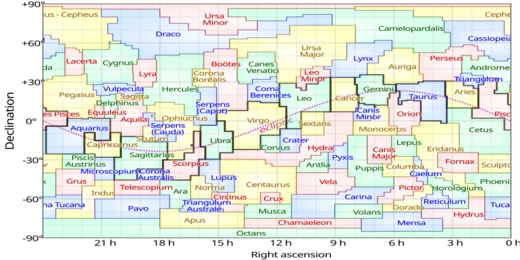
**Characteristics** Caelum is bordered by Dorado and Pictor to the south, Horologium and Eridanus to the east, Lepus to the north, and Columba to the west. Covering just 125 square degrees, it ranks 81st in size among the 88 modern constellations. Its main asterism consists of four stars, and a total of twenty stars are brighter than magnitude 6.5.
Quick Facts
- Abbreviation
- Cae
- Genitive
- Caeli
- Pronounce
- ˈ · s · iː · l · əm SEE · ləm, genitive ˈ · s · iː · l · aɪ SEE · lye
- Symbolism
- the chisel
- Ra
- 04 · 19.5–05 · 05.1
- Dec
- −27.02–−48.74
- Areatotal
- 125
- Arearank
- 81st
- Numbermainstars
- 4
- Numberbfstars
- 8
- Numberbrightstars
- 0
- Brighteststarname
- α Cae
Facts from the source article.
Lore & Background
Caelum was incepted as one of fourteen southern constellations in the 18th century by Nicolas Louis de Lacaille, a French astronomer and celebrated of the Age of Enlightenment. It retains its name Burin among French speakers, Latinized in his catalogue of 1763 as Caelum Sculptoris ('Engraver's Chisel'). Francis Baily shortened this name to Caelum, as suggested by John Herschel. In Lacaille's original chart, it was shown as a pair of engraver's tools: a standard burin and more specific shape-forming échoppe tied by a ribbon, but came to be ascribed a simple chisel. Johann Elert Bode stated the name as plural with a singular possessor, Caela Scalptoris – in German (die) Grabstichel ('the Engraver’s Chisels') – but this did not stick.
Caelum is bordered by Dorado and Pictor to the south, Horologium and Eridanus to the east, Lepus to the north, and Columba to the west. Its main asterism consists of four stars. The constellation's boundaries, as set by Belgian astronomer Eugène Delporte in 1930, are a 12-sided polygon. In the equatorial coordinate system, the right ascension coordinates of these borders lie between 04h 19.5m and 05h 05.1m and declinations of −27.02° to −48.74°. The International Astronomical Union (IAU) adopted the three-letter abbreviation 'Cae' for the constellation in 1922. Its main stars are visible in favourable conditions and with a clear southern horizon, for part of the year as far as about the 41st parallel north.
Reader's Guide
Due to its small size and location away from the plane of the Milky Way, Caelum is a rather barren constellation, with few objects of interest. The constellation's brightest star, Alpha Caeli, is only of magnitude 4.45, and only one other star, Gamma1 Caeli, is brighter than magnitude 5. Other notable objects in Caelum are RR Caeli, a binary star with one known planet approximately 20.13 parsecs (65.7 ly) away; X Caeli, a Delta Scuti variable that forms an optical double with Gamma1 Caeli; and HE0450-2958, a Seyfert galaxy that at first appeared as just a jet, with no host galaxy visible. Lacaille gave six stars Bayer designations, labeling them Alpha to Zeta in 1756, but omitted Epsilon and designated two adjacent stars as Gamma. Bode extended the designations to Rho for other stars, but most of these have fallen out of use. Caelum is too far south for any of its stars to bear Flamsteed designations. The only deep-sky object in Caelum to receive much attention is HE0450-2958, an unusual Seyfert galaxy. Originally, the jet's host galaxy proved elusive to find, and this jet appeared to be emanating from nothing. Although it has been suggested that the object is an ejected supermassive black hole, the host is now agreed to be a small galaxy that is difficult to see due to light from the jet and a nearby starburst galaxy.
Did You Know?
- Caelum is the eighth-smallest constellation, subtending a solid angle of around 0.038 steradians.
- Its name means 'chisel' in Latin, unrelated to the far more common Latin caelum meaning 'sky' or 'heaven'.
- The constellation contains HE0450-2958, a Seyfert galaxy whose jet initially appeared to have no host galaxy.
- RR Caeli, a binary star about 20.13 parsecs away, has one known planet and evidence for a second substellar body.
More in Constellations, Part 2 1-24
Spotted an error? Know more?
Reader corrections go straight into our review queue. Suggest an edit · How this site is sourced